September 21 in History|From The Hobbit and Malta’s Independence to the International Day of Peace
September 21 connects literature, national independence and the idea of peace, reminding us that change can begin with a story, a decision or a shared commitment.
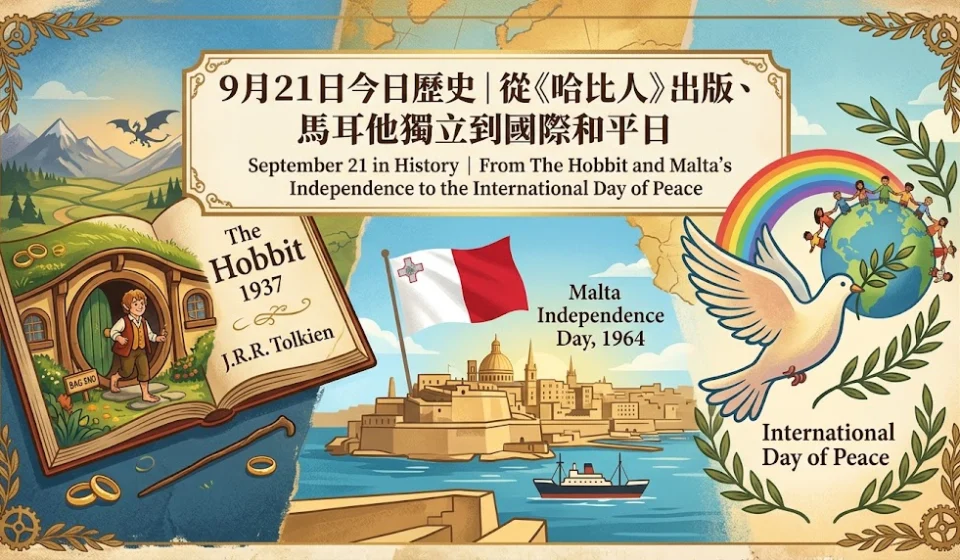
September 21 is a date that brings together literature, national identity and the idea of peace. One of its most memorable cultural milestones came in 1937, when J.R.R. Tolkien’s The Hobbit, or There and Back Again was published in Britain. George Allen & Unwin released the first edition on September 21, 1937, with an initial print run of only 1,500 copies. Tolkien also provided illustrations for the book himself. What began as a fantasy story aimed largely at younger readers would eventually become one of the most influential works of twentieth-century English-language fantasy and the foundation for the much larger world that Tolkien later developed in The Lord of the Rings. The story follows Bilbo Baggins, a quiet and comfort-loving hobbit whose ordinary life is interrupted when Gandalf and a group of dwarves arrive at his home and invite him on an unexpected journey. Bilbo initially seems like the least likely person to become an adventurer. He prefers familiar surroundings, regular meals and the security of home. Yet the journey gradually changes his understanding of himself and the world beyond his front door. The importance of The Hobbit therefore goes beyond its fantasy creatures and adventure. It demonstrated how a relatively simple story could develop into an enormous cultural world. The first edition quickly sold out, leading to further printings and a growing readership. The book introduced or popularised many elements that would become closely associated with Tolkien’s Middle-earth, including hobbits, dwarves, elves, dragons and a detailed mythology behind the characters and landscapes. The first printing contained only 1,500 copies, making its later cultural influence particularly remarkable. September 21 also marks a very different kind of transformation: Malta’s independence. On September 21, 1964, Malta became an independent state after a period of British rule. The Maltese government records that Prime Minister George Borg Olivier selected September 21 as Independence Day during the process of preparing the country for independence. Malta became a sovereign independent nation within the Commonwealth, and the date remains one of the country’s national holidays. Independence did not mean that every question about Malta’s future was suddenly solved. Instead, it began a new stage in which the country had to develop its own political institutions, economic direction and sense of national identity. Questions of citizenship, language, culture and international relationships became part of the continuing story of an independent Malta. The country’s geographical position in the Mediterranean has also contributed to a history shaped by different cultural influences. Malta’s modern identity therefore reflects several layers of history rather than a single tradition. Its language is part of that identity as well: Maltese is the national language, while Maltese and English have official status, alongside Maltese Sign Language. September 21 has another important meaning around the world because it is the United Nations International Day of Peace. The United Nations General Assembly established the International Day of Peace in 1981 through Resolution 36/67. At first, the day was connected with the opening of the General Assembly and was observed on the third Tuesday of September. The first Peace Day was observed in 1982. In 2001, the General Assembly adopted Resolution 55/282 and permanently established September 21 as the International Day of Peace, designating it as a day associated with non-violence and ceasefire. In 2026, the United Nations is marking the day under the theme “Invest in Peace: For Everyone, Everywhere, Every Day”. The message emphasises that peace is not simply the absence of conflict. It is also connected with safety, dignity, opportunity, cooperation and the conditions that allow people to live and work together. The United Nations describes ordinary people, students, community members and local organisations as part of this broader effort. This makes September 21 particularly interesting because the date can be viewed through three very different ideas. The Hobbit represents imagination: a writer creates a world that did not previously exist for his readers. Malta’s independence represents identity: a society establishes its own place in the international community. The International Day of Peace represents cooperation: people and institutions are reminded that a stable society depends on more than laws and governments; it also depends on how people treat one another. September 21 is also associated with important cultural figures. Leonard Cohen was born on this date in 1934. The Canadian singer-songwriter and poet eventually became an influential figure whose work crossed the boundaries between music and literature. Stephen King was born on September 21, 1947, and went on to become one of the most widely recognised American novelists of the modern era, particularly through his work in horror, suspense and popular fiction. These cultural connections give September 21 a distinctive character. It is a day when a book, a country and an international principle can all become part of the same historical conversation. History is often presented as a collection of major political decisions, famous leaders and dramatic events, but dates such as September 21 show another side of history. A novel can influence generations of readers. A country can redefine its relationship with the wider world. An international observance can create an annual opportunity to think about values that are easily forgotten during everyday life. The three stories also share a deeper idea: change begins when people imagine something different. Bilbo begins by imagining almost nothing beyond his comfortable home, yet he eventually discovers a much wider world. Malta moves from colonial rule towards an independent national identity and continues to develop its own institutions and culture. The International Day of Peace asks people to imagine a world in which cooperation, dignity and non-violence are not merely ideals but part of everyday life. September 21 therefore offers more than a list of historical anniversaries. It provides a small picture of how human societies create meaning. We write stories to imagine worlds, build institutions to organise societies, and create shared international principles to express values. Sometimes historical change begins with something as simple as a book appearing on a shelf, a nation taking responsibility for its own future, or people deciding that peace deserves to be remembered every year.
September 21 brings together literature, independence and peace: a story can create a world, a nation can shape its identity, and peace reminds us how people can live together. History is not only about what happened, but also about the values we continue to choose.