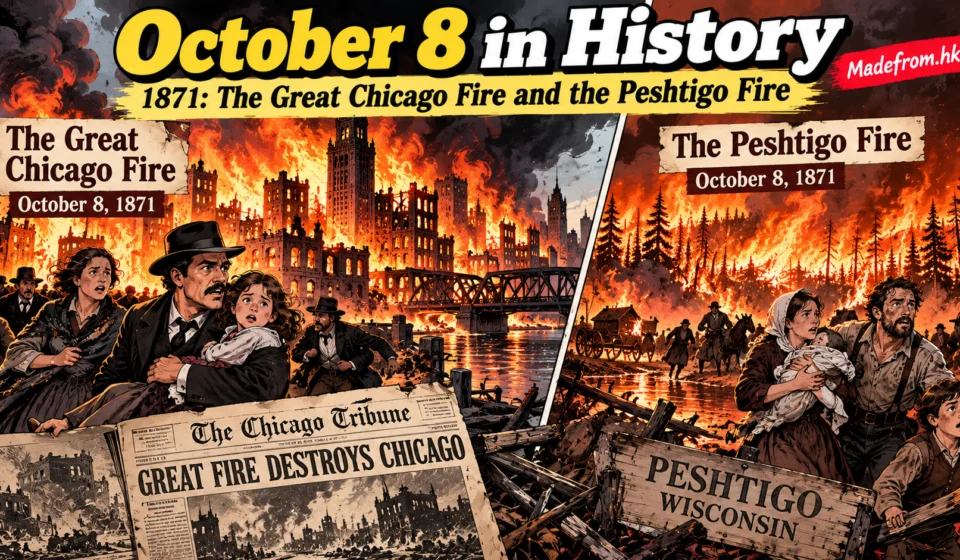
1. October 8, 1871: Fires Sweep Across the American Midwest
On October 8, 1871, several major fires struck the American Midwest. The best-known was the Great Chicago Fire, but the Peshtigo Fire in Wisconsin caused a far greater loss of life.
The conditions were dangerous. Parts of the region had experienced unusually dry weather, below-normal rainfall in the preceding months, warm temperatures, and strong winds. Chicago also contained many wooden buildings and wood-related industries, allowing flames to spread rapidly once fires broke out.
2. The Great Chicago Fire: A City Engulfed in Flames
The Great Chicago Fire began on the evening of October 8 and continued until around October 10.
Chicago was growing rapidly, with expanding population, commerce, and industry. Yet much of the city was built from wood. In dry and windy conditions, flames spread from building to building, destroying homes, businesses, factories, and public structures.
The fire killed approximately 300 people, destroyed more than 17,000 buildings, and left around 100,000 people homeless. Families lost their homes and possessions, while the city’s economy and neighbourhoods suffered enormous damage.
The precise cause of the fire has never been conclusively established. The familiar story that a cow knocked over a lantern in the O’Leary family’s barn remains unproven and should not be treated as established fact.
3. The Peshtigo Fire: A Deadly Disaster Overshadowed
On the same day, a devastating fire swept through Peshtigo and surrounding communities in Wisconsin.
The area was closely connected to the timber industry. Dry forests, wood products, strong winds, and other combustible materials helped the fire spread with extraordinary speed. In some places, people had little time to escape.
At least about 1,200 people died, and some estimates are higher. The Peshtigo Fire is widely regarded as the deadliest wildfire disaster in United States history. The town was largely destroyed, leaving survivors grieving for loved ones and struggling to rebuild their lives.
Why is Peshtigo less widely remembered than Chicago? Chicago was a major commercial centre, and its destruction attracted extensive attention. Peshtigo was a smaller community, and information and records from the disaster were more limited.
4. What Did the Fires Teach Us?
The two disasters demonstrate that major fires rarely result from a single factor. Weather, building materials, settlement patterns, available resources, and emergency preparedness can combine to turn a fire into a catastrophe.
First, construction and urban planning matter. When buildings are highly combustible and closely packed together, fire can spread rapidly across a neighbourhood.
Second, environmental conditions matter. Prolonged dryness, strong winds, and abundant combustible material can sharply increase fire risk. Under the wrong conditions, a small ignition can become a major disaster.
Third, emergency response and communication are essential. Warnings, evacuation routes, firefighting resources, and community preparedness can influence whether people have enough time to reach safety.
Chicago rebuilt after the disaster, and fire safety and building practices continued to evolve. Although not every modern fire-safety measure originated from this single event, the Great Chicago Fire became an important warning in the history of American urban development.
5. A Lesson for the Modern World
October 8, 1871, is more than a date associated with tragedy. It reminds us to consider the relationship between urban growth, environmental conditions, and public safety.
As cities expand and infrastructure becomes more complex, disaster prevention cannot wait until an emergency begins. Fire protection, building standards, forest management, early-warning systems, and public education all play a role in protecting lives.
History cannot change what happened, but it can help people make better decisions in the future.
The Great Chicago Fire is remembered for the city’s struggle to rebuild. The Peshtigo Fire reminds us that behind every disaster are individual lives, families, and communities whose losses must not be forgotten.