
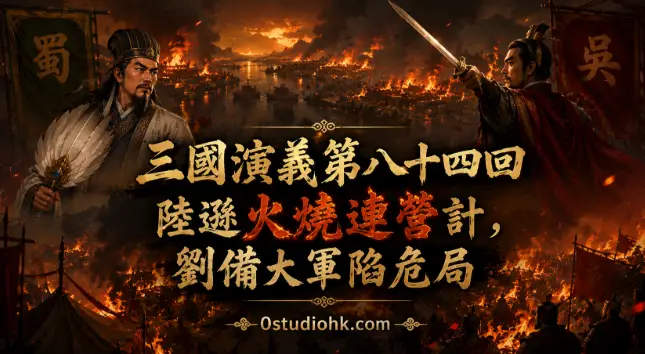
三國演義 第八十四回:陸遜火燒連營計,劉備大軍陷危局 | Romance of the Three Kingdoms Chapter 84: Lu Xun Burns the Shu Camps, Liu Bei’s Army Falls into Crisis
蜀漢大軍深入夷陵,劉備連營數百里,自信勝券在握。東吳大都督陸遜卻始終堅守不戰,耐心等待盛夏來臨。當時機成熟,一場精心策劃的火攻席捲山谷,蜀軍營寨瞬間化為火海,夷陵之戰自此徹底逆轉。
As Liu Bei’s vast army stretched across the valleys of Yiling, victory appeared within reach. Yet Lu Xun refused every opportunity to engage, patiently waiting for the perfect moment. When summer heat and favorable winds arrived, a devastating fire attack transformed the battlefield, turning Shu’s greatest campaign into one of its darkest military disasters.
中文
盛夏的夷陵,烈日炙烤著群山。
蜀漢數十萬大軍沿山谷紮營,營寨一座接著一座,綿延數百里,旌旗遮天蔽日。
劉備站在高處遠望東吳防線。
數月以來,吳軍始終閉營不出。
他相信,陸遜已經被自己的聲勢震懾,只要再向前推進,勝利便近在眼前。
然而,在東吳軍營中,陸遜卻始終神色平靜。
面對眾將請戰,他只是搖頭。
「蜀軍遠來,銳氣未衰。如今與之決戰,非上策。」
老將韓當、周泰等人雖然心急,仍選擇服從軍令。
陸遜每日巡視山林地形,仔細觀察蜀軍營寨的排列。
他發現,劉備為方便大軍駐紮,將營寨大多建於樹林之間。
一旦起火,火勢勢必迅速蔓延。
更重要的是,盛夏炎熱,山風吹拂,正是火攻最佳時機。
他知道,等待已久的機會終於到了。
一天夜裡,南風吹起。
陸遜立即召集眾將。
「今夜,便是決戰之時!」
數千名東吳士兵手持火把,分兵數路,悄悄逼近蜀軍營寨。
夜色掩護之下,沒有人察覺危機正在逼近。
隨著第一支火箭射出,熊熊烈火瞬間吞沒一座營寨。
火借風勢。
風助火威。
頃刻之間,無數營帳同時燃燒。
火光映紅整片山谷。
蜀軍將士從睡夢中驚醒。
有人尚未穿上鎧甲,營帳便已倒塌。
戰馬受驚四散奔逃。
糧草、兵器相繼被烈焰吞噬。
整座連營陷入前所未有的混亂。
劉備急忙率親兵組織抵抗。
然而四周濃煙瀰漫,將士彼此無法辨認。
東吳伏兵則趁亂四面殺出。
喊殺聲、哭喊聲與燃燒聲交織成一片。
昔日井然有序的大軍,轉眼變成四散奔逃的人群。
黃權望著火海,不禁長嘆。
「臣早言營寨不可相連。」
可惜,一切都已太遲。
陸遜親率大軍全面反攻。
吳軍士氣如虹,一路追擊。
蜀軍接連潰敗,無數將領戰死沙場。
馮習、張南等人奮力抵抗,終究寡不敵眾。
劉備在趙雲等將士保護下,艱難突圍。
一路撤退途中,火光依舊照亮夜空。
他回頭望去,只見數百里營寨盡成灰燼。
心中百感交集。
自己一心為兄弟報仇,卻讓蜀漢精銳幾乎損失殆盡。
東征以來建立的優勢,在一夜之間全部化為烏有。
另一邊,陸遜站在高坡上,遠望火海。
眾將齊聲祝賀。
「大都督妙計,足以名傳千古!」
陸遜卻沒有露出喜色。
他知道,真正的勝利,不只是擊敗劉備。
更重要的是,保住江東百年基業。
黎明時分,烈火逐漸熄滅。
昔日綿延數百里的蜀軍連營,只剩滿地焦土。
夷陵之戰的勝負,至此已經沒有懸念。
而逃出生天的劉備,仍將面對更加沉重的命運。
English Version
The summer heat settled heavily over the valleys of Yiling.
For months, Liu Bei’s enormous army had occupied an endless chain of camps stretching through forests and mountain passes. Confident after repeated advances, many Shu officers believed victory was only a matter of time.
Yet inside Wu’s headquarters, Lu Xun remained remarkably patient.
His generals repeatedly urged him to attack.
Each request received the same answer.
“The enemy still possesses confidence. We shall strike only when Heaven favors us.”
Day after day, Lu Xun personally inspected the terrain.
He carefully noted that most Shu camps had been constructed among dense woods to provide shade from the intense summer sun.
To him, those forests were not protection.
They were fuel.
At last, the opportunity arrived.
A powerful southern wind swept across the mountains on a hot summer night.
Lu Xun immediately assembled his commanders.
“The decisive moment has come.”
Thousands of Wu soldiers advanced silently under darkness, carrying torches and fire arrows instead of heavy weapons.
Without warning, flames erupted along the outer camps.
Within moments, strong winds carried the fire from one fortress to another.
Entire valleys became oceans of flame.
Sleeping soldiers awoke surrounded by burning tents.
Horses broke free in panic.
Weapons, food supplies, and command posts disappeared beneath the inferno.
Confusion spread faster than the fire itself.
Liu Bei desperately attempted to organize resistance, but thick smoke separated commanders from their units.
Communication collapsed.
Seeing the chaos, Lu Xun launched his full assault.
Wu forces attacked from every direction with overwhelming momentum.
The once-proud Shu army dissolved into desperate groups struggling simply to survive.
Huang Quan watched the disaster unfold with sorrow.
He had warned that the camps stretched too far apart to support one another in an emergency.
Now his fears had become reality.
Many distinguished Shu generals fought bravely before falling on the battlefield.
Others sacrificed themselves to protect Liu Bei during the retreat.
Escorted by loyal officers including Zhao Yun, the emperor narrowly escaped complete destruction.
Looking back toward the burning mountains, Liu Bei watched months of preparation vanish in a single night.
The campaign he had launched to avenge his sworn brothers had become the greatest military defeat of his reign.
From a distant ridge, Lu Xun quietly observed the victory.
His officers celebrated enthusiastically.
He remained calm.
Protecting Eastern Wu had always mattered more than personal glory.
As dawn finally broke, smoke drifted above blackened earth where hundreds of Shu camps had once stood.
The Battle of Yiling had reached its decisive turning point.
The fate of Liu Bei—and of Shu Han itself—would never be the same.