三國演義第六十回:張松獻西川地圖,劉備勢力再迎轉機 | Romance of the Three Kingdoms Chapter 60 Zhang Song Offers the Map of Xichuan
亂世之中,真正改變局勢的未必是戰場,而是一場相遇、一份地圖,以及一次被低估的選擇。
In chaotic times, history is not always changed by battle. Sometimes, a single meeting and a hidden map can reshape the future.
中文
西川群山連綿,蜀道險峻。
在天下動盪之際,這片土地始終像一道屏障,遠離中原戰火。
然而,越是安穩之地,越容易成為野心凝聚之處。
劉璋據守益州多年,雖能保境安民,卻缺乏雄心。
朝中上下,多有不滿。
其中最不被重視的人,卻成為改變局勢的關鍵。
那便是張松。
張松其貌不揚,言辭尖銳,卻心思極深。
他曾奉命前往許都見曹操,希望替西川尋求依靠。
然而,曹操向來重氣度、重威儀。
張松的外貌與態度,讓他心生輕視。
宴席之上,言語冷淡。
甚至故意怠慢。
張松強忍不滿,卻將一切記在心中。
離開許都時,他回望高城,神情陰沉。
他知道,曹操雖強,卻太過自負。
真正懂得用人的,或許另有其人。
於是,他南下荊州。
而在那裡,他見到了劉備。
與曹操不同,劉備親自相迎。
禮數周全,言談誠懇。
沒有輕視,也沒有傲慢。
只是平靜地傾聽。
這份態度,讓張松動搖。
夜談之中,諸多天下大勢逐漸展開。
一旁的諸葛亮則靜靜觀察。
他很快便察覺,張松此行,並非單純拜訪。
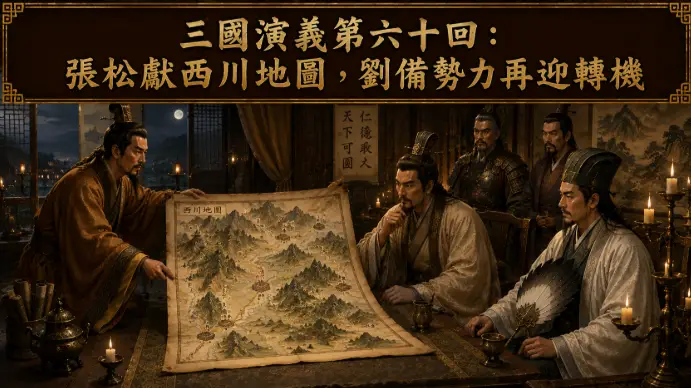
果然,數日之後,張松取出一物。
那是一份地圖。
西川山川道路、城池關隘,全盡其中。
這不只是地圖。
更是一把鑰匙。
得到它,便等於打開益州大門。
劉備沉默許久。
因為他知道,這份信任背後,意味著巨大改變。
若入西川,便不再只是寄人籬下。
而是真正建立根基。
然而,此舉亦充滿風險。
益州一旦動亂,天下局勢將再次改變。
張松卻毫不猶豫。
他已對劉璋失望。
也對曹操失望。
如今,他選擇將希望壓在劉備身上。
夜色漸深。
燭火映照地圖。
山川河流如同命運脈絡,在桌案上緩緩展開。
沒有人知道,這一夜之後,西川的命運將徹底改變。
但所有人都感受到——
天下,正在悄悄轉向。
English Version
Far beyond the political struggles of the central plains, the land of Xichuan remained protected by mountains and isolation.
Its roads were difficult, its terrain unforgiving, and its ruler, Liu Zhang, preferred stability over ambition.
For years, that caution had preserved the province.
But in an age of chaos, survival alone was rarely enough.
Within Liu Zhang’s administration, frustration quietly spread among officials who believed Yi Province possessed far greater potential than its leadership allowed.
Among them was Zhang Song.
He lacked the appearance of a traditional statesman. His features were mocked, his manner considered abrasive. Yet beneath that exterior was a sharp and calculating mind.
Originally, Zhang Song traveled north to meet Cao Cao.
The intention was political alignment.
If Cao Cao valued Yi Province, perhaps an alliance could secure its future.
But the meeting failed almost immediately.
Cao Cao judged quickly—and poorly.
He saw Zhang Song as insignificant and treated him with visible disdain.
The insults were subtle but unmistakable.
And Zhang Song never forgot them.
As he departed from Xu, resentment hardened into resolve.
If Cao Cao could not recognize talent, then perhaps someone else would.
That realization brought him south to Jingzhou, where he encountered Liu Bei.
The contrast was immediate.
Liu Bei welcomed him personally, treating him with sincerity rather than judgment.
There was no arrogance in the exchange.
Only respect.
For Zhang Song, that difference changed everything.
Their discussions stretched deep into the night, touching not only on politics, but on the future of the realm itself.
Nearby, Zhuge Liang listened carefully.
He sensed that Zhang Song carried more than conversation.
And soon, that intuition proved correct.
At a private meeting, Zhang Song revealed a detailed map of Xichuan.
Mountain routes.
River crossings.
Fortifications.
Strategic paths known only to insiders.
It was not merely information.
It was access.
The map transformed possibility into opportunity.
Liu Bei understood the significance immediately.
With Xichuan, he could move beyond dependence and establish a lasting foundation for power.
But accepting such a path also meant embracing conflict.
Yi Province would never remain unchanged once outside forces entered.
Still, Zhang Song made his choice without hesitation.
He had lost faith in Liu Zhang’s passivity and Cao Cao’s arrogance.
Now he placed his hopes in Liu Bei.
As candlelight flickered across the map, the future of the southwest quietly shifted.
No armies moved that night.
No battles were fought.
Yet one decision, made in silence, would eventually reshape the balance of the Three Kingdoms forever.