三國演義第五十六回:周瑜設宴奪荊州,諸葛亮再破東吳奇謀 | Romance of the Three Kingdoms Chapter 56 Zhou Yu’s Banquet Strategy Fails
荊州未定,聯盟難安。一場宴席之下,暗藏刀光與試探,而真正決定勝負的,仍是人心與算計。
Jingzhou remains unresolved, and so does the alliance. Beneath a grand banquet lies suspicion, ambition, and a battle of minds.
中文
江東秋風漸起,水面微寒。
赤壁之後,天下局勢進入短暫平衡。
但這份平衡,從未真正穩固。
荊州仍在劉備手中,而這件事,始終像刺一般留在周瑜心中。
他不願接受。
更不願等待。
於是,他再次設局。
這一次,不是兵鋒。
而是宴席。
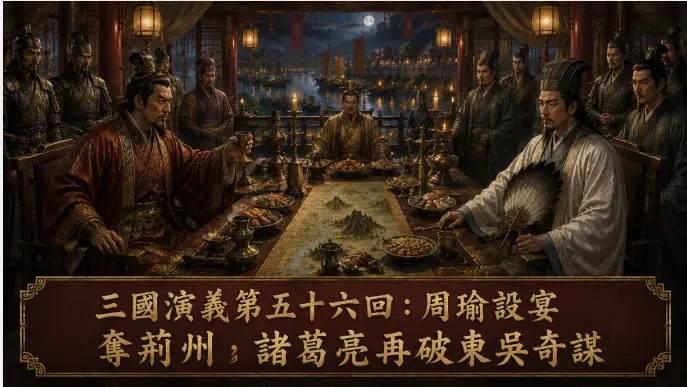
表面上,江東設宴款待劉備,氣氛和緩,禮數周全。
絲竹聲起,燈火映照。
但所有人都明白,這不是單純的相聚。
這是一場試探。
甚至,是陷阱。
周瑜深知,若強攻荊州,代價太大。
若能以局制人,則可不戰而勝。
他計畫在宴中掌握主動,逼迫劉備讓步。
然而,真正讓他忌憚的,始終不是劉備。
而是諸葛亮。
此人善觀局勢,更善觀人心。
任何細節,都可能成為反擊之處。
宴席開始後,氣氛看似融洽。
酒過數巡,話題漸漸轉向荊州。
周瑜語氣平和,卻步步進逼。
他強調聯盟大義,也提及東吳出兵之功。
字句之間,皆在施壓。
劉備沉默。
他並不擅長這種正面交鋒。
但諸葛亮卻始終從容。
他不急於反駁,而是順勢而行。
先示弱,再轉勢。
他刻意讓周瑜以為自己已佔上風。
而真正的布局,卻在暗中完成。
江東內部,有人主戰,有人主和。
孫權亦不願聯盟徹底破裂。
諸葛亮正是利用這一點。
他將局勢從「奪荊州」轉為「保聯盟」。
讓周瑜陷入兩難。
若逼得太急,便可能動搖東吳內部平衡。
若退讓,又無法達成目的。
最終,局面僵持。
周瑜雖設宴布局,卻始終無法真正掌控局勢。
而諸葛亮則在看似被動之中,再次取得主動。
宴散之時,江風吹入殿中。
燈火搖曳,人心亦動。
周瑜立於高台,望向遠去身影。
他知道,這場對局還未結束。
而且,只會越來越難。
English Version
The alliance between Wu and Liu Bei’s forces had become increasingly fragile.
What once united them—survival—was no longer enough to maintain trust.
At the center of the tension remained Jing Province.
Zhou Yu could not ignore it.
As long as Liu Bei controlled Jingzhou, Wu’s future remained uncertain.
But military confrontation carried risks.
An open conflict could weaken both sides and destabilize the balance that had kept Cao Cao contained.
So Zhou Yu chose another approach.
A banquet.
An invitation wrapped in courtesy, diplomacy, and ritual.
But beneath the surface, it was strategic pressure.
The setting was elegant. Music echoed through the halls, wine flowed freely, and formalities were carefully observed.
Yet everyone understood the reality beneath the performance.
This was negotiation disguised as celebration.
And perhaps something more dangerous.
Zhou Yu intended to use the gathering to corner Liu Bei politically.
To apply pressure subtly.
To create a situation where refusal would seem unreasonable.
But Zhuge Liang recognized the structure immediately.
He understood that this was not about direct force.
It was about momentum and perception.
Throughout the evening, Zhou Yu guided the conversation toward Jingzhou. He emphasized Wu’s sacrifices, the importance of fairness, and the imbalance created by Liu Bei’s growing position.
The argument was logical.
Which made it powerful.
Liu Bei remained cautious, saying little.
Zhuge Liang, meanwhile, appeared relaxed.
He did not resist aggressively.
Instead, he redirected the emotional weight of the discussion.
Rather than debating ownership directly, he shifted focus toward stability.
If the alliance fractured now, Cao Cao would benefit most.
If pressure became too obvious, Wu itself could become divided.
That was the key.
Zhuge Liang recognized that Zhou Yu was not acting alone.
Sun Quan still needed balance.
And balance meant avoiding extremes.
Slowly, the atmosphere changed.
What began as controlled pressure became uncertainty.
Zhou Yu found himself unable to force a decisive outcome without risking larger consequences.
The banquet ended without resolution.
But in truth, the outcome had already become clear.
Zhuge Liang had once again avoided defeat—not through confrontation, but through control of the broader situation.
And Zhou Yu understood something increasingly difficult to ignore.
Every attempt to outmaneuver Zhuge Liang only deepened the rivalry between them.