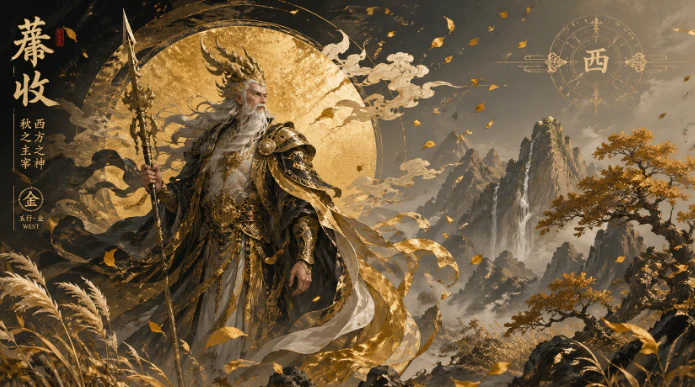
蓐收是《山海經》中象徵西方與秋季的神祇,代表收成、肅殺與秩序。他的形象融合金屬與戰爭氣息,反映古人對自然循環與力量平衡的理解。
Roushou, a deity from the Shan Hai Jing, embodies the West and autumn, symbolizing harvest, discipline, and severity. His metallic and martial nature reflects ancient perspectives on nature’s cycles and balance of power.
中文
當天地初分,四方各有其神,東有生發之氣,南有繁盛之火,而西方,則由蓐收掌管。他行於山海之間,身披金光,氣息如鋼鐵般冷冽。傳說他生於金氣之中,與秋同生,亦與收斂同在。當夏日的熱烈逐漸消散,萬物由盛轉衰,蓐收便從西方而來,帶著清冷的風與肅殺的意志,將天地間的繁華一一收束。
他的形象常被描述為威嚴而不可侵犯,有時似人,有時帶有猛獸之態,象徵著自然界中不可抗拒的力量。他手持兵器,並非為了征戰,而是象徵裁決與終結。對古人而言,秋並非單純的收穫季節,更是一個審判的時刻。成熟的果實被採摘,未成熟的則被淘汰,這種選擇與淘汰的過程,正是蓐收所代表的法則。
在山海的記述中,蓐收不只是自然之神,更像一位秩序的守護者。他使萬物各歸其位,使過度的繁盛得以節制,使生命在循環中保持平衡。當人們仰望天空,看到秋日高遠而清澈的景象,便會想起這位神祇的存在。他不是帶來生命的神,而是讓生命完成其週期的存在。
有時,風聲中彷彿能聽見他的腳步,那是一種無法逃避的節奏,提醒萬物終將歸於沉靜。落葉飄零,不只是衰敗,更是一種準備,為下一個春天鋪陳新的開始。蓐收的冷酷,並非殘忍,而是一種必要的平衡。
在古老的信仰裡,人們敬畏他,也理解他。他教會世人接受結束,理解失去,並在收束之中找到新的可能。當最後一片葉子落下,天地沉入寂靜,蓐收也隱入西方的盡頭,等待下一次季節的輪轉。
English Version
In the ancient vision of a divided cosmos, each direction was governed by a force of nature. The East breathed life into the world, the South ignited growth, and the West—quiet yet powerful—was ruled by Roushou. He moved between mountains and seas, cloaked in a metallic aura, carrying the chill of inevitability. Born from the essence of metal and aligned with autumn, he arrived when abundance reached its peak and began to fade.
Roushou was not a bringer of beginnings but a master of endings. As summer’s intensity softened, he swept across the land with crisp winds, gathering what had flourished and restoring balance. His presence marked a transition—fields were harvested, trees shed their leaves, and the world prepared for stillness. This was not destruction, but completion.
He was often imagined as a stern, almost untouchable figure, sometimes human, sometimes bearing features of a beast. His weapon symbolized judgment rather than war, a reminder that nature itself decides what endures and what must be released. Autumn, under his watch, became a season of quiet reckoning.
In these ancient narratives, Roushou represented more than a seasonal force—he embodied order. Without restraint, growth would spiral into chaos. Without endings, beginnings would lose meaning. His role ensured that life moved in cycles, not in endless expansion.
There were moments when the wind seemed to echo his passing—a subtle but undeniable rhythm. Leaves falling from branches were not merely signs of decay but signals of renewal in disguise. The stillness he brought was not emptiness, but preparation.
People of the past did not only fear him; they understood him. Through Roushou, they learned to accept closure, to see purpose in decline, and to trust that every ending holds the seed of another beginning. When the land fell silent and the sky stretched clear and distant, he would retreat once more to the far West, waiting patiently for the cycle to begin again.