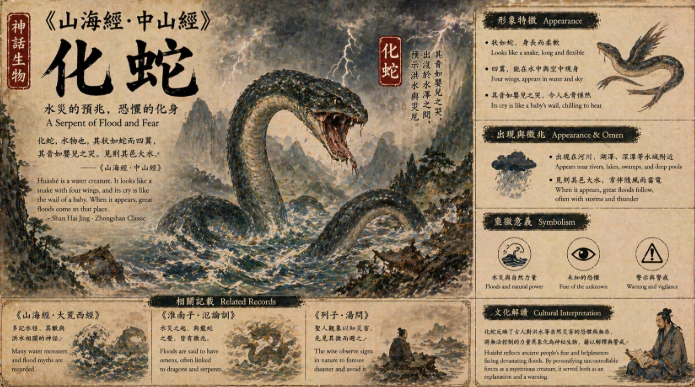
《山海經·中山經》中記載的化蛇,是一種與水災相關的神秘生物,其出現往往預示災難,象徵古人對自然力量的恐懼與敬畏。
In the Zhongshan Classic of the Shan Hai Jing, the creature Huàshé is tied to floods and disaster, reflecting ancient fears of nature’s overwhelming and unpredictable power.
中文
群山深處,霧氣終年不散,溪流在峽谷間蜿蜒,水聲如低語般迴盪。在這片少有人至的地域,流傳著關於化蛇的傳說。據說,那是一種似蛇非蛇的生物,身形修長,能在水中潛行,也能在岸上滑行,其聲如嬰兒啼哭,令人不寒而慄。每當牠出現,天空便變得陰沉,河水開始翻湧,彷彿預示著即將到來的災難。古人對此既恐懼又無奈。他們無法理解洪水的來源,也無法預測何時會發生。於是,這種無形的威脅被具象為化蛇的存在。當村落被洪水吞沒,當田地被沖毀,人們便相信是化蛇在作祟。牠不只是怪物,更是災難的化身,是自然力量的象徵。有人曾聲稱親眼見過牠,在暴雨之夜,閃電劃破天空,一道黑影在水面翻動,隨著雷聲消失無蹤。也有人說,牠潛伏於深潭之中,平日不現,一旦現身,必有大水。這些傳說在世代之間流傳,使化蛇的形象愈發清晰而恐怖。然而,化蛇的存在也反映了一種理解世界的方式。在缺乏科學解釋的時代,人們需要為災難尋找原因。將洪水歸因於某種生物,使混亂變得可被理解,也讓恐懼有了具體的對象。這種轉化並非單純的迷信,而是一種文化上的回應。它讓人們在無法掌控的環境中,仍能保有某種解釋與秩序。同時,化蛇也帶有警示的意味。牠提醒人們自然的力量不可忽視,河流與山谷並非永遠安全。當人們忽略環境的變化,災難便可能降臨。於是,這個故事不僅關於怪物,也關於生存與警覺。隨著時間推移,人們逐漸理解洪水的自然成因,化蛇不再被視為真實存在。然而,它的形象仍留在文化之中,成為對過去恐懼的記憶。當我們再次提起化蛇,不只是談論一個神話生物,而是在回望人類如何面對未知與災難。牠的身影或許從未真正出現,但牠所代表的恐懼卻真實存在,並深深影響了人類對自然的態度。這使得化蛇不僅是一段傳說,更是一種象徵,一種將無形力量轉化為可理解形象的方式。
English Version
Deep within mist-covered mountains where rivers wind through narrow valleys, there exists a legend whispered across generations—the tale of Huàshé. This mysterious creature, neither fully serpent nor entirely something else, is said to move seamlessly between water and land. Its presence is marked by an eerie sound, often described as a cry resembling that of an infant, echoing through the landscape and unsettling all who hear it. Whenever Huàshé appears, the environment itself seems to shift. The sky darkens, winds gather, and rivers begin to swell as if responding to an unseen force. In ancient times, such changes were not understood through scientific reasoning but experienced as signs of something greater at work. Floods, unpredictable and devastating, demanded explanation. In response, people shaped these events into narrative, giving form to fear through the figure of Huàshé. It became more than a creature—it became the embodiment of disaster itself. Stories of encounters spread among communities. Some claimed to have glimpsed its shadow moving beneath storm-driven waters, vanishing as quickly as lightning splits the sky. Others believed it dwelled in deep pools, emerging only when great floods were imminent. These accounts, repeated and embellished, solidified the image of Huàshé as both elusive and terrifying. Yet beneath the fear lies a deeper layer of meaning. The creation of such a creature reflects a fundamental human need—to understand and to assign cause to events beyond control. By imagining a being responsible for floods, chaos becomes interpretable, and fear gains a recognizable form. This process transforms the unknown into something that can be spoken about, remembered, and perhaps even prepared for. Huàshé also carries a warning. It reminds people that nature is not passive, that rivers can rise and landscapes can change with little notice. The legend encourages awareness and respect, suggesting that survival depends on recognizing the signs of imbalance. Over time, as knowledge of natural processes expanded, the literal belief in such creatures faded. Floods came to be understood through environmental and climatic factors rather than supernatural causes. However, Huàshé did not disappear. It remained within cultural memory, preserved as a symbol of humanity’s earlier encounters with uncertainty. Today, the story of Huàshé offers more than myth—it provides insight into how people once interpreted the world around them. It shows how imagination was used not to escape reality, but to make sense of it. Even if the creature itself never existed, the fear it represents is deeply real, echoing the timeless human experience of facing forces beyond control.