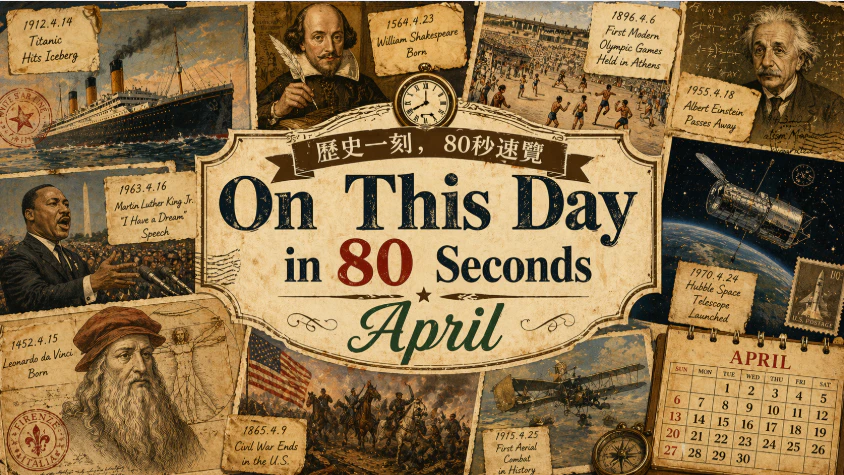
1990年Hubble Space Telescope發射升空|人類觀測宇宙的新里程碑 | Hubble Space Telescope Launched (1990) – A New Era in Observing the Universe | 歷史一刻,80秒速覽 April 24

一個望向宇宙的窗口,讓人類重新認識自己的位置。
A window into the cosmos that transformed how humanity understands the universe and its place within it.
中文
1990年4月24日,Hubble Space Telescope由美國NASA透過「發現號」太空梭成功發射升空,進入地球軌道。哈伯太空望遠鏡的誕生,標誌著天文觀測進入全新時代。與地面望遠鏡不同,哈伯能夠避開大氣層干擾,拍攝更清晰的宇宙影像,為科學家提供前所未有的觀測能力。雖然初期曾因主鏡面缺陷導致影像模糊,但經過1993年的維修任務後,哈伯迅速成為人類最重要的太空觀測工具之一。它拍攝的深空影像揭示了遙遠星系的存在,幫助科學家更準確地測量宇宙膨脹速度,並對黑洞、恆星形成與暗能量等研究提供關鍵數據。哈伯不僅改變了科學界對宇宙的理解,也讓普通人得以透過震撼的宇宙照片,重新思考人類在浩瀚宇宙中的位置。這項任務被視為太空探索史上的重大突破,其影響至今仍持續延伸。
English Version
On April 24, 1990, the Hubble Space Telescope was launched into orbit aboard a Space Shuttle mission by NASA, marking a transformative moment in the history of astronomy. Unlike ground-based telescopes, Hubble operates above Earth’s atmosphere, allowing it to capture exceptionally clear and detailed images of distant cosmic objects. Although the telescope initially faced challenges due to a flaw in its primary mirror, a servicing mission in 1993 successfully corrected the issue, enabling it to reach its full potential. Over the decades, Hubble has provided groundbreaking discoveries, including evidence of the accelerating expansion of the universe, detailed observations of distant galaxies, and insights into the life cycles of stars and the presence of black holes. Its deep-field images revealed that the universe contains far more galaxies than previously imagined, fundamentally changing our understanding of its scale and structure. Beyond its scientific achievements, Hubble has also inspired the public with stunning images that bring the beauty of the cosmos closer to Earth. The telescope remains one of the most important tools in space exploration, continuing to expand humanity’s knowledge of the universe and our place within it.