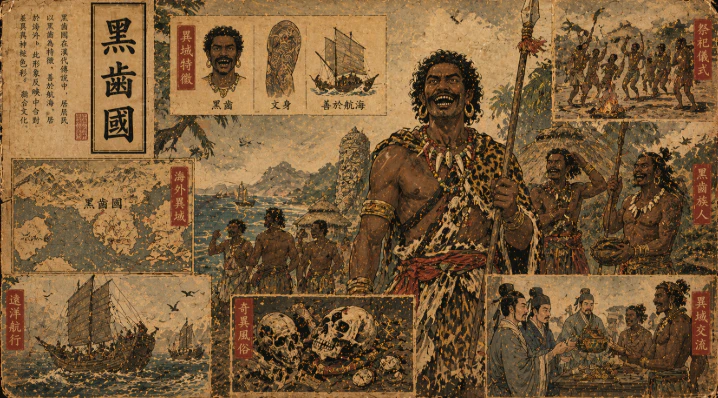
黑齒國記載於《山海經》,其民以黑齒為特徵,形象既陌生又鮮明。這一傳說不僅描繪異族,也反映古人對未知文化的想像與內心的恐懼投射。
The Black-Toothed Tribe appears in ancient Chinese myth as a people marked by darkened teeth. Their image reflects not just difference, but the way cultures project fear and identity onto the unknown.
中文
在遠離中土的海域彼端,有一片被記錄於古籍之中的國度,名為黑齒國。傳說此地之人,膚色與常人無異,言語亦近似,但唯有一點令人難以忽視——他們的牙齒皆為深黑之色,如墨染般沉重而醒目。這樣的特徵,使他們在眾多異國之中顯得格外突出,也因此在傳說中被賦予了種種神祕與不安的色彩。外來之人初聞此名,多半心生畏懼,想像其人必然兇猛異常,甚至帶有某種難以言說的危險。然而,當真正踏入這片土地,才會發現,那些黑齒之人並非怪異的存在,而是有著自身秩序與文化的族群。他們生活在濱海之地,潮汐與風向決定了他們的作息與勞作,漁獵與採集是日常的根本。黑齒並非天生,而是一種長久傳承的習俗,他們以特殊植物與礦物製成染料,塗於牙齒之上,使其呈現深黑之色。對他們而言,黑齒象徵成熟、力量與身份,是成人的標誌,也是族群認同的象徵。年幼者尚未染齒,唯有經歷某種儀式,才會正式成為族中的一員。這樣的文化,在外人眼中或許難以理解,甚至被誤解為野蠻或異常,但在黑齒國之中,卻是一種秩序與美的體現。當夜幕降臨,他們圍坐於火光之旁,談論海上的風浪與祖先的故事,黑齒在火光映照下閃動著幽暗的光澤,如同一種獨特的印記。關於黑齒國的傳說,往往帶有距離所產生的誤解。未曾親見之人,將其形象誇大,甚至與恐懼相連,將未知之物轉化為異樣的象徵。然而,當距離縮短,當視角改變,那些被視為怪異的特徵,便逐漸顯露出其背後的意義。黑齒國的存在,不只是異族的描繪,更是一面鏡子,映照出人心對差異的反應。有人選擇恐懼,有人選擇理解,而這兩者之間,正是文化交會之處。當海風吹過,帶來遠方的氣息,黑齒國依舊存在於傳說與現實之間。他們不因他人的目光而改變,也不試圖解釋自己的存在。他們只是生活,在自己的世界裡延續傳統。對於那些願意靠近的人而言,他們會發現,所謂的異常,不過是另一種生活方式,而所謂的恐懼,往往源自未曾理解的距離。
English Version
Far beyond the familiar world, across distant seas and uncertain horizons, there are stories of a place known as the Land of the Black-Toothed People. At first mention, the name alone is enough to create unease. It suggests something unusual, something outside the boundaries of what is considered normal. In many accounts, these people are described as human in form, yet marked by a single striking feature—their teeth are dark, almost black, standing out sharply whenever they speak or smile. For those who have never seen such a thing, the imagination fills in the gaps. The unknown becomes exaggerated, and difference begins to feel like danger. Over time, these imagined details grow into something larger than reality, shaping a reputation built more on fear than truth. But stories that travel far often lose their balance. When one moves closer—beyond rumor and assumption—the image begins to change. The Black-Toothed People are not defined by hostility or strangeness, but by a cultural practice that carries meaning within their own world. Their darkened teeth are not a deformity, but a deliberate choice, created through the use of natural substances passed down through generations. The act of coloring one’s teeth is tied to identity, maturity, and belonging. It marks a transition, a recognition that one has become part of the community in a deeper sense. What appears unsettling from a distance becomes, up close, a symbol of continuity and tradition. Their lives are closely connected to the coastal environment they inhabit. The rhythm of the tides shapes their daily routines, while the sea provides both sustenance and challenge. At night, they gather together, sharing stories and experiences, their faces illuminated by firelight. In those moments, the darkened teeth—once seen as a sign of otherness—become simply another detail in a shared human experience. The legend of the Black-Toothed People reveals something important, not just about them, but about those who tell their story. It shows how easily unfamiliar traits are transformed into symbols of fear, how identity is often defined in contrast to what lies outside it. The farther a culture seems, the more likely it is to be misunderstood. Yet when distance is reduced, when observation replaces assumption, the unfamiliar begins to make sense. The Black-Toothed People do not change to fit the expectations of others, nor do they seek to explain themselves. They exist as they are, within a system of meaning that is complete in its own right. Their story remains suspended between myth and interpretation, reminding us that what we fear often says more about ourselves than about those we fear. In the end, their legend is not about strangeness, but about perspective—the difference between seeing and understanding, and the quiet transformation that happens when one becomes the other.