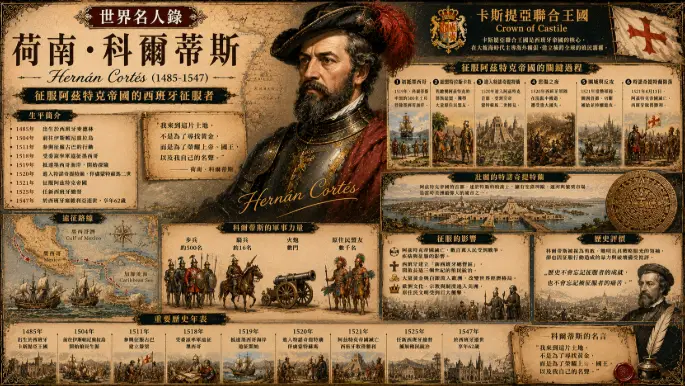
荷南·科爾蒂斯與卡斯提亞聯合王國:征服阿茲特克帝國的西班牙征服者 | Hernán Cortés and the Crown of Castile: The Conquistador Who Overthrew the Aztec Empire | 世界名人錄
荷南·科爾蒂斯是大航海時代最具影響力與爭議性的征服者之一,他率領少數西班牙人推翻阿茲特克帝國,改變中美洲歷史,也讓卡斯提亞聯合王國成為全球殖民強權。
Hernán Cortés became one of the most powerful and controversial conquistadors of the Age of Exploration after leading the Spanish conquest of the Aztec Empire and reshaping the future of the Americas forever.
中文版本
荷南·科爾蒂斯出生於1485年的西班牙麥德林,當時屬於卡斯提亞聯合王國。與許多後來前往美洲的征服者一樣,科爾蒂斯出身於沒落小貴族家庭,雖然家族具有一定社會地位,但財富有限。年輕時的科爾蒂斯聰明且充滿野心,曾短暫在薩拉曼卡大學學習法律,但他對學術生活缺乏興趣,更渴望冒險與名聲。十五世紀末至十六世紀初,西班牙在完成收復失地運動後迅速成為歐洲強權。哥倫布發現新大陸後,大量年輕西班牙人開始前往海外尋求財富與機會,而科爾蒂斯也被這股浪潮吸引。1504年,他前往伊斯帕尼奧拉島,正式踏入西班牙殖民世界。之後他參與古巴征服行動,並逐漸建立政治與軍事地位。1518年,古巴總督委派科爾蒂斯率領遠征隊探索墨西哥沿岸。然而,由於擔心科爾蒂斯野心過大,總督後來試圖撤回命令,但科爾蒂斯仍私自出航,展開改變世界歷史的遠征。1519年,科爾蒂斯率領約五百名士兵、少量騎兵與火炮抵達墨西哥海岸。他很快發現,中美洲存在高度發展的阿茲特克帝國。這個帝國以首都特諾奇提特蘭為中心,控制廣大領土與數百萬人口。然而,阿茲特克統治也引發周邊部族不滿,許多民族長期遭受重稅與軍事壓迫。科爾蒂斯敏銳地利用這些矛盾,成功與特拉斯卡拉等敵視阿茲特克的部族結盟。這些原住民盟友後來成為西班牙征服行動的重要力量。為了切斷部下退路並展現決心,科爾蒂斯下令毀棄部分船隻,迫使軍隊只能向內陸前進。隨著探險隊逐漸接近阿茲特克首都,關於西班牙人的傳聞也傳到皇帝蒙特蘇馬二世耳中。部分歷史記載指出,阿茲特克人曾將西班牙人的到來與古老神話聯繫起來,增加了局勢的不確定性。1520年,科爾蒂斯進入壯觀的特諾奇提特蘭。這座城市擁有運河、神殿與龐大市場,其規模與繁榮程度令西班牙人大為震驚。然而,雙方關係很快惡化。科爾蒂斯控制蒙特蘇馬作為政治人質,引發阿茲特克人民憤怒。之後西班牙人在宗教儀式期間屠殺大量阿茲特克貴族,更徹底激化衝突。1520年的「悲傷之夜」中,西班牙軍隊遭受重大損失,被迫逃離城市。但科爾蒂斯並未放棄。他重新集結盟友與軍隊,並利用火炮、騎兵與疾病帶來的影響展開反攻。天花等歐洲疾病在美洲迅速擴散,對缺乏免疫力的原住民造成毀滅性打擊。1521年,經過長期圍城戰後,特諾奇提特蘭最終陷落,阿茲特克帝國正式崩潰。征服完成後,西班牙建立「新西班牙總督區」,墨西哥逐漸成為西班牙在美洲最重要的殖民中心之一。科爾蒂斯獲得巨大財富與權力,被封為瓦哈卡谷侯爵。然而,他與西班牙王室及殖民官員之間的政治矛盾也逐漸加深。許多人擔心他權勢過大,因此國王逐步限制其權力。晚年的科爾蒂斯雖仍參與探險與殖民計畫,但已不再擁有早期影響力。1547年,荷南·科爾蒂斯於西班牙逝世,享年62歲。科爾蒂斯的歷史地位長期充滿爭議。一方面,他被視為極具膽識與戰略才能的軍事領袖,以極少兵力征服龐大帝國,被認為是世界歷史最驚人的征服行動之一。另一方面,他的征服也伴隨暴力、屠殺、文化破壞與殖民壓迫。阿茲特克文明在西班牙統治下迅速瓦解,大量原住民死於戰爭、勞役與疾病。歷史學家普遍認為,科爾蒂斯不只是個人冒險家,更象徵歐洲殖民擴張對美洲文明帶來的巨大衝擊。他讓卡斯提亞聯合王國建立橫跨全球的殖民帝國,同時也徹底改變墨西哥與拉丁美洲的歷史發展。直到今日,關於科爾蒂斯與阿茲特克征服的討論,仍持續牽動殖民、文化與歷史記憶等重要議題。
English Version
Hernán Cortés was born in 1485 in Medellín, within the Crown of Castile in Spain. He came from a family of lesser nobility that possessed social standing but limited wealth. Like many ambitious young Spaniards of his generation, Cortés sought fortune and recognition beyond the opportunities available at home. Although he briefly studied law at the University of Salamanca, he quickly lost interest in academic life and became increasingly attracted to adventure, military glory, and overseas exploration. Spain during this period was rapidly emerging as a global power after the completion of the Reconquista and the voyages of Christopher Columbus. The discovery of the Americas inspired countless Spaniards to seek land, gold, and prestige in newly conquered territories. In 1504, Cortés traveled to Hispaniola and entered the growing Spanish colonial world. He later participated in the conquest of Cuba, where he gained political influence, military experience, and valuable connections within the colonial administration. In 1518, the governor of Cuba selected Cortés to lead an expedition to explore the coast of Mexico. However, fearing Cortés’s ambition and independence, the governor attempted to cancel the mission shortly before departure. Cortés ignored the order and sailed anyway, beginning one of the most consequential expeditions in world history. In 1519, Cortés arrived on the Mexican coast with approximately five hundred soldiers, a small number of horses, and a handful of cannons. He soon learned of the powerful Aztec Empire, which dominated much of central Mexico from its magnificent capital, Tenochtitlan. Although the Aztecs ruled millions of people and maintained a highly organized civilization, many neighboring groups deeply resented Aztec control, tribute demands, and military domination. Cortés skillfully exploited these internal divisions by forming alliances with indigenous enemies of the Aztecs, particularly the Tlaxcalans. These alliances became essential to the success of the Spanish conquest because native allies provided thousands of additional warriors and local knowledge. Determined to prevent retreat and force total commitment from his men, Cortés famously ordered the destruction of parts of his fleet after landing. As the Spanish advanced inland, reports of their arrival reached Emperor Moctezuma II. Some later accounts suggested that certain Aztec beliefs and prophecies contributed to uncertainty about how to respond to the foreign invaders, although historians continue debating the accuracy of these interpretations. In 1520, Cortés entered the extraordinary city of Tenochtitlan, one of the largest and most sophisticated urban centers in the world at the time. Built on an island surrounded by canals, temples, marketplaces, and causeways, the city astonished the Spanish with its size and wealth. Relations between the two sides quickly deteriorated, however. Cortés seized Moctezuma as a political hostage in an attempt to control the empire indirectly, fueling growing resentment among the Aztec population. Violence escalated further after Spanish forces massacred Aztec nobles during a religious ceremony, triggering a massive uprising. During the chaotic retreat later remembered as “La Noche Triste,” or the Night of Sorrows, the Spanish suffered heavy losses while escaping the city. Yet Cortés refused to abandon the campaign. He reorganized his surviving forces, strengthened indigenous alliances, and prepared for a prolonged siege. European diseases, especially smallpox, also spread rapidly through the indigenous population, devastating communities that possessed no immunity. In 1521, after months of siege warfare, Tenochtitlan finally fell. The collapse of the Aztec capital marked the destruction of the empire and the beginning of Spanish colonial rule in Mexico. Following the conquest, Spain established the Viceroyalty of New Spain, which became one of the richest and most important regions within the Spanish Empire. Cortés himself received enormous wealth, titles, and lands, including the title Marquis of the Valley of Oaxaca. Despite these rewards, his growing influence created tensions with the Spanish Crown and colonial officials who feared he might become too powerful. Over time, the monarchy gradually reduced his authority. In his later years, Cortés continued participating in expeditions and colonial ventures but never regained the dominance he once possessed. He died in Spain in 1547 at the age of sixty-two. Hernán Cortés remains one of the most controversial figures in global history. Admirers portray him as a brilliant strategist and daring commander who achieved an astonishing military victory with limited resources. Critics view him as a symbol of conquest, destruction, exploitation, and colonial violence. The fall of the Aztec Empire led to profound cultural transformation, forced labor systems, religious conversion, and massive population decline caused by warfare and disease. Historians widely recognize Cortés as a central figure in the expansion of European colonial empires and the reshaping of the Americas. His conquest helped transform the Crown of Castile into a worldwide imperial power while permanently altering the history of Mexico and Latin America. Even centuries later, debates about Cortés continue to raise complex questions regarding empire, memory, conquest, and the legacy of colonialism.