法蘭斯高·皮薩羅與卡斯提亞聯合王國:征服印加帝國的西班牙冒險者 | Francisco Pizarro and the Crown of Castile: The Conquistador Who Defeated the Inca Empire | 世界名人錄
法蘭斯高·皮薩羅是大航海時代最具爭議性的征服者之一,他率領少數西班牙人攻陷印加帝國,改變南美洲歷史,也讓卡斯提亞聯合王國在新世界建立龐大殖民勢力。
Francisco Pizarro became one of the most controversial figures of the Age of Exploration after leading the Spanish conquest of the Inca Empire, forever transforming the history of South America and the expansion of the Spanish colonial world.
中文版本
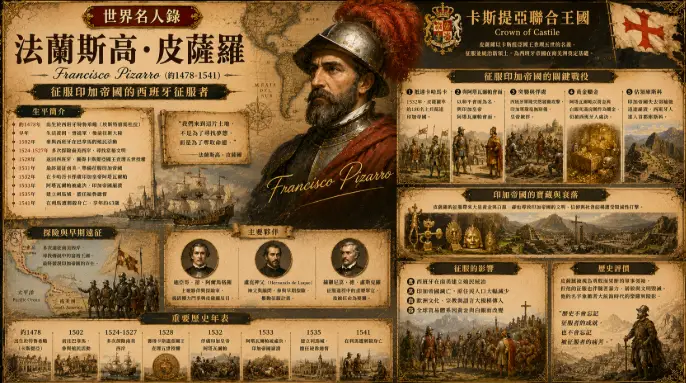
法蘭斯高·皮薩羅約於1478年出生於西班牙埃斯特雷馬杜拉地區的特魯希略,當時屬於卡斯提亞聯合王國。皮薩羅出身貧寒,據說是私生子,年幼時幾乎沒有接受正式教育,也不識字。他的成長背景與後來許多來自西班牙的征服者相似,生活艱苦、缺乏社會地位,因此許多年輕人都希望透過戰爭與海外冒險改變命運。十五世紀末的西班牙剛完成收復失地運動,天主教雙王伊莎貝拉與斐迪南成功統一大部分伊比利半島,同時也開始積極向海外擴張。哥倫布發現新大陸後,大量西班牙冒險者湧向美洲,希望獲得黃金、土地與榮耀。年輕時的皮薩羅加入西班牙軍隊,後來前往加勒比海與巴拿馬地區參與殖民活動。他逐漸熟悉新世界環境,也累積軍事與探險經驗。十六世紀初,西班牙人在中南美洲聽聞南方存在富裕文明與大量黃金。皮薩羅對這些傳聞產生極大興趣,並與迪亞哥·德·阿爾馬格羅及神父盧克合作,多次組織探險隊前往南美西岸。最初幾次遠征極為艱苦,探險隊遭遇飢餓、疾病與當地部族攻擊,甚至一度接近失敗。然而,皮薩羅始終不願放棄。他後來親自返回西班牙,向國王查理五世爭取支持,最終獲得征服與統治新領土的官方授權。1520年代末至1530年代初,皮薩羅再次率領探險隊南下,終於接觸到強盛的印加帝國。當時的印加帝國是南美洲最龐大的文明之一,版圖涵蓋今日秘魯、厄瓜多、玻利維亞與智利部分地區。然而,帝國內部正因皇位繼承問題爆發內戰,阿塔瓦爾帕與瓦斯卡爾兩兄弟為爭奪統治權而削弱國力。皮薩羅迅速察覺這是絕佳機會。1532年,皮薩羅率領僅約一百多名西班牙士兵抵達卡哈馬卡,與印加皇帝阿塔瓦爾帕會面。雖然西班牙人在人數上遠遠處於劣勢,但他們擁有火器、鋼鐵武器、騎兵與戰術優勢。會面期間,西班牙軍隊突然發動攻擊,造成大量印加人死傷,並成功俘虜阿塔瓦爾帕。這場突襲成為世界歷史最著名的征服事件之一。為換取自由,阿塔瓦爾帕答應以黃金與白銀填滿房間作為贖金。西班牙人最終獲得驚人財富,但仍於1533年處決阿塔瓦爾帕。印加帝國失去最高統治者後迅速陷入混亂。皮薩羅隨後率軍進入印加首都庫斯科,正式完成對帝國核心地區的控制。征服印加帝國後,西班牙在南美建立龐大殖民統治,而皮薩羅也成為秘魯總督。他於1535年建立利馬城,後來成為西班牙在南美最重要的殖民中心之一。然而,征服者之間很快因權力與財富分配爆發衝突。皮薩羅與昔日夥伴阿爾馬格羅逐漸反目,雙方最終爆發內戰。阿爾馬格羅被處決後,其支持者對皮薩羅充滿仇恨。1541年,皮薩羅在利馬遭阿爾馬格羅支持者刺殺身亡,享年約63歲。法蘭斯高·皮薩羅的歷史評價極具爭議。一方面,他被視為勇敢而果斷的探險家與軍事領袖,以極少兵力征服龐大帝國,被認為是大航海時代最驚人的軍事行動之一。另一方面,他的征服行動也伴隨暴力、屠殺、疾病傳播與原住民文明崩潰。西班牙殖民統治徹底改變南美洲社會結構與文化發展,也造成大量原住民人口死亡。歷史學家普遍認為,皮薩羅不只是單純征服者,更象徵歐洲殖民擴張與文明衝突的時代。他的行動讓卡斯提亞聯合王國成為世界性殖民帝國的重要力量,也使印加帝國從歷史舞台迅速消失。直到今日,關於皮薩羅與西班牙征服美洲的歷史,仍持續引發道德、文化與歷史責任上的激烈討論。
English Version
Francisco Pizarro was born around 1478 in the Spanish town of Trujillo in Extremadura, a rugged region within the Crown of Castile. He grew up in poverty and was reportedly born out of wedlock, receiving little formal education during his childhood. Like many later conquistadors, Pizarro came from a background with limited opportunities, where military service and overseas exploration offered one of the few possible paths to wealth and social advancement. Spain itself was undergoing enormous transformation during this era. Following the completion of the Reconquista and the unification of much of the Iberian Peninsula under Ferdinand and Isabella, the Spanish monarchy aggressively expanded across the Atlantic after Christopher Columbus opened the route to the Americas. Stories of gold, rich civilizations, and untapped lands attracted ambitious adventurers from across Spain. Pizarro joined military and colonial expeditions at a young age and eventually traveled to the Caribbean and the Isthmus of Panama, where he gained valuable experience in warfare, exploration, and survival in the New World. By the early sixteenth century, Spanish settlers in Central America began hearing rumors of an immensely wealthy empire far to the south. Pizarro became fascinated by these stories and partnered with Diego de Almagro and the priest Hernando de Luque to organize expeditions along the Pacific coast of South America. The early journeys were brutal and dangerous. Hunger, tropical disease, hostile terrain, and attacks from local groups nearly destroyed the expeditions several times. Despite repeated setbacks, Pizarro remained determined. He eventually returned to Spain and personally sought royal authorization from King Charles V, securing official support to conquer and govern newly claimed territories. During the late 1520s and early 1530s, Pizarro launched another expedition southward and finally encountered the vast Inca Empire, the most powerful civilization in South America at the time. The empire stretched across modern Peru, Ecuador, Bolivia, and parts of Chile. Yet beneath its immense strength, the empire was weakened by internal conflict. A devastating civil war had erupted between the rival brothers Atahualpa and Huáscar over the imperial throne. Pizarro quickly recognized the opportunity presented by this instability. In 1532, he and his small force of around 180 Spanish soldiers arrived at the city of Cajamarca and arranged a meeting with Emperor Atahualpa. Although vastly outnumbered by the Inca population, the Spanish possessed horses, steel weapons, firearms, and military tactics unfamiliar to the indigenous forces. During the encounter, Pizarro’s men launched a sudden surprise attack that caused chaos among the unarmed Inca attendants. Thousands of Inca followers were killed or scattered, while Atahualpa himself was captured. The seizure of the emperor became one of the most dramatic moments in world history. In exchange for his release, Atahualpa offered to fill a room with gold and silver as ransom. The Spanish collected enormous treasure, yet despite receiving the payment, they executed Atahualpa in 1533. Without its ruler, the Inca Empire rapidly descended into confusion and collapse. Pizarro soon marched into Cusco, the imperial capital, securing Spanish control over the heart of the empire. Following the conquest, Spain established colonial dominance across much of western South America. Pizarro was appointed governor of Peru and founded the city of Lima in 1535, which later became one of the most important centers of Spanish rule in the Americas. However, the conquistadors themselves soon became divided by greed, political rivalry, and disputes over territory. Pizarro’s relationship with his former ally Diego de Almagro deteriorated into open conflict, eventually leading to civil war among the Spanish conquerors. After Almagro’s execution, his supporters sought revenge. In 1541, Francisco Pizarro was assassinated in Lima by followers of his former partner, dying at approximately sixty-three years of age. Pizarro’s legacy remains deeply controversial. To some historians, he represents extraordinary determination and military audacity, leading one of the most astonishing conquests in history with only a tiny force against a massive empire. To others, he symbolizes the violence, exploitation, and destruction associated with European colonial expansion. The Spanish conquest brought disease, forced labor, cultural upheaval, and catastrophic population decline to indigenous societies throughout the Americas. The fall of the Inca Empire permanently transformed the political and cultural landscape of South America. Historians widely regard Pizarro as both a product and an architect of the Age of Exploration, a period when European empires expanded across the globe through conquest, trade, and colonization. His actions helped transform the Crown of Castile into one of the most powerful colonial empires in history while simultaneously contributing to the collapse of one of the greatest civilizations of the Americas. Even today, debates surrounding Pizarro continue to raise difficult questions about empire, conquest, morality, and historical memory.