
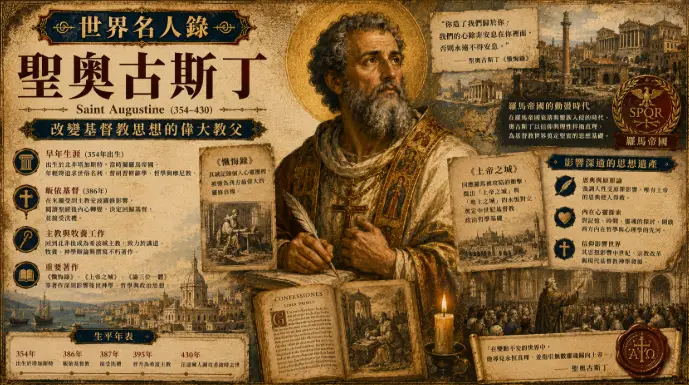
聖奧古斯丁與羅馬帝國:改變基督教思想的神學巨人 | Saint Augustine and the Roman Empire: The Theologian Who Shaped Christian Civilization| 世界名人錄
聖奧古斯丁是西方基督教歷史最重要的思想家之一,他在羅馬帝國衰落時代重新詮釋信仰、哲學與人性,深刻影響中世紀神學、歐洲文明與後世基督教世界。
Saint Augustine became one of the most influential thinkers in Christian history during the decline of the Roman Empire. His writings on faith, human nature, and salvation shaped theology, philosophy, and the foundations of Western civilization for centuries.
中文版本
聖奧古斯丁出生於354年的北非塔加斯特,當時屬於羅馬帝國的努米底亞行省,也就是今日阿爾及利亞地區。雖然地處北非,但當時的羅馬帝國已高度拉丁化,城市文化、教育制度與哲學思想都深受羅馬文明影響。奧古斯丁的父親帕特里修斯是異教徒,母親莫妮卡則是虔誠基督徒。母親對信仰的堅持深深影響了他的人生,也成為後世基督教文化中著名的聖人形象。年輕時的奧古斯丁聰明而充滿才華,尤其在修辭學與哲學方面表現出色。他前往迦太基求學,逐漸成為著名演說家與教師。然而,他年輕時的生活充滿放縱與迷惘。他追求名聲、享樂與世俗成功,並長期與情人同居,育有一子。奧古斯丁後來在《懺悔錄》中坦承自己青年時期內心充滿矛盾與欲望,始終無法找到真正平靜。為了尋求真理,他曾研究摩尼教、懷疑主義與新柏拉圖主義,希望從哲學中找到人生答案。雖然他對基督教曾抱持懷疑態度,但母親莫妮卡始終不斷為他祈禱,希望他最終回歸信仰。383年,奧古斯丁前往羅馬,之後又到米蘭擔任修辭學教授。在米蘭期間,他遇見著名主教安波羅修。安波羅修不僅學識淵博,也能以理性方式解釋《聖經》,徹底改變奧古斯丁對基督教的看法。同時,新柏拉圖主義思想也讓他開始思考靈魂、善惡與上帝存在等問題。386年,奧古斯丁在精神掙扎中經歷著名的宗教轉變。根據《懺悔錄》記載,他在花園中聽見孩童聲音反覆說著「拿起來讀吧」,於是翻開《聖經》,閱讀其中段落後深受感動,決定放棄過去生活,正式皈依基督教。387年,他接受洗禮,並開始走向宗教與神學道路。回到北非後,奧古斯丁建立修道團體,後來成為希波城主教。他在主教任內積極講道、寫作與參與神學辯論,逐漸成為拉丁教會最重要思想家之一。奧古斯丁最大的貢獻,在於他重新整合基督教信仰與古典哲學。他認為人類因原罪而天生帶有罪性,無法單靠自身力量獲得救贖,唯有依靠上帝恩典才能得救。這種「恩典論」深深影響後世天主教與新教神學。他也提出對時間、記憶與靈魂的深刻思考,被許多學者視為西方心理學與內在哲學的重要先驅。除了神學之外,奧古斯丁最著名的著作之一是《上帝之城》。410年,西哥德人攻陷羅馬城,震撼整個羅馬世界。許多人認為基督教削弱了帝國傳統,導致羅馬衰亡。奧古斯丁則在《上帝之城》中提出不同觀點。他認為人類世界的帝國終將衰敗,真正永恆的是屬於上帝的精神國度。這本書不僅回應羅馬帝國危機,也建立中世紀基督教政治思想的重要基礎。奧古斯丁生活的年代,正值羅馬帝國逐漸瓦解的時代。政治混亂、蠻族入侵與社會動盪持續加劇,但基督教卻逐漸成為歐洲文明核心。奧古斯丁的思想正好連接古典世界與中世紀基督教文明,被視為西方歷史的重要轉折人物。430年,汪達爾人包圍希波城時,奧古斯丁病逝,享年75歲。他去世後不久,西羅馬帝國也逐漸走向滅亡。然而,他留下的大量著作卻持續影響後世超過千年。從中世紀神學家托馬斯·阿奎那,到宗教改革時代的馬丁·路德與加爾文,都深受奧古斯丁思想影響。今日,他被尊為基督教歷史最偉大的教父之一,也是西方哲學與神學發展中不可忽視的核心人物。即使在現代,關於自由意志、罪惡、人性與信仰的討論,仍能看見奧古斯丁思想留下的深遠影響。
English Version
Saint Augustine was born in 354 in the town of Thagaste in Roman North Africa, located in present-day Algeria. At the time, the Roman Empire still dominated the Mediterranean world, and North Africa had become one of its most culturally sophisticated regions. Augustine grew up within a society shaped by Roman law, Latin education, and classical philosophy. His father, Patricius, followed traditional pagan beliefs, while his mother Monica was a deeply devoted Christian whose faith would profoundly influence Augustine’s future. From an early age, Augustine displayed exceptional intelligence and talent in rhetoric and literature. He traveled to Carthage for higher education, where he became immersed in the vibrant intellectual culture of the late Roman world. Yet despite his academic success, Augustine later described his youth as a period of spiritual confusion and moral excess. He pursued ambition, pleasure, and worldly achievement while struggling internally with questions about truth, morality, and human purpose. In his famous autobiography “Confessions,” Augustine openly reflected on his youthful desires, emotional conflicts, and search for meaning. For many years, he explored various philosophical and religious traditions, including Manichaeism, skepticism, and Neoplatonism, hoping to discover answers to life’s deepest questions. In 383, Augustine moved to Rome and later to Milan, where he gained prestige as a professor of rhetoric. During his time in Milan, he encountered Bishop Ambrose, one of the most respected Christian intellectuals of the age. Ambrose’s eloquent preaching and philosophical interpretation of scripture challenged Augustine’s negative assumptions about Christianity. At the same time, Neoplatonic philosophy encouraged him to think more deeply about the soul, evil, truth, and the nature of God. Augustine experienced a dramatic spiritual crisis in 386. According to his own account, he heard a childlike voice repeating the phrase “Take up and read,” prompting him to open the Bible and read a passage that profoundly moved him. This moment became the turning point of his life. He abandoned his previous ambitions and embraced Christianity wholeheartedly. In 387, Augustine was baptized by Ambrose in Milan, marking the beginning of his transformation into one of Christianity’s greatest thinkers. After returning to North Africa, Augustine founded a religious community and eventually became bishop of Hippo. In this role, he preached extensively, wrote theological works, and defended Christian doctrine against numerous intellectual and religious challenges. Augustine’s influence grew rapidly across the Latin-speaking Christian world. One of his greatest achievements was the integration of Christian theology with classical philosophical traditions. He argued that humanity was fundamentally affected by original sin and incapable of achieving salvation through human effort alone. According to Augustine, divine grace was essential for redemption. His teachings on grace, free will, and sin became central foundations for both Catholic and later Protestant theology. Augustine also explored the nature of memory, time, consciousness, and human psychology in ways that were remarkably advanced for his era. Many scholars consider him one of the earliest major thinkers to examine the inner life of the human mind. Among Augustine’s most influential works was “The City of God,” written after the Visigoths sacked Rome in 410. The fall of Rome shocked the ancient world and caused many Romans to blame Christianity for weakening traditional imperial values. Augustine responded by arguing that earthly empires are temporary and imperfect, while the true eternal kingdom belongs to God. In his view, human history reflected a struggle between the earthly city driven by pride and power and the heavenly city guided by faith and divine love. “The City of God” became one of the foundational texts of medieval Christian political thought and profoundly shaped European intellectual history. Augustine lived during the final centuries of the Western Roman Empire, an age marked by invasions, political instability, and cultural transformation. As Roman institutions weakened, Christianity increasingly emerged as the unifying force of European civilization. Augustine’s writings helped bridge the intellectual world of classical antiquity with the emerging Christian Middle Ages. In 430, while the Vandals besieged Hippo, Augustine died at the age of seventy-five. Shortly afterward, the Western Roman Empire continued its decline toward collapse. Yet Augustine’s legacy survived long after Rome itself faded. Medieval theologians, Renaissance scholars, Protestant reformers, and modern philosophers all engaged deeply with his ideas. Thinkers such as Thomas Aquinas, Martin Luther, and John Calvin drew heavily from Augustine’s teachings. Today, Saint Augustine remains one of the most influential figures in the history of Christianity and Western thought. His reflections on faith, human nature, morality, and the search for truth continue to inspire readers more than sixteen centuries after his death.