幻術之中真假難辨,人心所見未必為實,世間奇技往往映照貪念與驚奇。
Illusions blur reality and deception, revealing how human desire and curiosity shape what we believe to be true.
中文版本
市集中,有一賣藝人,衣衫簡陋,言談卻極為自信。其人擅長奇術,常於人群之中表演,觀者如堵。某日,他於市中擺攤,自稱能「隔空取桃」,眾人聞之皆疑。
時值盛夏,桃樹結實。然其所立之地,四周並無果樹。有人譏笑:「若真能取桃,何須空言?」賣藝人微微一笑,命人備竹籃與繩索。
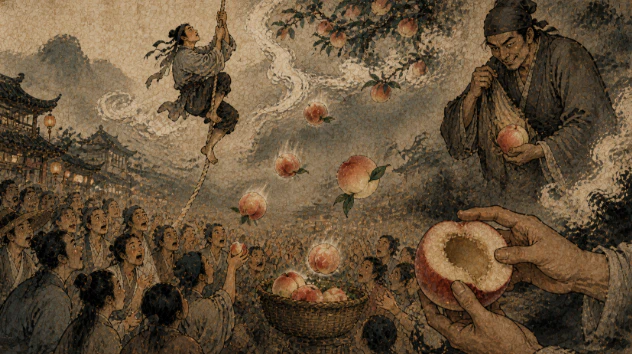
他仰首望空,似見遠方高樹,隨即將繩拋出。繩索竟似附著於無形之物,懸於半空。眾人驚愕未定,只見他攀繩而上,身形漸隱於空中。
片刻之後,空中傳來枝葉搖動之聲。忽有熟桃落下,紅潤鮮美。賣藝人隨後滑繩而下,手持桃果,分與眾人。眾人品嚐,果然甘甜。
觀者驚歎不已,紛紛稱奇。有人欲再觀其術,賣藝人卻搖頭道:「此術不可多示。」言罷收攤。
然有一人心生貪念,暗中尾隨。待至僻靜之處,見賣藝人停步,從懷中取出數枚桃子,竟與方才無異。那人恍然,知其乃幻術欺人。
然而當夜,那人將桃帶回家中,欲與家人分享。剖開之時,內中竟空無一物,唯餘薄皮。眾人驚愕,方知所見之桃亦非真物。
次日再尋賣藝人,已不知去向。有人言其為妖術,有人言乃高人隱世。議論紛紛,莫衷一是。
此事傳開,眾人始悟:世間所見,未必為實。人心若有貪念,則更易為幻所惑。
English Version
In a bustling marketplace, a traveling performer drew crowds with nothing but confidence and a mysterious claim—he could pluck peaches from thin air.
It was the height of summer, when peach trees were heavy with fruit. Yet no such trees stood anywhere near the square where he performed. Skeptics laughed openly.
“If you can truly do this,” one man challenged, “then show us.”
The performer merely smiled.
He asked for a rope and a basket. Then, gazing upward as if seeing something invisible to others, he cast the rope into the sky. To everyone’s astonishment, it hung suspended, as though caught on an unseen branch.
Without hesitation, he began to climb.
Higher and higher he went, until his body faded into the air itself.
A hush fell over the crowd.
Moments later, the faint rustling of leaves echoed above them—though nothing could be seen. Then, one by one, ripe peaches dropped from the sky, landing softly at their feet.
The performer descended, holding several more in his hands. He offered them freely. The fruit was fragrant, juicy, undeniably real.
The crowd erupted in awe.
Yet not all were satisfied.
One man, driven by suspicion—and perhaps envy—decided to follow the performer after the show. Keeping his distance, he watched as the man entered a quiet alley.
There, the illusion dissolved.
From within his robes, the performer produced several peaches, identical to those from before. The observer scoffed. “So it was a trick after all.”
That night, he brought one of the peaches home, eager to expose the deception. But when he cut it open, he froze.
Inside was nothing.
No flesh, no seed—only an empty skin.
The sweetness, the weight, the fragrance—it had all been an illusion, or something stranger.
The next day, the performer was gone.
No trace.
Some claimed he was a master illusionist. Others whispered that he was something more—something not bound by ordinary reality.
In the end, the truth remained uncertain.
But one lesson lingered: what we see is not always what is real. And when desire clouds judgment, even the most obvious illusions become convincing truths.