
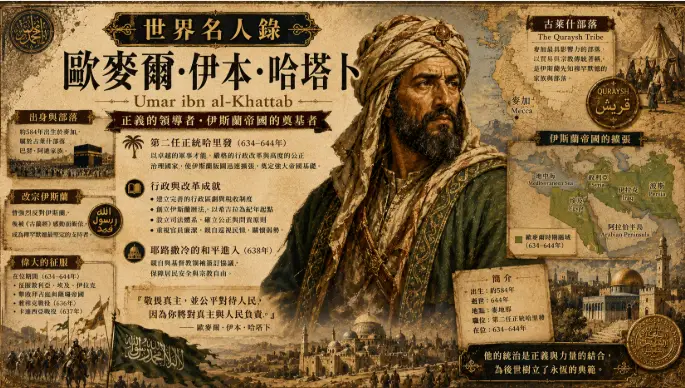
歐麥爾·伊本·哈塔卜與古萊什部落:伊斯蘭帝國擴張的重要統治者 | Umar ibn al-Khattab and the Quraysh Tribe: The Caliph Who Expanded the Islamic World | 世界名人錄
歐麥爾·伊本·哈塔卜是伊斯蘭歷史最重要的統治者之一,他以強大領導力與嚴格公正聞名,在短短十年間建立橫跨中東的大帝國,深刻改變了伊斯蘭世界與世界歷史。
Umar ibn al-Khattab became one of the most influential leaders in Islamic history through his military leadership, political reforms, and vision of justice. Under his rule, the early Islamic state expanded rapidly and emerged as a major power across the Middle East.
中文版本
歐麥爾·伊本·哈塔卜約於584年出生於阿拉伯半島的麥加,屬於古萊什部落中的巴努·阿迪家族。古萊什部落在當時阿拉伯社會具有極高地位,不僅掌握麥加的商業與宗教影響力,也長期管理克爾白聖殿。年輕時的歐麥爾以體格強壯、性格剛烈與口才出眾聞名。他熟悉部落政治與商業活動,在阿拉伯社會中具備相當影響力。早期的歐麥爾曾強烈反對伊斯蘭教,認為穆罕默德的傳教破壞了傳統部落秩序與宗教信仰。根據伊斯蘭傳統記載,他原本甚至打算刺殺穆罕默德,但在接觸《古蘭經》內容後深受震撼,最終皈依伊斯蘭。歐麥爾的改宗被視為伊斯蘭歷史的重要轉折,因為他的加入大幅提升穆斯林社群的政治與軍事力量。此後,他成為先知穆罕默德最親近的重要同伴之一,並積極參與伊斯蘭社群建立。622年,穆罕默德與信徒遷徙至麥地那,歷史上稱為「希吉拉」,歐麥爾也是核心參與者之一。在隨後的歲月中,他參與多場關鍵戰役,包括巴德爾戰役、烏侯德戰役與壕溝戰役,逐漸成為伊斯蘭世界最重要的軍事與政治人物之一。632年穆罕默德去世後,穆斯林社群面臨領導權問題。阿布·伯克爾成為首任哈里發,而歐麥爾則作為主要顧問協助穩定局勢。634年,阿布·伯克爾逝世後,歐麥爾正式成為第二任正統哈里發。在他的統治下,伊斯蘭國家進入急速擴張時期。歐麥爾領導穆斯林軍隊擊敗拜占庭帝國與薩珊波斯帝國,征服敘利亞、埃及、伊拉克與波斯大片土地。636年的雅穆克戰役被視為伊斯蘭歷史最重要的勝利之一,拜占庭軍隊在此遭受重大挫敗,使伊斯蘭勢力成功控制黎凡特地區。同時,卡迪西亞戰役則重創薩珊帝國,為波斯帝國最終崩潰奠定基礎。短短數年間,伊斯蘭國家從阿拉伯半島勢力迅速成長為橫跨中東的大帝國。除了軍事成就之外,歐麥爾最受後世稱頌的是其行政與法律改革能力。他建立較完整的政府制度,包括省級行政區、司法體系、稅收制度與軍隊管理方式。他創立伊斯蘭曆法,以希吉拉作為紀年起點,這套曆法至今仍被伊斯蘭世界廣泛使用。歐麥爾也高度重視社會公平與官員廉潔。他經常親自巡視城市與市場,了解人民生活狀況,並嚴格監督地方官員。許多歷史記載形容他生活簡樸,即使身為帝國統治者,仍維持樸素作風,深受人民敬重。宗教政策方面,歐麥爾對被征服地區採取相對務實態度。他允許基督徒與猶太人保留宗教信仰與部分自治權,但需繳納人頭稅。耶路撒冷於638年和平向穆斯林投降後,歐麥爾親自進入城市,並與基督教領袖簽訂協議,保障居民與宗教場所安全。這段歷史在伊斯蘭與中東歷史中具有重要象徵意義。644年,歐麥爾在麥地那遭波斯奴隸刺殺,數日後逝世,享年約60歲。他死後由奧斯曼繼任哈里發。後世穆斯林普遍將歐麥爾視為最偉大的伊斯蘭統治者之一,尤其在遜尼派傳統中地位極高。他不僅成功擴張伊斯蘭世界版圖,更建立了影響深遠的政治與法律制度。歷史學家普遍認為,若沒有歐麥爾時代的軍事與行政改革,伊斯蘭文明未必能如此迅速崛起。他的統治奠定了後來伊斯蘭黃金時代的基礎,也使古萊什部落從阿拉伯半島地方勢力轉變為世界歷史的重要核心之一。
English Version
Umar ibn al-Khattab was born around 584 in the city of Mecca on the Arabian Peninsula. He belonged to the Quraysh tribe, specifically the Banu Adi clan, one of the influential families connected to the political and commercial life of Mecca. During this period, the Quraysh controlled trade routes and oversaw the Kaaba, making them one of the most powerful tribal groups in Arabia. Umar grew up known for his physical strength, intelligence, strong personality, and skill in public speaking. Before embracing Islam, he was deeply committed to traditional Arabian tribal customs and strongly opposed the teachings of the Prophet Muhammad, whom he believed threatened the social and religious order of Meccan society. According to Islamic tradition, Umar initially intended to confront and even kill Muhammad, but his life changed dramatically after hearing verses from the Quran. Deeply moved by its message, he converted to Islam and quickly became one of the religion’s most important supporters. His conversion marked a turning point for the early Muslim community because his influence and courage strengthened the position of Muslims in Mecca. Umar soon became one of Muhammad’s closest companions and participated in the migration from Mecca to Medina in 622, an event known as the Hijra that later became the starting point of the Islamic calendar. Over the following years, Umar fought in several major battles alongside the Prophet, including the battles of Badr, Uhud, and the Trench. Through these experiences, he emerged as both a military strategist and a trusted political adviser within the growing Islamic state. After the death of Prophet Muhammad in 632, the Muslim community faced uncertainty regarding leadership succession. Abu Bakr became the first caliph, while Umar served as his key adviser and helped preserve unity during a critical period. In 634, following Abu Bakr’s death, Umar became the second caliph of the Rashidun Caliphate. Under his leadership, the Islamic world entered an era of extraordinary expansion. Muslim armies defeated both the Byzantine Empire and the Sasanian Persian Empire, rapidly conquering Syria, Egypt, Iraq, and large portions of Persia. The Battle of Yarmouk in 636 became one of the most decisive victories in Islamic history, severely weakening Byzantine control in the Levant. At nearly the same time, the Battle of al-Qadisiyyah shattered the military strength of the Persian Empire and opened the path toward the collapse of Sasanian rule. Within only a decade, the Islamic state transformed from a regional Arabian power into one of the largest empires in the world. Beyond military conquest, Umar became famous for his administrative reforms and commitment to justice. He established systems of provincial government, taxation, military organization, and judicial administration that created a stable imperial structure. He also introduced the Islamic lunar calendar based on the Hijra, a system still used throughout the Muslim world today. Umar believed rulers should remain accountable to the people, and many historical accounts describe him personally walking through the streets of Medina at night to understand the conditions of ordinary citizens. Despite controlling a vast empire, he lived simply and rejected excessive luxury, earning a reputation for humility and fairness. In conquered territories, Umar adopted relatively pragmatic religious policies. Christians and Jews were generally allowed to maintain their faith, communities, and places of worship in exchange for paying a special tax known as the jizya. In 638, after Jerusalem peacefully surrendered to Muslim forces, Umar personally entered the city and negotiated agreements guaranteeing protection for its inhabitants and holy sites. This event became one of the defining moments of early Islamic history and strengthened the city’s importance within the Muslim world. Umar’s leadership came to an end in 644 when he was attacked in Medina by a Persian slave during morning prayers. He died several days later from his wounds at approximately sixty years of age. Uthman ibn Affan succeeded him as caliph. In Islamic tradition, especially within Sunni Islam, Umar is remembered as one of the greatest rulers and companions of the Prophet Muhammad. Historians often credit him not only with expanding the Islamic Empire but also with establishing political and legal systems that shaped Islamic civilization for centuries. His combination of military success, administrative skill, and personal discipline made him one of the most influential figures in Middle Eastern and world history. The foundations he created during his rule helped pave the way for the later Islamic Golden Age and permanently transformed the role of the Quraysh tribe from a regional Arabian power into the center of a global civilization.