
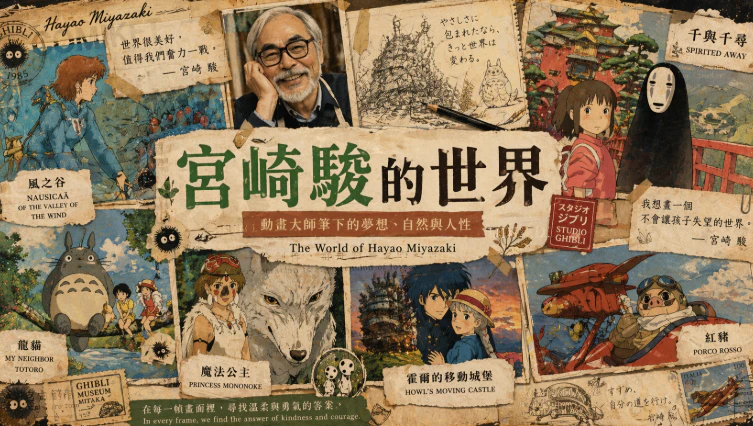
宮崎駿的世界 第十二篇:宮崎駿的世界:離開與回歸,成為自己之後 The World of Hayao Miyazaki: Departure and Return, After Becoming Oneself
在宮崎駿的故事裡,旅程的終點從來不是勝利,而是回來,但這個「回來」並不代表回到原點,而是在經歷一切之後,成為一個不一樣的自己。
In Miyazaki’s stories, the end of a journey is not victory but return, yet this return does not mean going back to the same place, it means coming back as someone changed.
中文
宮崎駿的角色幾乎都經歷一段離開原有世界的過程,這種離開並不總是自願,有時是被迫,有時則是一種成長的必經之路,在千與千尋中,千尋離開現實世界進入神靈的領域,她在那裡學會工作、承擔責任與理解他人,而當她回到原來的世界時,一切看似恢復正常,但她已經不再是原本的自己,這種改變並不明顯,卻深刻存在,而在魔女宅急便中,琪琪主動離開家鄉,進入陌生的城市,她在這個過程中經歷挫折與迷失,甚至失去原本的能力,而當她重新找回飛行的力量時,她並沒有回到起點,而是帶著新的理解繼續生活,而在霍爾的移動城堡中,蘇菲的旅程同樣是一種離開與回歸,她從一個平凡的少女變成老太太,再在這個過程中逐漸認識自己,她的外在改變反映內在的轉變,而最終的回歸,也不是恢復原狀,而是一種重新定位,宮崎駿透過這些故事反覆呈現一種結構,角色離開熟悉的世界,經歷未知與不確定,然後再回到現實,但這個回歸並不是結束,而是一種新的開始,這種結構讓他的作品帶著一種循環感,同時也強調變化的不可逆性,人可以回到原來的地方,但無法回到原來的狀態,而這種差異,正是成長的證明,而宮崎駿並沒有將這種成長描寫成戲劇性的轉變,他更關注那些細微的變化,那些不容易被察覺,卻長期影響人的部分,角色可能沒有獲得明確的答案,也沒有解決所有問題,但他們學會了如何面對世界,如何在不確定之中繼續前行,而這種能力,使他們能夠在回歸之後,重新與現實建立關係,而這種重新建立的關係,往往更加穩定,也更加真實,宮崎駿的故事之所以動人,正是因為他沒有將旅程視為逃離,而是視為一種必要的過程,離開讓人看見不同的可能,而回歸則讓人理解自己所處的位置,而在這兩者之間,角色完成了一種轉變,這種轉變沒有終點,也不需要終點,它持續存在於生活之中,而這種持續的變化,正是宮崎駿世界最核心的節奏.
English Version
Miyazaki’s characters almost always undergo a departure from their original environment, and this departure is not always a choice, sometimes it is imposed, sometimes it is an inevitable part of growth, in Spirited Away Chihiro leaves the human world and enters a realm governed by unfamiliar rules, where she learns responsibility, labor, and empathy, when she returns, the external world appears unchanged, yet her perception and sense of self have shifted, and this subtle transformation defines her journey, in Kiki’s Delivery Service Kiki willingly leaves home to find her place in a new city, encountering uncertainty and self-doubt along the way, even losing her ability to fly, and when she regains it, she does not return to who she was before, but continues forward with a deeper understanding of herself, in Howl’s Moving Castle Sophie’s journey involves both physical and emotional transformation, as her shifting age reflects her evolving self-awareness, and her eventual return is not a restoration of her previous state but a redefinition of who she is, through these narratives Miyazaki presents a recurring structure of departure, transformation, and return, where the return is not a conclusion but a continuation, this cyclical pattern emphasizes that while one may return to a familiar place, it is impossible to return unchanged, and this difference becomes the essence of growth, Miyazaki avoids dramatic resolutions and instead focuses on subtle, lasting changes that shape how individuals engage with the world, his characters may not find clear answers or resolve every conflict, but they gain the ability to navigate uncertainty and continue moving forward, and it is this capacity that allows them to reconnect with reality after their journey, forming relationships that are more grounded and authentic, Miyazaki’s storytelling resonates because it does not treat departure as escape but as a necessary process, leaving allows for the discovery of new perspectives, while returning provides a sense of context and belonging, and within this movement, characters undergo a transformation that does not seek completion, but remains ongoing, woven into the fabric of everyday life, reflecting a worldview where change is constant and identity is continuously shaped through experience.