
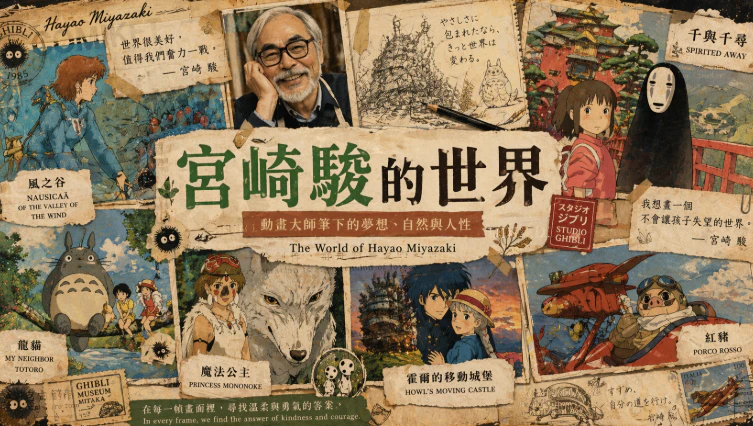
宮崎駿的世界 第九篇:邊界與轉化,世界之間的流動 The World of Hayao Miyazaki: Boundaries and Transformation, The Flow Between Worlds
在宮崎駿的故事裡,世界從來不是固定的,人與非人、現實與幻想之間總有一道模糊的邊界,而真正重要的,往往發生在跨越這條邊界的瞬間。
In Miyazaki’s stories, worlds are never fixed, and between human and non-human, reality and fantasy, there is always a blurred boundary, where the most meaningful moments occur when that boundary is crossed.
中文
宮崎駿筆下的世界經常由多個層次構成,而這些層次之間並沒有明確的分隔,而是一種可以被穿越的邊界,在千與千尋中,千尋誤入神靈的世界,那並不是完全獨立的空間,而是一個與人類世界重疊卻不同運作的領域,河流、名字與規則都構成這個世界的邏輯,而千尋的轉變正是在這種跨越之中發生,她從一個外來者逐漸成為能夠理解這個世界的人,而在霍爾的移動城堡中,邊界則體現在空間與時間的變化,城堡的門可以通往不同地方,現實被重新排列,而蘇菲的身體也在不同年齡之間轉化,這些變化讓世界不再穩定,而是一種持續流動的狀態,而在龍貓中,邊界則更加隱約,森林中的存在既像現實的一部分,也像想像的延伸,龍貓既是真實的存在,也可能是一種童年的感知,宮崎駿並沒有試圖解釋這些界線,他讓它們保持模糊,因為正是在這種模糊之中,世界才顯得更豐富,而角色的轉變也才有可能發生,邊界在他的作品裡不只是分隔,而是一種過渡,一種讓角色重新理解自我與世界的機會,當角色跨越邊界,他們並不只是進入另一個空間,而是進入另一種視角,他們開始看見原本看不見的事物,也開始理解原本無法理解的存在,而這種理解,往往伴隨著轉化,這種轉化並不一定是外在的改變,也可能是一種內在的調整,角色的價值觀、情感與認知都在這個過程中產生變化,而這種變化,讓他們能夠在不同世界之間找到自己的位置,宮崎駿透過這些跨越與轉化,描繪出一種流動的世界觀,在這個世界裡,界線並不穩固,身份也不是固定的,人可以改變,世界也會回應這種改變,而這種互動,使得他的故事帶著一種開放性,觀眾不需要找到唯一的解釋,而是可以在不同的層次之間移動,而這種移動本身,就是理解的一部分,宮崎駿並沒有強調哪一個世界是真實的,他讓所有世界同時存在,而角色則在其中不斷轉換位置,而這種不斷變動的狀態,使他的作品既具有奇幻性,也具有深層的現實感
English Version
Miyazaki’s worlds are often layered rather than divided, composed of overlapping realities that interact rather than remain separate, in Spirited Away Chihiro enters a realm of spirits that does not exist apart from the human world but alongside it, governed by its own rules and meanings, where names, contracts, and relationships define identity, her transformation unfolds through this crossing, as she moves from confusion to understanding, gradually adapting to a reality that once felt incomprehensible, in Howl’s Moving Castle boundaries become fluid through shifting spaces and identities, doors lead to different locations, time bends, and Sophie’s physical form changes in response to her inner state, creating a world where transformation is constant and stability is temporary, in My Neighbor Totoro the boundary is even more subtle, as the forest becomes a space where imagination and reality coexist, Totoro’s presence cannot be easily categorized as either real or imagined, and this ambiguity allows the world to feel both grounded and magical, Miyazaki does not seek to define these boundaries clearly, instead he preserves their uncertainty, because it is within this ambiguity that meaning emerges, boundaries in his work are not barriers but thresholds, spaces of transition where characters gain new perspectives, when they cross these thresholds, they do not simply enter a different place but encounter a different way of seeing, this shift in perception often leads to transformation, not always visible but deeply internal, affecting how characters understand themselves and others, through these processes Miyazaki presents a worldview that is inherently fluid, where identity is not fixed and reality is not singular, individuals change and the world responds in turn, creating a dynamic relationship between self and environment, this fluidity gives his stories an openness that resists singular interpretation, inviting audiences to move between layers of meaning rather than settle on definitive answers, Miyazaki does not privilege one world as more real than another, instead he allows multiple realities to coexist, with characters navigating between them, and it is within this constant movement that his work achieves both its sense of wonder and its emotional depth.