
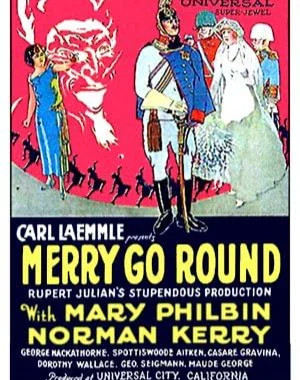
《旋轉木馬》融合浪漫與社會階級對立,背景設於奧地利帝國末期,由Rupert Julian與Erich von Stroheim共同參與創作,展現華麗與現實交錯的情感世界。
Set in the fading days of imperial Austria, Merry-Go-Round presents a story of love divided by class and circumstance. Associated with Rupert Julian and Erich von Stroheim, the film blends visual richness with emotional conflict. Through its dramatic setting and layered characters, it explores desire, illusion, and the fragile boundaries between social worlds, offering a compelling glimpse into silent-era storytelling at its most expressive.
中文
《旋轉木馬》故事發生在奧地利帝國的晚期,一個充滿華麗表象與階級分化的時代。影片以一名貴族軍官與一位馬戲團女子之間的愛情為主線,描繪兩個截然不同世界的交錯與衝突。男主角身處上流社會,擁有地位與責任,生活被傳統與榮譽所規範,而女主角則來自流動且不穩定的表演團體,她的世界充滿自由與不確定性。兩人在旋轉木馬與嘉年華的氛圍中相遇,浪漫情感在短暫的相處中迅速升溫,但這段關係從一開始便註定充滿障礙。影片透過強烈的視覺對比,呈現階級差異所帶來的壓力與限制,上流社會的莊嚴與規範,與民間娛樂的喧鬧與自由形成鮮明對照。Erich von Stroheim原本參與導演工作,其風格中對細節與社會寫實的重視,使影片在場景與人物刻畫上呈現出高度真實感,而最終由Rupert Julian完成導演工作,讓作品在敘事上更為流暢。整體畫面華麗且富有節奏感,特別是嘉年華與旋轉木馬場景,象徵著命運的循環與情感的短暫,角色在其中彷彿被命運推動,無法真正掌握自己的未來。故事不僅描寫愛情的激情,也呈現其脆弱與易逝,當現實與責任介入,理想與情感逐漸瓦解。影片透過角色的選擇與掙扎,反映出個人在社會結構中的局限,以及自由與束縛之間的矛盾。隨著劇情發展,觀眾能感受到一種無法逆轉的命運感,浪漫逐漸轉為苦澀,最終留下對人生與愛情的深刻反思。《旋轉木馬》在視覺與情感上都具有高度表現力,並透過場景設計與人物關係,營造出一種既夢幻又現實的氛圍。作為1920年代的重要默片之一,它不僅展現出電影工業的成熟,也反映出當時對社會與人性的觀察,使其在電影史中具有重要地位。
English Version
Merry-Go-Round is set during the final years of the Austro-Hungarian Empire, a period marked by elegance, hierarchy, and underlying instability. The story revolves around a romance between a noble officer and a carnival performer, two individuals from vastly different worlds whose lives intersect in fleeting yet transformative ways. The officer is bound by duty, tradition, and social expectations, while the performer exists in a realm of movement and uncertainty, where freedom comes at the cost of security. Their meeting within the vibrant atmosphere of a carnival creates an immediate emotional connection, intensified by the contrast between their lifestyles. The film uses visual juxtapositions to highlight these differences, placing structured aristocratic environments alongside the lively chaos of public entertainment. Originally associated with Erich von Stroheim, whose attention to realism and detail shaped the film’s early direction, the project was later completed by Rupert Julian, resulting in a balance between expressive authenticity and narrative clarity. The imagery is rich and symbolic, with the recurring presence of the merry-go-round serving as a metaphor for cyclical fate and the transient nature of happiness. As the narrative unfolds, the romance deepens but becomes increasingly strained by societal constraints, revealing the limits imposed by class and expectation. The characters are drawn into a situation where desire conflicts with obligation, and where personal choice is overshadowed by external pressures. The film gradually shifts in tone, moving from enchantment to melancholy, emphasizing the inevitability of change and loss. Through its emotional arc, Merry-Go-Round explores themes of illusion, longing, and the impossibility of escaping one’s circumstances. The performances and visual composition work together to create a sense of intimacy within a grand historical setting, allowing audiences to connect with the characters’ inner struggles. As a silent-era production, the film demonstrates the power of visual storytelling, using movement, expression, and atmosphere to convey complex emotional states. It remains a significant work for its blend of romance and realism, offering a poignant reflection on love and social division within a richly detailed cinematic world.
影片簡介(預告片/片段)
貴族與藝人相戀,命運如旋轉木馬般流轉
A nobleman and a performer fall in love, caught in a cycle of fate shaped by class, desire, and fleeting moments
電影資料
導演:Rupert Julian、Erich von Stroheim(未掛名)
類型:劇情 / 愛情 / 歷史 / 無聲電影
製片公司:Universal Pictures
上映年份:1923
主要演員
Norman Kerry
Mary Philbin
Cesare Gravina
George Hackathorne