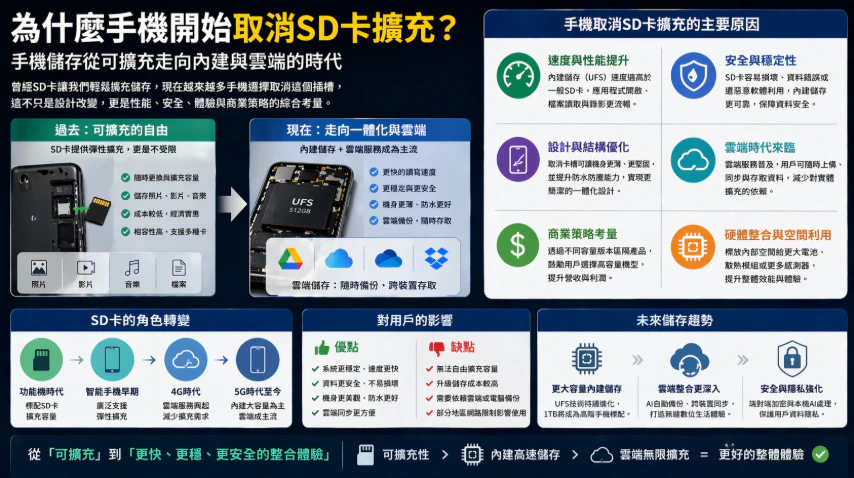
中文:越來越多智能手機取消SD卡擴充功能,從iPhone到部分Android裝置,這一趨勢反映設計與生態的轉變。
English: More smartphones are removing SD card support, from the iPhone to many Android devices, reflecting shifts in design priorities and ecosystem control.
中文
曾幾何時,SD卡是手機不可或缺的功能之一,用戶可以透過記憶卡自由擴充儲存空間,儲存照片、影片與音樂,這在早期智能手機與功能機時代極為普遍。然而,隨著手機技術與使用習慣的改變,越來越多品牌開始取消SD卡插槽,這一轉變背後涉及多重因素。首先是速度與性能的考量,內建儲存採用高速快閃記憶體,其讀寫速度遠高於一般SD卡,能確保系統運行流暢與應用程式快速啟動,而SD卡的性能差異較大,可能影響整體使用體驗。其次是安全與穩定性問題,SD卡容易損壞或出現資料錯誤,對於現代依賴大量數據的應用環境來說,這種不穩定性成為風險。設計方面,取消SD卡插槽有助於提升手機的一體化結構,使機身更薄、更堅固,同時提升防水防塵能力,與不可更換電池的趨勢相呼應。此外,隨著雲端服務的普及,用戶不再需要依賴實體儲存,透過網絡即可存取資料,從照片備份到文件同步,雲端逐漸取代SD卡的角色。另一方面,這一變化亦涉及商業策略,廠商透過提供不同容量版本的手機,鼓勵用戶選擇更高儲存配置,從而提升產品價值與利潤,同時也加強對生態系統的控制。對用戶而言,取消SD卡意味著失去部分自由,但換來更穩定與一致的使用體驗。從更宏觀的角度來看,這種轉變反映出科技產品正從開放與可擴展走向封閉與整合,手機不再是一個可以隨意升級的裝置,而是一個完整的數碼系統。這不僅改變了硬體設計,也影響了用戶對儲存與資料管理的方式,使數碼生活更加依賴雲端與平台服務。最終,SD卡的消失並非單一原因所致,而是性能、設計、安全與商業因素共同作用的結果,體現出現代科技發展的方向與取捨。
English Version
SD cards were once a defining feature of mobile devices, offering users the flexibility to expand storage easily for photos, videos, and music. In the early smartphone and feature phone era, this capability was considered essential. However, as technology evolved, many manufacturers began removing SD card slots, driven by a combination of technical, design, and strategic factors. One of the primary reasons is performance. Built-in storage uses high-speed flash memory that significantly outperforms most SD cards, ensuring smoother system performance and faster app loading times. In contrast, SD cards vary widely in quality and speed, potentially causing inconsistent user experiences. Reliability is another key concern. SD cards are more prone to failure, corruption, and data loss, which can be problematic in a world where smartphones handle critical personal and professional data. From a design perspective, eliminating the SD card slot allows for more compact and durable devices, contributing to slimmer profiles and improved water and dust resistance, aligning with the broader trend of integrated smartphone design. At the same time, the rise of cloud computing has reduced the need for physical storage expansion. Users can now store and access data through online services, making SD cards less essential than before. Strategic considerations also play a role. By removing expandable storage, manufacturers can encourage users to purchase higher-capacity models, increasing revenue while maintaining tighter control over the user ecosystem. For consumers, this shift represents a trade-off between flexibility and consistency. While the loss of expandable storage limits user choice, it also delivers a more stable and optimized experience. On a broader scale, the decline of SD cards reflects a wider transformation in technology—from open, modular systems toward integrated, controlled environments. Smartphones are no longer devices that users can easily modify, but cohesive digital platforms designed to deliver seamless performance. The disappearance of SD card support is therefore not the result of a single decision, but the outcome of multiple converging factors, illustrating the evolving priorities of modern technology and user experience.