September 25 in History|From William Faulkner and the Transatlantic Telephone Cable to the Chicago Marathon
September 25 connects literature, communication, medicine, sport and conservation, from William Faulkner’s fictional world to transatlantic calls and the Chicago Marathon.
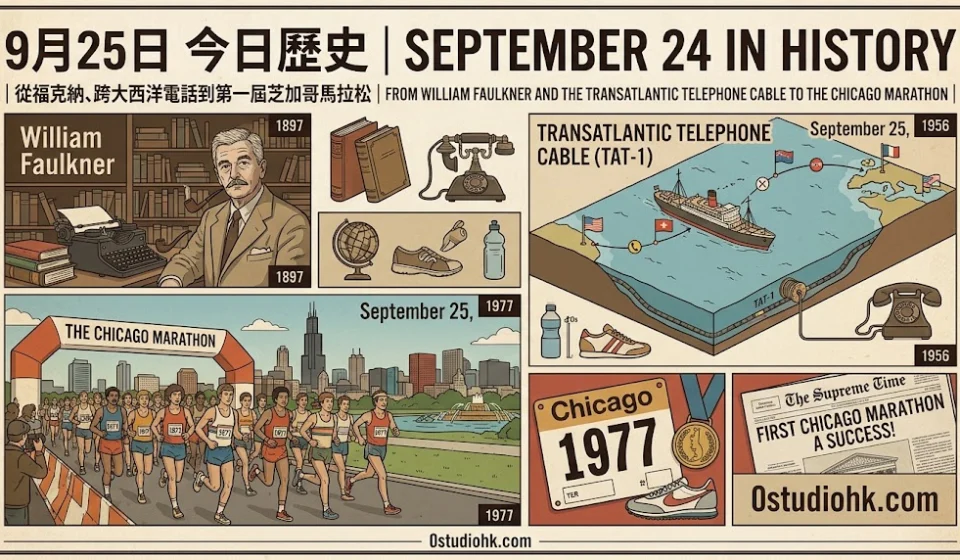
September 25 can be understood through a simple idea: people have repeatedly found ways to overcome distance and limitations. On September 25, 1897, American novelist William Faulkner was born in New Albany, Mississippi. He later became one of the major literary figures of the twentieth century. The Library of Congress notes that Faulkner spent much of his youth in Oxford, Mississippi, and created the fictional Yoknapatawpha County, a setting that became central to many of his works. Faulkner’s fictional world included characters from different social backgrounds and explored family relationships, social change, memory and the complicated history of the American South. One of the most distinctive aspects of his writing was his ability to turn a fictional place into something resembling a complete social landscape. Readers could encounter different characters and places across several works, gradually developing a deeper understanding of the fictional county and its history. His novels often experimented with narrative structure and perspective, asking readers to reconstruct events through memories, different viewpoints and changes in chronology. In this sense, Faulkner did more than tell individual stories. He created a literary environment that readers could return to and explore from different directions. His work became an important part of twentieth-century American literature and continues to be studied for both its literary techniques and its treatment of society and history. September 25 also marks a major milestone in the history of global communication. On September 25, 1956, TAT-1, the first transatlantic telephone cable system, officially entered service. The cable connected Clarenville in Newfoundland with Gallanach Bay near Oban in Scotland and created a new way of carrying telephone conversations across the Atlantic. Before TAT-1, transatlantic telephone communication depended largely on radio transmission. Radio made long-distance calls possible, but it also had limitations in signal quality and capacity. The new submarine cable provided a more reliable system for carrying voice calls. On the day of its inauguration, a three-way telephone conversation connected London, Ottawa and New York, symbolising a new stage in international communication. TAT-1 initially had 36 telephone channels, yet during its first 24 hours of public service it carried 588 calls between London and the United States and 119 calls between London and Canada. Its capacity was later increased to 48 channels. Today, people can make international calls through smartphones and internet services almost instantly, so it is easy to forget how difficult long-distance communication once was. Undersea cables remain fundamental to global communications, and TAT-1 represents an important stage in their history. From nineteenth-century submarine telegraph cables to twentieth-century telephone cables and today’s high-capacity fibre-optic networks, the basic objective has remained remarkably consistent: to make physical distance less of a barrier to communication. September 25 also has an important place in the history of sports medicine. In 1974, American orthopaedic surgeon Frank Jobe performed a reconstruction of the ulnar collateral ligament on baseball pitcher Tommy John. The procedure later became widely known as Tommy John surgery. It uses a tendon graft to replace a damaged ligament in the elbow and eventually became a well-known reconstructive procedure in baseball and other throwing sports. The significance of the procedure lies in its approach to repair. Instead of simply treating pain, doctors could reconstruct damaged tissue and attempt to restore function. Modern sports medicine has developed enormously since then, but the underlying idea remains important: understanding the structure of the body can allow doctors to find new ways to repair injuries and help people return to activity. The story also shows how medical developments can influence sporting culture. The health and recovery of athletes became increasingly connected with specialist medical knowledge, rehabilitation and long-term physical care. On September 25, 1977, another very different kind of physical challenge took place in Chicago: the first Chicago Marathon. About 4,200 runners took part in the inaugural race, which was originally known as the Mayor Daley Marathon. The event eventually developed into one of the world’s major city marathons. The early race was much smaller than the modern event, but the basic idea was already powerful. Running does not require a complicated stadium. A city can become the course, while roads, spectators, volunteers and participants create the event together. This is why major city marathons are more than sporting competitions. They can become part of urban culture. Participants move through familiar streets from a completely different perspective, while local residents become spectators and supporters. The city itself becomes part of the experience. Over time, this model of mass participation helped transform running from an individual activity into a major community event in many parts of the world. September 25 is also associated with conservation history. On September 25, 1890, Sequoia National Park was established in California by an act of Congress. The park is famous for its giant sequoia trees. The creation of a national park reflects an important idea: some landscapes have value beyond their immediate economic use and can be protected for future generations. Giant sequoias make this idea particularly powerful because of their enormous age and size. Human buildings, roads and businesses can change within decades, while individual trees may have existed for centuries. Conservation therefore involves more than protecting scenery. It also protects a connection with a much longer scale of time. A forest can become a living historical record, allowing future generations to experience something that existed long before them. Another September 25 milestone came in 1981, when Belize joined the United Nations. Membership of the United Nations marked Belize’s participation in the wider international community. Belize is located in Central America and has a cultural history influenced by Caribbean, Central American and different ethnic traditions. Its official language is English, another reflection of its particular historical development. When these events are considered together, September 25 reveals a surprisingly clear theme: extending human possibilities beyond their previous boundaries. Faulkner used words to create a fictional world that readers could explore across generations. TAT-1 allowed human voices to cross the Atlantic through a physical cable beneath the sea. Reconstructive surgery offered injured athletes a way to recover physical function. The Chicago Marathon turned individual running into a large-scale urban experience. Sequoia National Park preserved ancient trees beyond the lifespan of any single generation. These stories may seem unrelated, but each involves some form of extension. A story extends imagination into the mind of the reader. A communication cable extends the human voice across distance. Medical reconstruction extends the possibilities of physical recovery. A marathon extends individual effort into a shared community event. Conservation extends the life of a landscape into the future. This is one of the reasons history is often most interesting when viewed through ordinary life. International telephone calls, novels, medical treatment, public sporting events and protected forests can seem completely normal today, yet each depends on decisions, technologies and ideas developed by earlier generations. September 25 therefore provides a useful reminder that modern life is built from accumulated changes. The ability to communicate across oceans, read literature from another era, recover from serious injuries, participate in major sporting events or visit protected natural landscapes did not appear overnight. Each reflects people trying to solve problems, create new possibilities or preserve something they believed was worth keeping. History is not only about dramatic events. It is also about the gradual expansion of what ordinary people can do, experience and share.
September 25 follows a theme of overcoming distance and limits: literature expands imagination, cables extend communication, medicine extends physical recovery, marathons turn effort into community culture, and conservation carries natural memory into the future.