September 24 in History|From the U.S. Supreme Court and Honda to The Great Gatsby and the Muppets
September 24 connects institutions, industry and culture, from the creation of the U.S. federal judiciary to Honda, F. Scott Fitzgerald and Jim Henson.
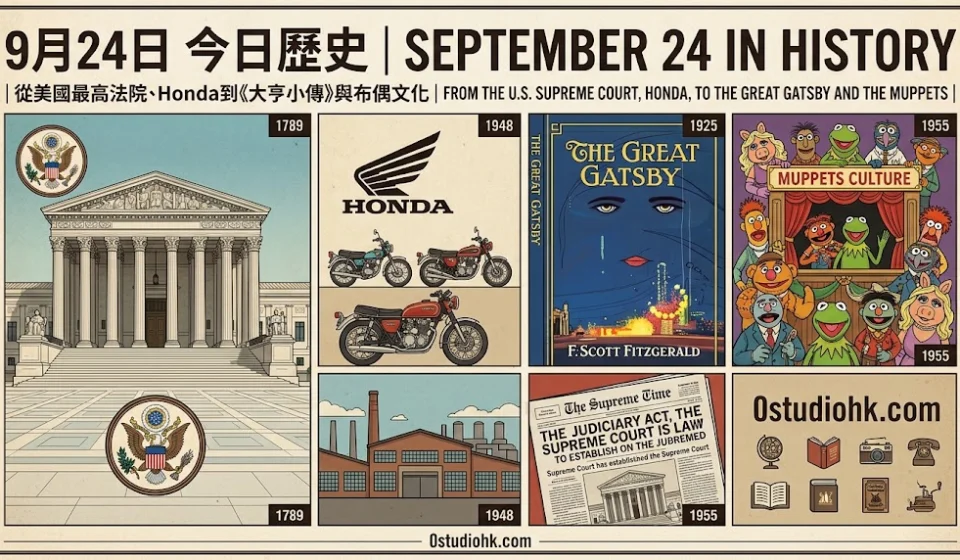
September 24 offers a fascinating mixture of institutions, industry and culture. On September 24, 1789, President George Washington signed the Judiciary Act of 1789, creating the basic structure of the federal judicial system of the newly established United States. The U.S. Senate’s historical records explain that the act established federal district and circuit courts as well as the Supreme Court, and provided for a Supreme Court consisting of a Chief Justice and five Associate Justices. On the same day, Washington nominated John Jay to become the first Chief Justice. The importance of the Judiciary Act was not simply that it created a number of courts. It translated the constitutional idea of federal judicial power into an operating institutional system. The United States was still a young country, and its government required practical structures through which laws could be interpreted and disputes could be handled. The act therefore represents one of those moments in history when an abstract political principle became an everyday institution. People do not normally think about constitutional structure when they visit a court, but the court system itself is the result of decisions made more than two centuries ago. September 24 also marks the beginning of another organisation that would eventually become globally familiar. In 1948, Soichiro Honda founded Honda Motor Company in Japan. Historical records place the founding on September 24, 1948, in Hamamatsu. The Honda of 1948 was obviously very different from the global automotive and motorcycle company known today. Post-war Japan needed affordable and practical transportation, and Honda developed its early business around mechanical engineering, engines and motorcycles. Over time, the company expanded into automobile production and eventually became a major international manufacturer. The Honda story demonstrates how business growth and technological development often happen together. A company needs technology that solves real problems, but technology also needs an organisation capable of turning engineering ideas into reliable products. Honda gradually built that connection between engineering, manufacturing, consumer needs and international markets. Its history therefore provides an example of how a small company can develop into a global brand through continuous adaptation rather than through one single breakthrough. September 24 is also the birthday of American writer F. Scott Fitzgerald. Born on September 24, 1896, in St. Paul, Minnesota, Fitzgerald became one of the best-known American writers of the twentieth century. The Library of Congress notes that he is particularly famous for The Great Gatsby, while his first novel, This Side of Paradise, published in 1920, brought him almost immediate fame. Fitzgerald became closely associated with the cultural atmosphere of the American Jazz Age. His fiction explored ambition, wealth, romance, social status and the tension between dreams and reality. The Great Gatsby remains especially important because it offers more than a story about wealthy people and glamorous parties. It explores how people imagine success and how social class can shape their opportunities and relationships. Fitzgerald’s work also demonstrates the relationship between literature and history. Historical documents can tell us what happened during a particular period, but literature can provide another kind of evidence: an imaginative picture of how people might have experienced that period. Fitzgerald transformed the atmosphere of the 1920s into characters, conversations, relationships and conflicts. His writing therefore continues to be read not only as literature but also as a way of thinking about American society and culture. Another major cultural figure born on September 24 was Jim Henson, born in 1936 in Greenville, Mississippi. Henson became a pioneering puppeteer, television creator and artist whose characters became part of global popular culture. The Jim Henson Company describes him as an innovator in puppetry, technology and visual arts and identifies Kermit the Frog among the memorable characters he brought to life. Henson’s achievement was not simply creating puppets. He transformed puppetry into a sophisticated form of television storytelling. His work demonstrated that puppets could have distinct personalities, voices, relationships and emotional lives. Through programmes such as Sesame Street and The Muppet Show, puppetry reached enormous audiences and became a form of entertainment that could appeal to children while also containing humour and ideas appreciated by adults. Henson also combined traditional craft with television production, performance and new technology. The result was a creative style that could continue to develop as the media environment changed. His career is a reminder that an old artistic form does not necessarily become obsolete when new technology appears. Sometimes it can become more powerful when it is adapted to a new medium. September 24 also has an important place in the history of environmental preservation. In 1906, President Theodore Roosevelt proclaimed Devils Tower in Wyoming the first national monument of the United States. The decision reflected a growing recognition that natural landscapes could have public, cultural and historical value beyond their potential for development. Devils Tower is a striking geological formation, and its designation helped establish the national monument as an important mechanism for preserving places of significance. This idea of preservation creates an interesting connection with the other stories of September 24. A judicial system preserves rules through which society operates. A company preserves and develops technical knowledge by turning engineering ideas into products. Literature preserves something about the imagination and social atmosphere of an era. A national monument preserves a landscape for future generations. In each case, something is created or recognised and then given a structure that allows it to continue. Fitzgerald and Henson also represent two very different forms of cultural creation. Fitzgerald used words to construct characters, relationships and social worlds. Henson used puppetry, performance, voices, television and visual design to create characters that could become part of everyday family life. Yet both demonstrate the ability of culture to outlive its original moment. A novel can continue to be read decades after its publication, while a fictional character can remain familiar to audiences long after its creator has died. Cultural history therefore has its own kind of continuity. The life of a work does not necessarily end when the person who created it is gone. When these events are placed together, September 24 becomes a day about turning ideas into lasting structures. A law can become an institution. Engineering can become a product. A writer can turn the atmosphere of a historical period into a novel. An artist can turn a simple piece of fabric and foam into a character recognised around the world. A landscape can become something that society decides should be protected rather than simply used. These examples may appear unrelated, but they share a common theme: people constantly create ways to make ideas last. Some survive through laws and institutions, some through companies and technology, and others through books, television and popular culture. September 24 therefore offers a broader lesson about history. History is not only a record of major events or famous individuals. It is also the story of how societies build systems, develop technologies, create cultural works and decide what should be preserved for the future. The institutions we use, the products we buy, the books we read and the characters we remember all have origins. Understanding those origins helps us see the present not as something that appeared suddenly, but as the result of countless decisions and creative efforts made by people in earlier generations.
September 24 connects institutions, technology and culture: courts create structure, Honda develops technology, Fitzgerald captures an era, Henson creates lasting characters, and preservation protects places for future generations.