September 23 in History|From Nintendo, Chewing Gum and the Birth of Ray Charles
September 23 connects games, everyday products and music culture, from Japanese playing cards and commercial chewing gum to the remarkable musical life of Ray Charles.
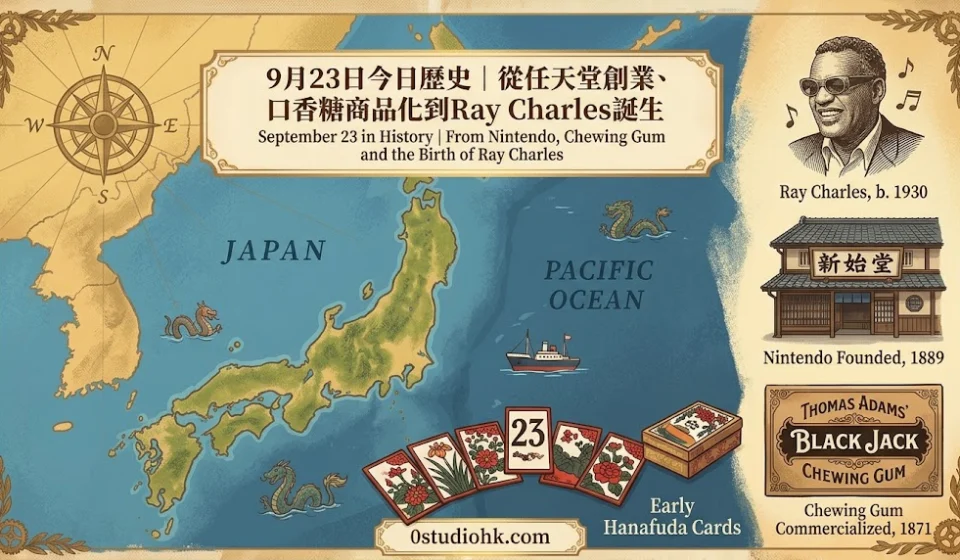
September 23 brings together several stories that appear unrelated at first: a traditional Japanese card business, the commercialisation of chewing gum, the birth of a major musician and the arrival of a futuristic animated television family. Together, however, they reveal something important about cultural history: many things that eventually become globally recognised begin as small, ordinary ideas. On September 23, 1889, Fusajiro Yamauchi began manufacturing and selling Japanese playing cards known as Hanafuda in Kyoto. Nintendo’s official corporate history identifies this period as the beginning of the company’s long history. Today Nintendo is one of the world’s best-known entertainment companies, associated with video games, consoles and characters recognised across generations. Yet its original business had nothing to do with electronic games. It began with traditional playing cards. Hanafuda cards use colourful images connected with the months and seasons, and they became part of Japanese gaming culture. Nintendo’s later history shows how dramatically a company can change while retaining a connection with entertainment. In 1902, the business began producing and selling Western-style playing cards in Japan. In 1953, it became the first company in Japan to successfully mass-produce plastic playing cards, and in 1959 it began selling playing cards featuring Disney characters. These developments show that Nintendo did not move directly from playing cards to modern video games. Instead, it experimented with different products and markets over many decades. The company eventually entered toys and electronic entertainment before becoming the Nintendo known around the world today. This long history is important because modern brands can easily appear as if they were created with their final purpose already in mind. Nintendo is a good example of the opposite. A company can begin with one product, respond to changes in consumer behaviour, explore new technologies and gradually build a completely different identity. Business history is therefore rarely a straight line. It is usually a process of experimentation, adaptation and reinvention. September 23 also takes us into a very different part of everyday life: chewing gum. On September 23, 1848, John B. Curtis began selling what is widely regarded as the first commercially produced branded chewing gum, called “The State of Maine Pure Spruce Gum”. Guinness World Records identifies Curtis as the producer of the first branded, commercially produced chewing gum. The product was made from spruce resin and was developed into something that could be manufactured and sold to consumers. The idea of chewing natural materials, of course, was much older than the nineteenth century. People in different parts of the world had long chewed various natural resins and plant materials. What changed in the nineteenth century was the commercial system surrounding the product. Once a material could be processed, packaged, given a name and sold consistently, an everyday habit could become a consumer industry. The history of chewing gum is therefore more than a curiosity about a familiar sweet. It illustrates how modern consumer culture developed. A successful product depends on much more than the raw material. Taste, texture, packaging, branding, distribution, price and consumer habits all influence whether something becomes commercially successful. Today a packet of chewing gum in a supermarket or convenience store may seem like a very small purchase, but behind it is a long history of manufacturing and marketing. The story also demonstrates how industrialisation transformed ordinary habits into organised businesses. A natural substance that once had a local or informal use could eventually become a branded product available to a much wider population. September 23 is also the birthday of one of the most influential musicians in modern American music: Ray Charles. Born Ray Charles Robinson on September 23, 1930, in Albany, Georgia, he became a pioneering musician whose work helped shape soul music. His official biography describes how he combined blues, gospel, R&B, rock, country and jazz to create a distinctive musical style. Charles encountered music at a very young age and began playing the piano before he was five. When he was around six, glaucoma began affecting his eyesight, and he eventually became blind. He attended the Florida School for the Deaf and Blind in St. Augustine, where he learned to read and write music in Braille and studied several instruments, including piano and clarinet. His importance is not simply the story of a blind musician who achieved success. His deeper contribution was the way he connected musical traditions that had often been treated as separate. Gospel, blues, rhythm and blues, country, jazz and rock each had different histories and audiences. Charles brought elements of these traditions together and helped create a sound that crossed musical boundaries. His work became an important part of the development of soul music and influenced generations of performers. September 23 also has a place in television history. On September 23, 1962, Hanna-Barbera’s animated sitcom The Jetsons premiered on ABC. Television Academy records the premiere date and describes the programme as one of the early colour television programmes on the network. The series imagined an ordinary family living in a highly technological future, with automated household devices, unusual forms of transport, mechanical assistants and futuristic homes. Not all of its predictions became reality, but that was not necessarily the point. The Jetsons captured the optimism of the early 1960s and turned ideas about technological progress into everyday comedy. Its popularity also demonstrated how entertainment can influence the way people imagine the future. A television programme does not need to predict technology accurately to shape cultural expectations. It can simply create images of what life might look like and allow audiences to imagine themselves living in that world. This creates an interesting connection with Nintendo’s history. Nintendo began with a traditional form of entertainment and gradually moved towards electronic entertainment, while The Jetsons used television to imagine what technology might bring to everyday life. Both stories demonstrate that entertainment is not merely about passing time. It can also influence how people understand technology, family life and the future. When the events of September 23 are viewed together, a common pattern emerges. A deck of cards, a piece of chewing gum, a musical performance and an animated television programme may seem like very small things compared with major political or economic events. Yet each became part of a much larger cultural story. Nintendo grew from a traditional card business into a global entertainment company. Chewing gum developed from natural resin and an old habit into a modern consumer product. Ray Charles transformed musical influences from different traditions into a distinctive sound. The Jetsons turned technological optimism into a shared cultural image of the future. None of these developments required the invention of an entirely new human activity. Instead, they often involved taking something that already existed and finding a new way to make it, sell it, combine it or present it. That is an important lesson about innovation. Innovation is not always a dramatic invention that appears suddenly. Sometimes it is a gradual process of changing an existing idea until it becomes something different. The history of Nintendo is a particularly strong example. Its original product and its modern products are separated by more than a century of business experimentation. The company survived because it was able to change. The history of chewing gum tells a similar story at a smaller scale: the act of chewing was ancient, but commercial production created a new market. Ray Charles shows the same principle in music: the individual musical traditions already existed, but combining them in a new way created something distinctive. The Jetsons did something similar with technology and entertainment by combining familiar family life with imaginative ideas about the future. September 23 can therefore be remembered as a day of cultural transformation. It reminds us that the things we take for granted often have surprisingly long histories. A card game can become the beginning of a global brand. A small consumer product can develop into an international industry. A musician can connect traditions and influence generations. A television cartoon can leave behind images that become part of popular culture. History is not only made by large institutions or dramatic events. It is also made by ordinary objects, creative people and small ideas that find a way to reach a much larger audience. That may be the most interesting lesson of September 23: we can never be completely certain which ordinary idea of today will become an important cultural symbol of tomorrow.
September 23 shows how small ideas can become major parts of culture: cards led to Nintendo, resin became a consumer product, music crossed boundaries, and animation turned ideas about the future into shared memories.