From One Letter to a Connected World
1. October 9, 1874: A Milestone in International Postal History
Before telephones, email, and instant messaging, letters were one of the most important ways to communicate with distant family members, business partners, and government institutions.
In the nineteenth century, however, sending mail across borders could be complicated. Countries operated under different postal regulations, postage rates, and transportation arrangements. A letter travelling through several countries could involve multiple procedures and charges.
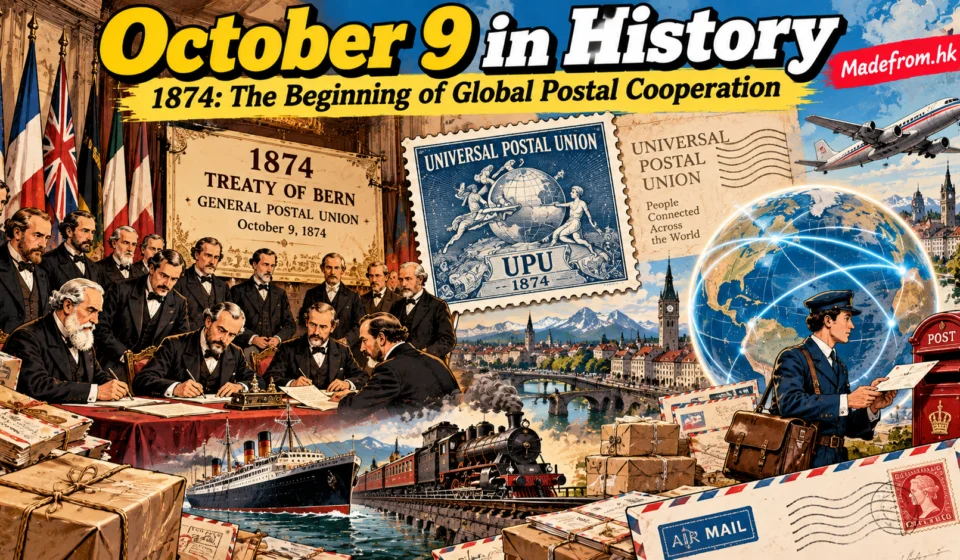
On October 9, 1874, representatives of 22 countries signed the Treaty of Bern in Switzerland, establishing the General Postal Union. The agreement created a shared framework for international mail exchange and became a key milestone in the development of global postal cooperation.
Its importance lay in helping countries move beyond a confusing network of separate bilateral arrangements towards a more coordinated international system.
2. The Birth of the Universal Postal Union
The General Postal Union gradually attracted more participating countries. In 1878, it adopted the name Universal Postal Union, commonly known as the UPU.
The organization works to coordinate international postal services, facilitate the exchange of mail, and support cooperation among national postal administrations.
This was a significant idea for its time. It demonstrated how countries with different languages, laws, and administrative systems could cooperate through common rules to make an essential service function across borders.
In 1948, the Universal Postal Union became a specialized agency of the United Nations, continuing its role in international postal cooperation.
3. Why Is October 9 World Post Day?
In 1969, the Universal Postal Union Congress in Tokyo, Japan, designated October 9 as World Post Day to commemorate the organization’s establishment in 1874.
World Post Day highlights the role of postal services in more than delivering letters. Postal networks support commerce, public services, community connections, and communication between remote areas and the wider world.
Although many people now send fewer personal letters, postal networks remain important. Parcel delivery, e-commerce, official documents, and some financial and public services continue to rely on postal systems and related logistics networks.
4. From Postage Stamps to E-commerce
The evolution of postal services has always been connected to transportation and technology.
Early mail travelled by people, horse-drawn vehicles, ships, and railways. The development of steamships, rail networks, aviation, and modern logistics made it possible to move mail more quickly across cities, countries, and continents.
Postage stamps also helped make the payment of postage easier to administer. As postal systems became more standardized, individuals and businesses could send documents and goods more conveniently.
The internet transformed communication through email and instant messaging, but physical postal services did not disappear. Instead, online shopping increased demand for parcel delivery, encouraging postal services to expand beyond traditional letters into logistics and e-commerce support.
5. What Does World Post Day Mean Today?
In a globalized world, digital information can travel in seconds, but physical goods still depend on reliable transportation networks to reach their destinations.
Postal services connect households, businesses, governments, and communities. They also provide important links for people living in remote areas. During natural disasters, transport disruptions, and other emergencies, the reliability of postal and logistics networks can affect the delivery of essential supplies and documents.
World Post Day is therefore more than a commemoration of an international organization. It reminds us that an apparently ordinary public service depends on coordination, technology, dedicated workers, and cooperation among countries.
A letter can carry a personal message, a parcel can connect people across distant places, and an international postal system can help bring the world closer together. From the Treaty of Bern in 1874 to today’s global logistics networks, postal history demonstrates humanity’s ability to overcome distance through cooperation.