October 5 in History|The Day Pop Culture Began Changing the World
On October 5, 1962, The Beatles released “Love Me Do” while the first James Bond film premiered in London, marking a remarkable moment for modern pop culture.
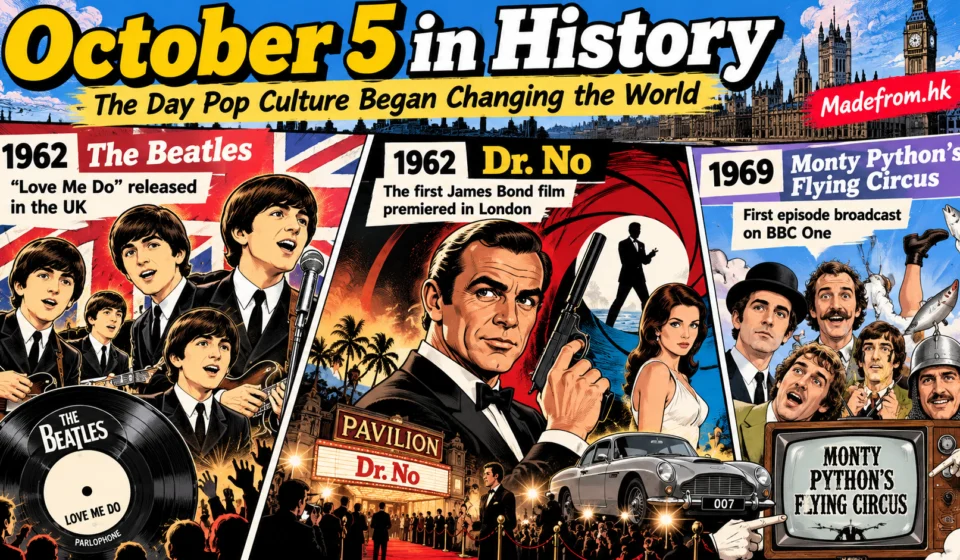
October 5 offers a remarkable snapshot of the moment when modern popular culture was beginning to take a new shape. On October 5, 1962, The Beatles released their first UK single, “Love Me Do,” while the first James Bond film, Dr. No, premiered at the London Pavilion. Seven years later, on October 5, 1969, another major British cultural phenomenon arrived when Monty Python’s Flying Circus was broadcast for the first time on BBC One. Three very different events, across music, cinema and television, can therefore be connected through one simple idea: new forms of entertainment were beginning to influence audiences on an unprecedented scale. The Beatles’ “Love Me Do” was released in Britain on October 5, 1962, backed by “P.S. I Love You.” The Beatles’ official website identifies the record as the group’s first UK single. At the time, there was no guarantee that the young Liverpool group would become one of the most influential musical acts in history. “Love Me Do” did not immediately become a huge chart success; its original UK release reached number seventeen. Yet its importance became much greater with hindsight. It was the beginning of a recording career that would soon transform British and international popular music. The Beatles would go on to develop an increasingly distinctive musical identity, write and record increasingly ambitious material, and become a global cultural phenomenon. Their influence extended beyond songs. Their hairstyles, clothing, interviews, personalities and public image became part of a wider cultural movement. Young people increasingly became an important force in the entertainment market, and the music industry learned that a successful band could influence far more than record sales. The release of “Love Me Do” therefore represents more than the arrival of a new single. It represents the beginning of a cultural story that would develop rapidly during the 1960s. On exactly the same day, another major cultural character appeared on the big screen. Dr. No, the first James Bond film, held its world premiere at the London Pavilion on October 5, 1962, with Sean Connery playing the role of James Bond. Bond had already existed as a literary character in Ian Fleming’s novels, but cinema transformed the character into an international entertainment phenomenon. The combination of sophisticated clothing, exotic locations, cars, gadgets, danger and adventure helped establish a recognizable formula that later Bond films would repeatedly develop. Dr. No was not simply the beginning of another movie; it became the foundation of one of the longest-running film franchises in popular culture. The importance of Bond can also be understood through the way modern entertainment works. A successful character can move beyond a single story and become a recognizable identity connected with films, music, fashion, vehicles, products and visual design. That approach would later become central to many modern entertainment franchises. The coincidence of The Beatles and James Bond appearing on the same date is particularly fascinating. One represented the rapidly changing world of popular music, while the other represented a new generation of international cinema. Both would become symbols of Britain around the world. Seven years later, October 5 produced another major British cultural milestone. Monty Python’s Flying Circus made its first broadcast on BBC One on October 5, 1969. BBC programme records confirm the first episode was transmitted that evening. The programme, created and performed by Graham Chapman, John Cleese, Terry Gilliam, Eric Idle, Terry Jones and Michael Palin, approached comedy in a way that frequently ignored traditional rules. Sketches could suddenly change direction, characters could break the normal structure of a scene, and the programme could even make fun of television itself. The result was a distinctive form of surreal and experimental comedy that would become highly influential. Looking back, the three October 5 milestones form an interesting cultural timeline. “Love Me Do” represents the emergence of a new pop-music generation. Dr. No represents the expansion of character-driven film franchises. Monty Python represents television comedy becoming more experimental and self-aware. Each began as a relatively simple creative project, yet each eventually became part of a much larger cultural legacy. October 5 also has an important connection with the growth of television itself. In 1947, U.S. President Harry Truman delivered the first televised address from the Oval Office, demonstrating how television was becoming an increasingly powerful way for public figures to communicate with large audiences. This development helps explain the wider cultural changes taking place during the middle of the twentieth century. Television entered ordinary homes, music could be promoted through radio and television, films could create international stars, and comedy programmes could reach millions of viewers simultaneously. Entertainment was becoming faster, more visual and more connected. The cultural transformation of the 1960s therefore did not happen because of one single invention. It emerged from several technologies and industries developing together. Record players, radio, television, cinema and printed media created an environment in which a song, actor, character or comedy routine could quickly become part of everyday conversation. This was very different from the world that exists today, but the underlying principle is surprisingly familiar. Modern creators can publish music, videos, comics and stories online and reach audiences around the world almost immediately. In 1962, however, a new song depended on a record label, physical records, radio stations, music shops and newspaper coverage. A film depended on cinemas and distribution networks. A television comedy programme depended on broadcasters and scheduled transmission. The technology was slower, but the cultural process was similar: an idea had to reach an audience, connect with people and then spread. That is why October 5 is such an interesting date for understanding popular culture. “Love Me Do” was not the end of The Beatles’ story; it was the beginning. Dr. No was not the final Bond adventure; it was the first film in a franchise that would continue for decades. Monty Python’s first broadcast was not the conclusion of their creative work; it was the beginning of a new style of television comedy. History often becomes clearer when we return to these beginnings. Once we know what happened later, we can look back at an apparently ordinary first step and recognize its significance. October 5 shows how a small cultural event can eventually become something much larger. A short pop song can become the starting point of a musical revolution. A fictional spy can become a global character. A television comedy experiment can influence generations of writers and performers. These developments remind us that popular culture is not simply entertainment. It is also a record of how society changes, how technology creates new possibilities, and how audiences decide which ideas will survive. October 5 therefore offers more than a list of historical events. It provides a snapshot of a world entering a new cultural age, one in which music, cinema and television would increasingly shape how people imagined themselves and the world around them.
October 5 captures a remarkable cultural shift, as The Beatles, James Bond and Monty Python each helped redefine music, cinema and television for generations to come.