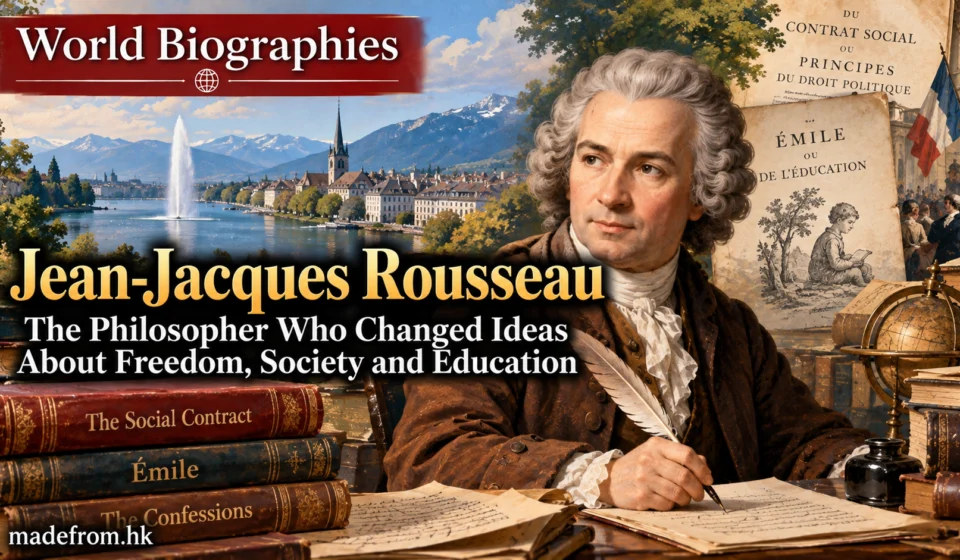
Jean-Jacques Rousseau: The Philosopher Who Changed Ideas About Freedom, Society and Education
Jean-Jacques Rousseau was an influential philosopher, writer, educator and composer of the Enlightenment. Born in Geneva in 1712, he explored freedom, inequality, education, society and human nature. His major works, including The Social Contract, Émile and The Confessions, influenced modern political philosophy, education, literature and social thought.
Jean-Jacques Rousseau was born in Geneva on June 28, 1712, into a middle-class family with voting rights in the city. His father, Isaac Rousseau, came from a family traditionally involved in watchmaking, while his mother, Suzanne Bernard Rousseau, came from a more socially prominent background. Rousseau’s mother died only nine days after his birth, an event he later described as his first misfortune. His childhood was shaped by family circumstances, religious traditions and an early exposure to literature and ideas. As a young man, Rousseau left Geneva and travelled to France, where he entered the household of Françoise-Louise de Warens. He became her protégé and later her lover, learned the manners of higher society, converted to Catholicism for a period and spent time in religious institutions before eventually returning to Protestantism. These experiences exposed him to different social environments and religious traditions. In 1742, Rousseau moved to Paris, hoping to develop a career connected with music. There he met Denis Diderot, Étienne Bonnot de Condillac and other important thinkers and scholars. His relationship with the intellectual circles surrounding the Encyclopédie became an important part of his early career. At Diderot’s invitation, Rousseau contributed articles on music to the Encyclopédie. His reputation changed dramatically after he entered the Academy of Dijon essay competition in 1749 with his Discourse on the Arts and Sciences. The work received recognition and brought him considerable attention in France. He later wrote the Discourse on the Origin and Basis of Inequality Among Men, which further established his reputation as an original and controversial thinker. Between 1756 and 1762, Rousseau lived in relative seclusion near Paris and produced some of his most important works, including The Social Contract and Émile. At the same time, his personal relationships and intellectual disagreements became increasingly complicated. Rousseau had initially been friendly with several figures of the French Enlightenment, including Diderot and Jean le Rond d’Alembert, but serious differences eventually developed between him and other Enlightenment writers. His disagreement with Voltaire over the establishment of a theatre in Geneva contributed to a lasting break between the two men. His relationship with the Encyclopédie circle also deteriorated, and the publication of Émile intensified opposition to Rousseau in France and elsewhere in Europe. These conflicts contributed to a period of flight and uncertainty. Rousseau eventually sought protection in Neuchâtel, then under Prussian influence, where he continued writing. During this period he produced the Constitutional Project for Corsica. His circumstances became even more difficult when his residence at Môtiers was attacked with stones in 1765. Rousseau then travelled to Britain with David Hume, hoping to find safety. He stayed in England for a time, although his relationship with Hume later deteriorated. Rousseau eventually returned to France under restrictions and lived under various circumstances while continuing to write. In 1768, he married Thérèse Levasseur, whom he had first met in Paris in 1745. They had five children, all of whom Rousseau arranged to be placed in an orphanage. During his later years, he continued writing and produced works that became important parts of his literary legacy. He completed Dialogues: Rousseau Judge of Jean-Jacques in 1776 and began Reveries of the Solitary Walker. He also copied music and studied botany. His life had moved through very different social positions: he experienced periods of recognition, worked in humble occupations, served in diplomatic settings and eventually lived quietly in the countryside. These experiences gave him an unusual perspective on the relationship between individuals and society. Rousseau’s philosophical ideas covered ethics, politics, education, literature and human nature. In his early writings, he questioned whether the development of knowledge and the arts necessarily improved human morality. He argued that social refinement could conceal selfishness and weaken genuine virtue. In Émile, he explored the relationship between human desires, happiness and education, arguing that education should respect human nature rather than simply impose social expectations. His educational philosophy distinguished between natural education, education through things and education through people, seeking harmony among them. These ideas contributed to the development of naturalistic approaches to education and influenced later thinkers. Rousseau’s political philosophy became especially influential through The Social Contract, published in 1762. He examined how individuals could form a legitimate society while maintaining freedom. His concept of popular sovereignty placed the people at the centre of political authority, while the idea of the general will became one of the most important concepts associated with his political thought. He also examined inequality and argued that many forms of social inequality developed through human institutions and historical processes. His writings became important reference points for later discussions of democracy, political legitimacy, social organisation and individual freedom. The Social Contract was not immediately successful, but it later became one of the most influential works in Western political thought. Rousseau was also an accomplished musician and composer. He wrote music, composed operas and developed ideas about musical notation. His opera The Village Soothsayer became one of his best-known musical works. His intellectual interests therefore extended well beyond philosophy, linking political thought, education, literature, music and the study of society. Rousseau’s literary work was equally significant. His novel Julie, or the New Heloise contributed to the development of pre-Romantic and Romantic literature, while The Confessions became an important landmark in the history of autobiography. His later Reveries of the Solitary Walker reflected an increasing emphasis on subjectivity, personal reflection and the individual’s relationship with the world. His writings about society, language and human development also influenced later sociology, anthropology and literary theory. Rousseau died on July 2, 1778, at Ermenonville, France, at the age of 66. Eleven years after his death, the French Revolution began, and Rousseau’s writings became increasingly important within revolutionary political culture. In 1794, sixteen years after his death, he was transferred to the Panthéon in Paris and commemorated as a national figure. His legacy continued to expand long after his death. His ideas influenced later philosophers, political thinkers, educators and writers, while his works continued to shape debates about freedom, equality, society, education and the individual. Rousseau’s life was marked by intellectual achievement, controversy, exile, personal conflict and constant movement between different social worlds. His work remains important because he did not examine society only as an abstract system; he repeatedly asked how social institutions affect the individual, how education shapes a person and how human beings can live together while preserving freedom.
Jean-Jacques Rousseau left a broad intellectual legacy across philosophy, politics, education, literature and music. His writings challenged established assumptions about society and human development, while The Social Contract, Émile and The Confessions became enduring works in modern intellectual history.