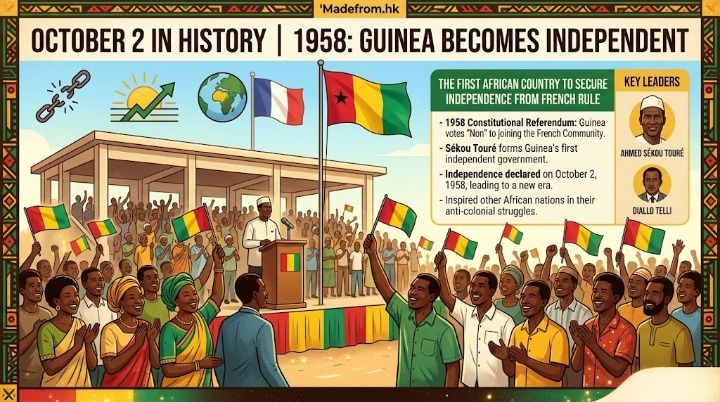
Today in History: October 2|958: Guinea Becomes Independent
On October 2, 1958, Guinea proclaimed independence, marking a significant turning point in the decolonization of French West Africa.
October 2, 1958, marked a defining moment in the modern history of Guinea. On that day, Guinea formally proclaimed itself an independent republic, ending its status within the French colonial system. The declaration followed a referendum held in September, when Guinean voters rejected the proposed French Community established under the new constitutional arrangements of the French Fifth Republic. According to historical records from the U.S. Department of State, the Republic of Guinea was formally established by proclamation of its National Assembly on October 2, 1958. To understand why this decision mattered, it is necessary to look at the political situation in France and French Africa in 1958. France was attempting to reshape its relationship with its overseas territories. Under the new constitutional framework introduced during Charles de Gaulle’s return to power, French territories were offered a new political arrangement known as the French Community. The system was intended to maintain links between France and its African territories while providing them with a greater degree of internal self-government. Guinea, however, chose a different path. In the September 1958 referendum, Guinean voters rejected membership in the French Community. The result placed Guinea in a position very different from that of most other French territories in Africa, which initially chose to remain within the new constitutional structure. Guinea’s independence on October 2 was therefore not an isolated event. It was the direct consequence of the political choice made in the referendum only weeks earlier. Guinea decided that it would not remain within the French Community and instead established itself as an independent state. This makes the date particularly important in the history of French West Africa. It is more precise to describe Guinea as the first French African territory to reject the French Community arrangement and move directly to independence, rather than simply calling it the first African country to become independent. Other African states had already achieved independence, including Ghana, which became independent from Britain in 1957. Guinea’s historical significance lies specifically in its decision to reject the political framework offered by France in 1958. Ahmed Sékou Touré became the leading figure of the new Guinean state. Independence immediately created a new set of challenges. A country could declare independence in a single day, but building an independent administration, economy, diplomatic service and political system would take much longer. Guinea also had to establish its position in an international environment dominated by the competing interests of former colonial powers and the emerging independent states of Africa. The relationship between Guinea and France became particularly complicated after independence. Historical U.S. diplomatic documents show that the French government was concerned about Guinea’s decision and was also watching how the other French African territories might react. France was aware that the treatment of Guinea could influence the choices of other territories considering whether to remain within the French Community or eventually seek full independence. Guinea quickly began seeking international recognition. On October 2, Sékou Touré sent messages requesting recognition of the new republic from foreign governments. The United States did not formally recognize Guinea until November 1, when President Dwight D. Eisenhower sent a letter recognizing the Republic of Guinea. This diplomatic process illustrates how independence was more than a symbolic declaration. A newly independent country needed to establish relations with other governments, gain international recognition and create its own place within the emerging international system. Guinea was entering independence at a time when the political map of Africa was changing rapidly. Across the continent, nationalist movements were demanding greater self-government, while European colonial powers were increasingly under pressure to reconsider their political relationships with African territories. A U.S. intelligence assessment from 1958 described West Africa as one of the fastest-changing regions in the world, with new independent countries emerging and nationalist demands accelerating. Guinea’s decision was therefore watched closely beyond its own borders. Other French African territories were interested in what independence would mean in practical terms, including the future of their political and economic relationships with France. The French government was also concerned that Guinea’s example could encourage other territories to reject the Community arrangement. In this wider context, October 2, 1958, became part of a much larger process of African decolonization. Ghana’s independence in 1957 had already demonstrated that a former European colony could become an independent African state. Guinea’s decision in 1958 showed that territories under French rule could also reject continued constitutional association with their former colonial power. The years that followed would bring a rapid wave of independence across Africa, particularly around 1960, when numerous African countries achieved independence. Guinea’s path was therefore an early and distinctive part of that transformation. The significance of October 2 is not simply that a new flag was raised or a new government was announced. Independence represented the beginning of a new responsibility. Guinea now had to make decisions for itself, develop its own institutions and determine its foreign relations without being formally governed by France. The historical record also shows that the transition was not necessarily easy. Diplomatic relations between Guinea and France were complicated, while Guinea sought recognition and support from other countries. For Guineans, October 2 remains Independence Day, a date associated with national sovereignty and the beginning of the country’s independent political history. Looking back from the present, the importance of October 2, 1958, can be understood as part of a larger transformation in the twentieth-century world. Colonial empires that had existed for generations were beginning to give way to independent states. Political authority was moving from European capitals to newly established governments in Africa and elsewhere. Guinea was one of the early examples of this transformation within the French colonial system. History rarely changes completely in a single day, but certain dates become clear dividing lines. October 2, 1958, was such a date for Guinea. Before that day, the territory remained part of the French colonial framework; afterwards, Guinea entered the international community as an independent republic. Its independence also demonstrated that the future of French West Africa would not necessarily follow one single political path. For that reason, October 2 deserves a place in the historical record not only as Guinea’s Independence Day, but also as a significant milestone in the wider story of African decolonization.
October 2, 1958, marked Guinea’s decisive break from the French Community and became an important milestone in the wider decolonization of French Africa.