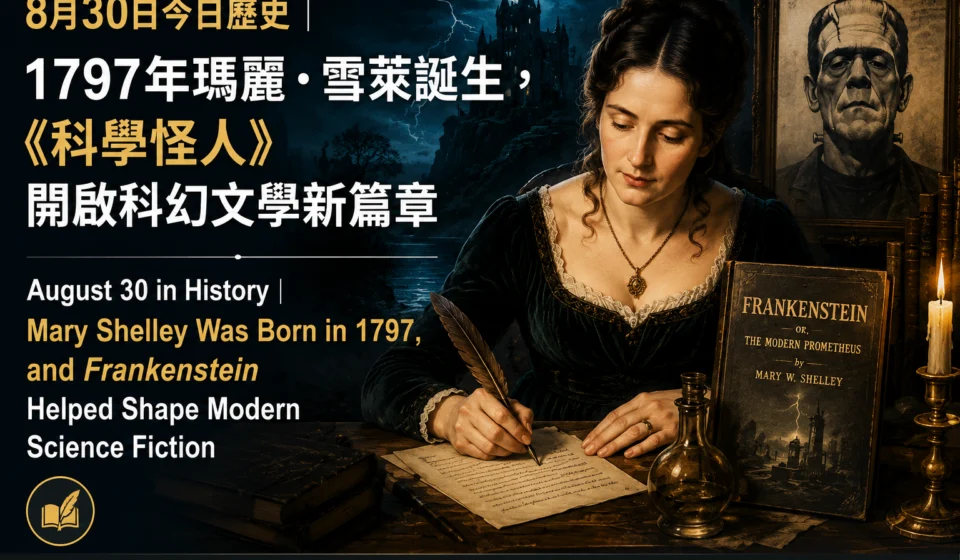
8月30日今日歷史|1797年瑪麗・雪萊誕生,《科學怪人》開啟科幻文學新篇章 | August 30 in History|Mary Shelley Was Born in 1797, and Frankenstein Helped Shape Modern Science Fiction
1797年8月30日,瑪麗・雪萊誕生。多年後,她以《科學怪人》探索科學、生命、孤獨與人性的界線,成為世界文學史上的重要作家。
On August 30, 1797, Mary Shelley was born. Years later, her novel Frankenstein would explore science, creation, loneliness and human responsibility, leaving a lasting mark on world literature.
中文版本
1797年8月30日,瑪麗・沃斯通克拉夫特・雪萊(Mary Wollstonecraft Shelley)出生於英國倫敦一個充滿思想與文學氣息的家庭。她的母親是著名女性主義思想家瑪麗・沃斯通克拉夫特,父親則是哲學家、政治思想家兼作家威廉・戈德溫,因此瑪麗從小便生活在一個重視閱讀、思想與自由討論的環境之中。雖然她的母親在她出生後不久便去世,但母親的思想以及父親收藏的大量書籍,仍然成為她日後成長的重要精神背景。瑪麗年輕時與詩人珀西・比希・雪萊(Percy Bysshe Shelley)相識,兩人後來共同生活,並前往歐洲旅行。1816年,她與珀西・雪萊、拜倫勳爵(Lord Byron)以及其他友人來到瑞士日內瓦附近,當時的歐洲正經歷一段陰冷而多雨的夏季。眾人經常留在室內閱讀、談論科學、哲學、自然與超自然現象,也互相提出創作故事的挑戰。就在這段特殊的環境下,年輕的瑪麗開始構思一個關於科學家與生命創造的故事。她後來逐步完成《Frankenstein; or, The Modern Prometheus》,中文通常譯作《科學怪人》或《弗蘭肯斯坦》,作品於1818年正式出版。故事主角維克多・弗蘭肯斯坦是一名年輕科學家,他對生命的奧秘充滿強烈好奇,最終利用自己的知識與實驗創造出一個具有生命的存在。然而,當創造物真正出現在他面前時,他卻因恐懼而拋棄了自己的創造。這個決定成為整個故事悲劇的起點。創造物原本渴望理解世界,也希望得到人類的接納,但由於外貌與一般人不同,他不斷遭到排斥、恐懼與孤立。於是,作品逐漸從一個看似恐怖的怪物故事,轉變成對人類責任、社會偏見、孤獨與道德界線的深刻思考。《科學怪人》最重要的地方之一,是它沒有單純把「怪物」描寫成天生邪惡的存在,而是讓讀者思考:一個被創造出來的生命,如果從未得到愛、教育與理解,最後走向悲劇,究竟應該由誰負責?維克多・弗蘭肯斯坦真正面對的問題,也不只是如何創造生命,而是創造生命之後應該承擔甚麼責任。這個問題在兩百多年後仍然具有現代意義。今天,人類討論人工智能、基因工程、生物科技以及其他快速發展的新技術時,同樣需要思考技術能力與道德責任之間的關係。《科學怪人》因此不只是一本十九世紀的哥德小說,它也經常被視為早期科幻文學的重要作品之一。英國圖書館指出,1818年出版的《Frankenstein》講述一名年輕科學家透過非傳統而前衛的科學方法創造生命,並已成為最具影響力的英語小說之一。 瑪麗・雪萊筆下的故事亦逐漸超越小說本身,成為電影、舞台劇、電視作品、漫畫及流行文化中反覆出現的經典題材。「Frankenstein」這個名字甚至在日常文化中經常被用來代表創造者以及失控的創造物。不過,原著真正關注的並不只是那個外表可怕的生物,而是創造者與被創造者之間複雜的關係。作品同時提出一個非常現代的問題:當人類擁有改變自然甚至創造生命的能力時,我們是否也準備好承擔相應的後果?這正是《科學怪人》歷久不衰的原因。瑪麗・雪萊在非常年輕的時候便創作出這部作品,而她後來的文學生涯亦並不只限於《科學怪人》。她還寫下《The Last Man》等小說以及大量其他作品,英國圖書館的館藏資料亦收錄她不同時期的小說、作品及手稿。 回望1797年8月30日這一天,我們看到的並不只是一位著名作家的出生,而是一個日後深刻影響世界文學與科幻想像的人物誕生。瑪麗・雪萊把當時人們對科學進步的期待、對未知世界的恐懼,以及對人類自身界線的疑問,融合成一個跨越時代的故事。她所創造的並不只是一個「怪物」,而是一面讓人類重新觀看自己的鏡子。兩百多年後,《科學怪人》仍然提醒我們,真正值得思考的問題從來不只是「人類能不能做到」,而是「當我們做到之後,應該怎樣負責」。這也讓瑪麗・雪萊在世界文學史上留下了極其獨特的位置。
English Version
Mary Wollstonecraft Shelley was born in London on August 30, 1797, into a family surrounded by literature, philosophy and radical ideas. Her mother, Mary Wollstonecraft, was a pioneering writer and thinker whose work argued strongly for women’s education and intellectual independence, while her father, William Godwin, was a philosopher, political thinker and author. Mary lost her mother shortly after birth, but she grew up surrounded by books and ideas that would later influence her development as a writer. Her early life was unconventional, and her relationship with the poet Percy Bysshe Shelley brought her into a wider literary and intellectual circle. In 1816, Mary and Percy travelled to the Lake Geneva region, where they spent time with Lord Byron and other friends. The summer was unusually cold and wet, keeping the group indoors for long periods. They read, talked about science and philosophy, discussed supernatural stories and challenged one another to create tales of their own. During this remarkable period, Mary began imagining a story about a young scientist who discovers how to create life. The idea eventually developed into Frankenstein; or, The Modern Prometheus, which was published in 1818. The novel follows Victor Frankenstein, a young scientist whose fascination with the mystery of life drives him to conduct an extraordinary experiment. He succeeds in creating a living being, but the moment he sees what he has made, he becomes frightened and abandons it. That decision sets the tragedy in motion. The creature is not presented simply as an embodiment of evil. Instead, Mary Shelley gives him a desire to understand the world, to learn, to communicate and to find companionship. His repeated rejection by human society gradually transforms his loneliness into anger and revenge. This makes Frankenstein far more complex than a conventional horror story. At its heart, the novel asks questions about responsibility, isolation, prejudice, scientific ambition and the consequences of creation. Victor’s greatest failure is not simply that he experiments with life. It is that he creates a living being without accepting responsibility for what happens afterwards. The creature is left without guidance, family or a place in society, and the consequences spread outward until both creator and creation are caught in a cycle of suffering. This idea has helped Frankenstein remain relevant far beyond the nineteenth century. Modern readers can see echoes of its central questions in debates surrounding artificial intelligence, genetic engineering, biotechnology and other rapidly developing technologies. The issue is not merely whether human beings possess the technical ability to create something new, but whether they are prepared to understand, control and take responsibility for what they create. The British Library describes Frankenstein as a Gothic horror story about a young scientist who creates a living creature through unconventional scientific methods, and notes that the novel has become one of the most influential works of English literature. Over time, Frankenstein has also become one of the most recognisable stories in global popular culture. Its characters and themes have appeared repeatedly in films, theatre, television, comics and countless adaptations. The name Frankenstein itself has become deeply embedded in everyday language, although popular culture often simplifies the original story by treating Frankenstein as the name of the creature. In Mary Shelley’s novel, however, Frankenstein is the name of the scientist, Victor Frankenstein, while the creature remains unnamed. That distinction matters because the novel is fundamentally concerned with the relationship between creator and creation. Mary Shelley asks readers to consider what happens when a person gains extraordinary power but fails to accept the responsibilities that come with it. The story also challenges the simple idea that appearance determines character. The creature becomes frightening partly because society refuses to see him as a person capable of thought, emotion and moral development. His tragedy therefore reflects both personal rejection and wider social prejudice. This makes the novel surprisingly modern. It can be read as a warning about scientific ambition, but it can also be understood as a meditation on loneliness and the human need for connection. Mary Shelley did not stop writing after Frankenstein. She produced other novels, including The Last Man, as well as essays, travel writing and other literary works. The British Library’s collections preserve manuscripts and records connected with her writing and show the breadth of her literary career. Yet Frankenstein remains the work that defines her place in literary history. Its influence can be seen in modern science fiction, Gothic literature and stories about technology that escapes human control. More importantly, its central question remains remarkably difficult to answer: if humans gain the power to create new forms of life or intelligence, what obligations should follow? On August 30, 1797, the birth of Mary Shelley marked the beginning of a life that would eventually produce one of literature’s most enduring imaginative works. Her achievement was not simply inventing a frightening creature. She created a story that forced readers to look beyond fear and consider the person behind the appearance, the creator behind the experiment and the responsibility behind every act of creation. More than two centuries later, Frankenstein continues to speak to a world increasingly shaped by science and technology. That enduring relevance is perhaps Mary Shelley’s greatest legacy. She showed that a story born from a dark and imaginative night could become a lasting conversation about science, humanity and the consequences of our own ambitions.
總評
中文版本
瑪麗・雪萊以《科學怪人》超越時代,將科學想像、生命倫理、孤獨與人性融入文學。她留下的不只是經典怪物,更是一個持續追問人類責任的故事。
English
Mary Shelley turned a Gothic tale into a timeless exploration of science, responsibility, loneliness and humanity. Frankenstein remains powerful because it asks not only what humans can create, but what they owe to their creations.