《香港百貨 007》香港吉利市百貨興衰史|80年代屋邨百貨傳奇與新加坡英保良集團發展 | Klasse Grand Hong Kong History|The Rise and Fall of an 80s Department Store Chain
香港1980年代是百貨公司高速發展的黃金年代,來自新加坡的吉利市百貨憑藉親民定位及屋邨策略迅速擴張,成為不少香港家庭的重要購物回憶。從沙田禾輋邨起步,到進駐銅鑼灣與太古城,吉利市曾見證香港零售業最繁盛的時光。
Klasse Grand arrived in Hong Kong during a transformative era when department stores were reshaping urban lifestyles across the city. Backed by Singapore’s Emporium Holdings, the chain expanded rapidly from public housing estates to major commercial districts, leaving behind a lasting memory for many families who experienced Hong Kong’s retail boom of the 1980s.
中文
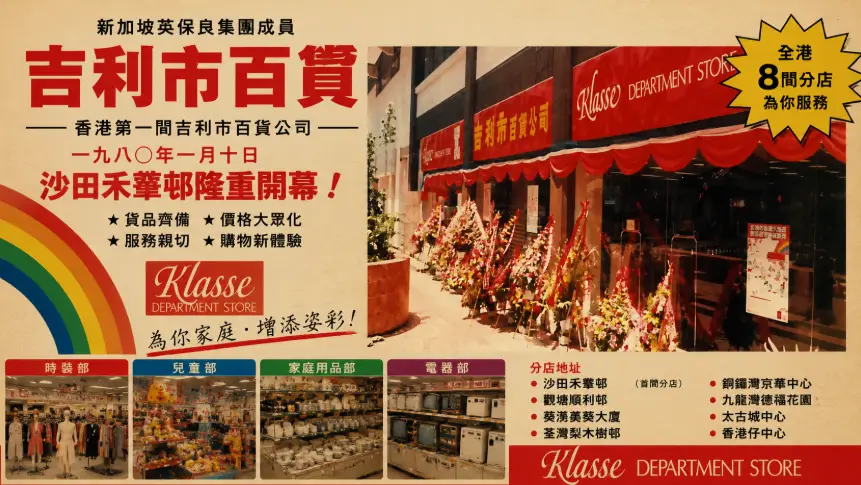
香港吉利市百貨(Klasse Grand)是1980年代香港零售市場中極具代表性的外資百貨品牌之一,由新加坡英保良集團(Emporium Holdings)創辦及經營。英保良集團由新加坡林氏家族掌控,主席為林道順,董事長為林道榮,集團於東南亞地區曾擁有超過60間百貨公司與超級市場,在新加坡、馬來西亞及汶萊均有龐大零售網絡。1970年代末期香港經濟迅速起飛,人口增加,加上大型公共屋邨與新市鎮發展成熟,吸引大量海外零售企業進軍香港市場,英保良集團亦於1979年正式成立「英保良集團(香港)有限公司」,為進軍香港鋪路。1980年1月10日,吉利市百貨首間香港分店於沙田禾輋邨正式開幕,成為品牌在香港的重要起點。禾輋邨當時屬新界大型公共屋邨之一,人口密集,加上居民消費需求上升,令吉利市迅速建立穩定客源。吉利市百貨主打「大眾化家庭百貨」路線,商品價格較傳統高級百貨便宜,目標客群主要為中產家庭及屋邨居民。店內售賣商品種類繁多,包括男女時裝、童裝、家庭用品、文具、玩具、電器、化妝品、廚具及食品等,幾乎涵蓋市民日常生活所需。相比日資百貨主打高級時尚與精品形象,吉利市則更重視實用性與家庭化消費模式,因此深受一般市民歡迎。隨著首店取得成功,吉利市開始快速擴張,其後陸續於觀塘順利邨、葵湧美葵大廈、荃灣梨木樹邨等公共屋邨開設分店,成為當時少數積極進駐屋邨市場的大型百貨公司之一。這種策略成功打入基層及中產家庭市場,亦改變了香港居民對屋邨商場的購物模式。除了公共屋邨外,吉利市亦積極進軍大型商場與商業區,其中最著名的是位於銅鑼灣京華中心的旗艦店。該店連同地庫共六層,總面積超過五萬平方呎,是當時吉利市規模最大的分店之一。旗艦店設計較一般屋邨分店豪華,並加入更多時尚及高級商品,希望吸引港島區消費者及遊客。此外,吉利市亦曾於九龍灣德福花園及太古城中心等大型私人屋苑商場設店,進一步提升品牌形象及市場覆蓋率。全盛時期的吉利市百貨在香港共擁有8間分店,成為1980年代香港百貨市場的重要品牌之一。當時不少家庭會在周末到吉利市購物,小朋友則對玩具部及文具部留下深刻印象,而節日期間的大減價與抽獎活動更是熱門話題。吉利市百貨除了售賣商品外,也反映了香港社會由傳統街市與小型店舖逐漸轉向現代化大型零售模式的轉變。然而,1980年代中期東南亞經濟環境轉差,新加坡母公司英保良集團受到嚴重衝擊,資金鏈開始出現問題。由於集團過度擴張,加上租金及營運成本高昂,吉利市香港業務逐漸陷入財政危機。其後陸續傳出拖欠供應商貨款、欠租及拖糧等問題,更引發多宗法律訴訟。隨著財政狀況惡化,吉利市最終於1986年6月宣佈全線結業,多間分店在短時間內停止營業,震驚香港零售界。部分原有舖位後來由其他大型百貨公司承租,例如香港仔中心分店便由日資伊勢丹百貨接手。1987年,英保良集團接受新加坡司法管理,而香港業務則被明輝發展收購,該公司後來易名為網智金控。至1992年,英保良香港公司正式解散,象徵吉利市百貨時代正式結束。雖然吉利市存在時間不算長,但它曾是1980年代香港屋邨與家庭式百貨文化的重要代表,也見證了香港零售市場由本地化走向國際化的發展歷程。對不少香港人而言,吉利市百貨不只是購物場所,更是一段屬於香港黃金年代的集體回憶。
English Version
Klasse Grand was one of the most memorable foreign department store chains to enter Hong Kong during the retail boom of the 1980s. The brand was established by Singapore-based Emporium Holdings, a major retail group owned by the Lim family and led by chairman Lim Tow Soon and managing director Lim Tow Yong. At its peak, the company operated more than sixty department stores and supermarkets across Singapore, Malaysia, and Brunei, making it one of Southeast Asia’s most recognizable retail empires. As Hong Kong’s economy accelerated in the late 1970s, overseas retailers saw enormous opportunities in the city’s expanding middle class and rapidly growing public housing estates. Emporium Holdings officially formed Emporium Holdings Hong Kong Limited in 1979, preparing for a large-scale expansion into the territory. The first Klasse Grand department store officially opened on January 10, 1980, at Wo Che Estate in Sha Tin. The location was carefully chosen because Sha Tin was one of Hong Kong’s fastest-growing new towns, filled with young families and residents eager for modern shopping experiences. Unlike luxury Japanese department stores that focused on premium fashion and imported goods, Klasse Grand positioned itself as an affordable family-oriented retailer. The stores offered a wide range of daily necessities including clothing, cosmetics, toys, household goods, kitchenware, stationery, electrical appliances, and groceries. This practical and accessible approach made the brand especially popular among working-class and middle-class families. Following the success of its first store, Klasse Grand expanded aggressively across Hong Kong. New branches appeared in public housing estates such as Shun Lee Estate in Kwun Tong, Mei Kwai House in Kwai Chung, and Lei Muk Shue Estate in Tsuen Wan. At the time, few large department stores were willing to target estate communities directly, but Klasse Grand recognized the enormous purchasing power of these densely populated neighborhoods. The strategy proved highly successful and helped transform estate shopping centers into lively retail hubs. Beyond public housing districts, Klasse Grand also moved into major commercial areas in an effort to strengthen its brand image. Its most famous flagship branch opened at Capitol Centre in Causeway Bay. Spanning six floors including the basement and covering more than 50,000 square feet, the store became one of the chain’s most ambitious retail projects in Hong Kong. Compared with estate branches, the Causeway Bay flagship featured a more stylish interior and a broader selection of fashionable merchandise aimed at urban professionals and tourists. Additional branches later opened in large private housing developments including Telford Gardens in Kowloon Bay and Cityplaza in Taikoo Shing. At its peak, Klasse Grand operated eight branches throughout Hong Kong and became a familiar name among local shoppers. Many families spent weekends browsing the stores, while children often remembered the toy and stationery departments as highlights of their visits. Seasonal sales campaigns, lucky draws, and festive promotions also attracted huge crowds during holidays. More than simply a retail chain, Klasse Grand reflected a major cultural shift in Hong Kong as consumers moved away from traditional street markets toward modern shopping malls and department stores. However, the company’s rapid expansion eventually became difficult to sustain. During the mid-1980s, Southeast Asia experienced a serious economic slowdown, placing heavy financial pressure on Emporium Holdings. Rising rental costs, operational expenses, and aggressive business expansion weakened the group’s finances. Reports soon emerged that Klasse Grand was struggling to pay suppliers, rent, and employee wages, leading to multiple legal disputes. As the financial crisis deepened, the entire Hong Kong operation collapsed in June 1986, forcing all branches to close within a short period. The sudden shutdown shocked both shoppers and the retail industry. Several former locations were later taken over by other department store operators, including Japanese retailer Isetan, which assumed control of the Aberdeen Centre branch. In 1987, Emporium Holdings entered judicial management in Singapore, while the Hong Kong business was later acquired by Ming Fai Development, a company eventually renamed Netwise Holdings. By 1992, the Hong Kong subsidiary was officially dissolved, bringing the Klasse Grand story to an end. Although the brand existed for only a relatively short time, it left behind a strong legacy in Hong Kong’s retail history. For many residents, Klasse Grand represented more than a department store — it symbolized the optimism, modernization, and family-centered consumer culture of Hong Kong during its golden age of economic growth.
總結
吉利市百貨雖然只在香港經營短短數年,但其屋邨百貨模式與親民定位,成功成為1980年代香港家庭的重要生活回憶,也見證了香港零售業由傳統走向現代化的轉變。
Though its time in Hong Kong was brief, Klasse Grand became an unforgettable part of the city’s retail landscape. Its family-focused approach and expansion into housing estates captured the spirit of Hong Kong’s rapidly modernizing consumer culture during the 1980s.