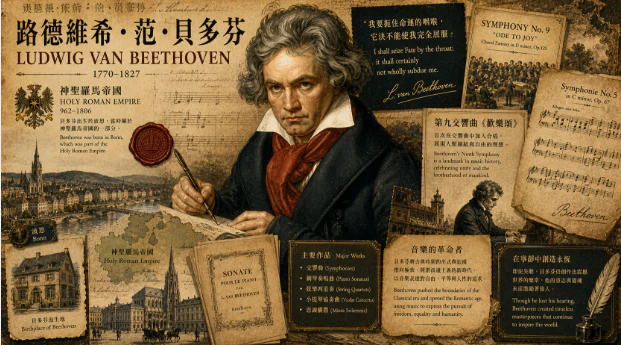
在神聖羅馬帝國的文化背景下,路德維希·范·貝多芬以突破性的創作改變音樂史,開啟古典走向浪漫的新時代。
Within the cultural world of the Holy Roman Empire, Ludwig van Beethoven transformed music history through groundbreaking compositions, bridging the Classical and Romantic eras.
中文
在西方音樂史上,路德維希·范·貝多芬被視為最具影響力的作曲家之一,他出生於波恩,當時屬於神聖羅馬帝國的範圍,成長於音樂氛圍濃厚的家庭,父親希望他成為下一個神童,從小便對他進行嚴格訓練。貝多芬早年受到約瑟夫·海頓與沃爾夫岡·阿馬德烏斯·莫札特所代表的古典音樂傳統影響,但他並未停留於既有框架,而是逐漸發展出強烈個人風格。他的音樂充滿戲劇性與情感張力,打破了古典時期對形式與比例的嚴格限制,將音樂轉化為表達內心世界的藝術。在維也納發展期間,他創作了大量交響曲、鋼琴奏鳴曲與弦樂作品,其中《第三交響曲「英雄」》象徵著他創作風格的重大轉變,將音樂從宮廷娛樂提升為具有哲學與人文意義的藝術形式。然而,貝多芬的人生並非一帆風順,他在三十歲左右開始出現聽力衰退,最終幾近失聰,這對一位音樂家而言幾乎是致命打擊,但他並未因此停止創作,反而在孤獨與痛苦中完成了一系列震撼人心的作品,包括《第五交響曲》與《第九交響曲》,後者更首次在交響曲中加入合唱,將音樂推向全新境界。他的作品展現了人類對命運的抗爭與對自由的追求,深刻反映了當時歐洲社會的思想變革。貝多芬不僅是作曲家,更是藝術自主精神的象徵,他拒絕完全依附貴族贊助,逐步建立音樂家作為獨立創作者的地位,這對後來的藝術發展具有深遠影響。他的音樂跨越時代,至今仍被廣泛演奏與研究,成為人類文化遺產中不可或缺的一部分,象徵著創造力、堅持與人性光輝的極致表現。
English Version
In the history of Western music, Ludwig van Beethoven stands as a transformative figure whose work redefined artistic expression. Born in Bonn within the Holy Roman Empire, Beethoven grew up in a musically inclined environment where his father rigorously trained him in hopes of cultivating prodigious talent. His early development was shaped by the Classical traditions represented by Joseph Haydn and Wolfgang Amadeus Mozart, yet Beethoven soon moved beyond these influences to forge a bold and deeply personal musical language. His compositions introduced unprecedented emotional depth and structural innovation, expanding the boundaries of classical forms and transforming music into a medium of profound human expression. After moving to Vienna, he established himself as a leading composer and pianist, producing works that would redefine the possibilities of symphonic and chamber music. His Symphony No. 3, known as the “Eroica,” marked a decisive turning point, elevating music from refined entertainment to a vehicle for philosophical and emotional exploration. Beethoven’s life, however, was marked by immense personal struggle, particularly his gradual loss of hearing, which began in early adulthood and eventually led to near-total deafness. Rather than ending his career, this adversity seemed to deepen his artistic vision, resulting in some of his most powerful compositions, including the iconic Fifth Symphony and the groundbreaking Ninth Symphony, which introduced choral elements into the symphonic form. His music reflects a profound engagement with themes of fate, struggle, and triumph, mirroring the intellectual and social transformations of Europe during his lifetime. Beethoven also played a crucial role in redefining the status of the artist, asserting creative independence rather than relying entirely on aristocratic patronage, thus paving the way for the modern concept of the autonomous artist. His legacy endures not only through his compositions but also through the enduring ideals of artistic freedom and human resilience that his work embodies, securing his place as one of the most influential composers in history.