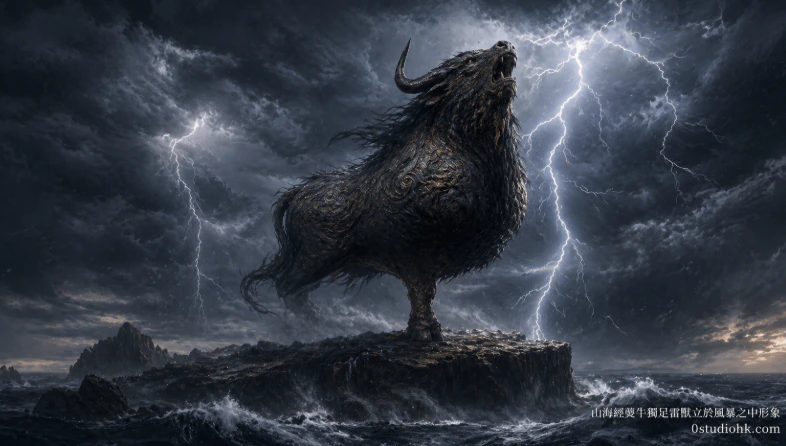
在《山海經》的神話世界中,夔牛是一種充滿震撼力量的神獸,牠以獨足之姿立於天地之間,聲如雷鳴。這種奇異生物不僅象徵自然之威,也反映古人對雷電與天象的敬畏與想像。
In the mythic realm of the Shan Hai Jing, Kui Niu stands as a creature of awe and power, a one-legged beast whose roar echoes like thunder across the heavens. It embodies the force of nature and reflects ancient humanity’s reverence for storms and celestial phenomena.
中文
天地初開之時,風雷尚未分明,雲海翻湧於群山之巔,萬物在混沌之中孕育。一聲巨響撕裂長空,如萬鼓齊鳴,震動四野,山石崩裂,江河翻騰。那聲音來自一座孤立於東海之外的荒島,島上無草無木,唯有一頭巨獸靜立於岩石之上。牠便是夔牛。夔牛形似牛,卻僅有一足,身軀龐大如山,皮色蒼黑如暴雨前的天幕。牠的雙目如火,在黑暗中閃爍,仿佛蘊藏雷霆之力。每當牠踏地而立,整座島嶼便隨之震動,而當牠發出吼聲,天地間的雷電便隨之應和。古人傳言,夔牛的聲音可傳千里,其鳴如雷,震懾萬物,甚至能驅散妖邪,亦能引來災厄。某年,海上風暴異常頻繁,漁民不敢出海,天空終日陰沉。有人說,是夔牛甦醒了。於是,一隊勇士奉命前往尋找這頭傳說中的雷獸,希望能平息天怒。他們乘船越過洶湧海浪,終於抵達那座無人之島。當他們踏上岸時,天地寂靜得異常,彷彿一切聲音都被吞噬。忽然,大地微微震動,一道低沉的聲音從遠處傳來,如遠雷滾動。勇士們循聲而行,最終在高崖之上看見了夔牛。牠正立於風中,獨足支撐著龐大的身軀,仰首望天。那一刻,天空烏雲翻滾,雷光閃現。夔牛發出一聲怒吼,雷電隨之劈落,照亮整片海域。勇士們心生畏懼,卻仍試圖接近。然而當他們踏出一步,夔牛的目光轉向他們,那眼神中既有野性,也有一種難以言喻的孤寂。傳說夔牛本為天界之獸,因觸犯天規而被放逐於此,從此孤守荒島,以雷聲為語。牠的吼聲不只是力量的象徵,更是一種無法回歸的哀鳴。勇士們終於明白,他們面對的並非單純的猛獸,而是一種承載天意與懲罰的存在。他們放下武器,跪地祈求風暴平息。奇異的是,夔牛並未攻擊,反而緩緩轉身,再次仰天長鳴。雷聲過後,風暴漸息,雲層散開,陽光重新照耀海面。勇士們平安歸來,將所見所聞傳遍大地。從此,人們不再將夔牛視為災厄,而是視為天威的象徵,是天地之間力量的化身。每當雷聲響起,人們便想起那座孤島上的獨足巨獸,想起那聲既震撼又孤獨的吼聲,提醒世人敬畏自然,亦記住力量與孤獨往往相伴而生。
English Version
In an age when the world was still shaping itself, storms roamed freely across the skies, and thunder had yet to be understood. Beyond the eastern seas lay a barren island, untouched by life, where silence ruled—until it was broken by a sound that shook the heavens. It was not merely thunder, but something deeper, something alive. Upon that island stood Kui Niu, a colossal creature unlike any other. Its form resembled a bull, yet it stood on a single leg, its immense body balanced with unnatural stillness. Its hide was dark as storm clouds, and its eyes burned like distant lightning. When it moved, the ground trembled. When it roared, the sky answered. Sailors spoke of it in fearful whispers, claiming its voice could travel across oceans, calling storms into existence or driving them away. During one relentless season of tempests, when waves devoured ships and the horizon vanished beneath endless clouds, people believed the beast had awakened once more. A group of warriors set out to confront it, hoping to restore calm to the seas. Their journey was perilous, but they reached the island at last. What greeted them was not chaos, but an eerie stillness, as though the world itself held its breath. Then came the vibration beneath their feet—a warning. They climbed toward the cliffs and found the creature standing against the wind, gazing into the storm-filled sky. In that moment, lightning split the clouds, and Kui Niu released a roar that seemed to command the heavens. Thunder crashed in response, illuminating the vast ocean below. The warriors felt fear, but also something else—a strange understanding. When the creature turned its gaze upon them, they saw not only power, but solitude. Legends spoke of Kui Niu as a being once tied to the heavens, cast down for reasons long forgotten. Now it remained alone, its voice echoing endlessly across sea and sky. Its thunder was not merely a display of strength, but an expression of something deeper—perhaps longing, perhaps sorrow. The warriors lowered their weapons, realizing they were not facing a beast to be slain, but a force to be respected. They knelt, offering silence instead of challenge. The creature did not attack. Instead, it turned once more toward the sky and roared again. This time, the storm began to fade. The winds softened, the clouds parted, and sunlight returned to the sea. When the warriors came home, their story changed how people saw the thunder. No longer was it simply a sign of fear, but a reminder of the balance between power and isolation. And whenever storms gather and thunder rolls across the sky, it is said that Kui Niu still stands upon that distant island, its solitary cry echoing through the heavens, reminding the world of forces beyond human control.