
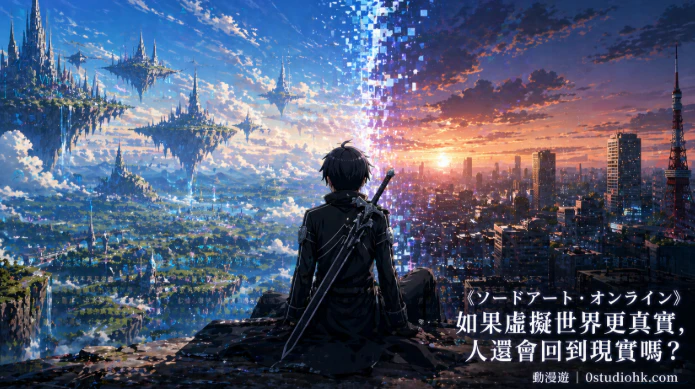
虛擬比現實更真實?《ソードアート・オンライン》的存在困境與人性選擇 Virtual More Real Than Reality? Existential Choice and Human Nature in Sword Art Online
當科技能夠打造一個比現實更真實的世界,人類對「回去」的渴望是否仍然存在?在《ソードアート・オンライン》中,虛擬不再只是娛樂,而是一個能承載情感、關係與生命意義的空間,這讓現實的價值開始動搖。
When technology can construct a world that feels more vivid and meaningful than reality itself, the question is no longer about escape, but about belonging. In Sword Art Online, the virtual realm evolves into a place where emotions, identity, and purpose thrive, challenging the very necessity of returning to the physical world.
在《ソードアート・オンライン》的設定中,虛擬世界不只是遊戲,而是一個具備觸感、情感與社會關係的完整空間,玩家在其中建立友情、愛情,甚至找到人生意義,當這些體驗的真實感超越現實,人開始產生一種心理轉移,現實不再是唯一的「真實」,反而變成一個較為貧乏、受限與痛苦的對照世界,這種反差正是作品最核心的哲學問題之一,當虛擬世界能夠提供更自由的身份、更公平的機會與更純粹的情感,人是否還有理由回到一個充滿限制的現實,從心理學角度來看,人對「真實」的定義並不完全來自物理,而是來自感受與記憶,只要情感是真實的,經驗就會被大腦認定為真實,因此在SAO的世界中,角色對虛擬世界的依附並非逃避,而是一種重新選擇存在方式的過程,然而問題並不止於此,虛擬世界雖然提供理想化的環境,但它同時也是被設計與控制的空間,規則由系統決定,自由其實是一種被框架限制的自由,這意味著人類在虛擬中獲得的幸福,可能建立在一種看不見的操控之上,而現實雖然殘酷,卻擁有不可預測與不可替代的價值,正因為不完美,才讓選擇與成長變得真實,回到現實,並不是因為現實比較好,而是因為那裡承載著不可複製的因果關係與存在重量,SAO中的角色最終仍然選擇回歸現實,並不是否定虛擬世界,而是承認兩者的不同功能,虛擬可以擴展人生,但不能完全取代人生,真正的問題並非「會不會回去」,而是「人會如何重新定義現實」,當虛擬變得越來越真實,現實也必須重新證明自己的價值,而未來的世界,或許不再是二選一,而是一種交錯與融合,人同時存在於兩個世界,並在其中不斷調整自己的身份與意義
English Version
In Sword Art Online, the virtual environment is not merely a game but a fully realized domain where sensory immersion, emotional depth, and social structures coexist, allowing players to form relationships, pursue meaning, and reconstruct their identities in ways often constrained in reality, as these experiences grow increasingly authentic, the psychological boundary between virtual and real begins to dissolve, leading individuals to question whether reality still holds a unique claim to truth, when a digital world offers greater freedom, fairness, and emotional clarity, reality may appear restrictive, flawed, and even unnecessary, yet the definition of what is “real” is not purely physical but deeply rooted in perception, memory, and emotional resonance, meaning that if an experience feels genuine, it becomes genuine to the mind, however, the virtual world carries an inherent paradox, while it offers liberation, it is ultimately governed by systems, algorithms, and designed limitations, creating an illusion of freedom within invisible constraints, this raises a critical tension, as fulfillment in such a space may depend on structures beyond human control, in contrast, reality, despite its imperfections, possesses unpredictability and consequence, elements that give weight to choices and authenticity to growth, the decision to return to reality in SAO is not a rejection of the virtual but a recognition of its limits, virtual worlds can enhance life, expand identity, and offer new forms of connection, but they cannot fully replace the complexity and causality of existence in the physical world, the deeper question is not whether people will return, but how they will redefine what reality means in an era where virtual experiences rival or surpass it, as technology advances, the future may not force a choice between worlds, but instead create a layered existence where individuals navigate both, continuously reshaping their sense of self, purpose, and belonging