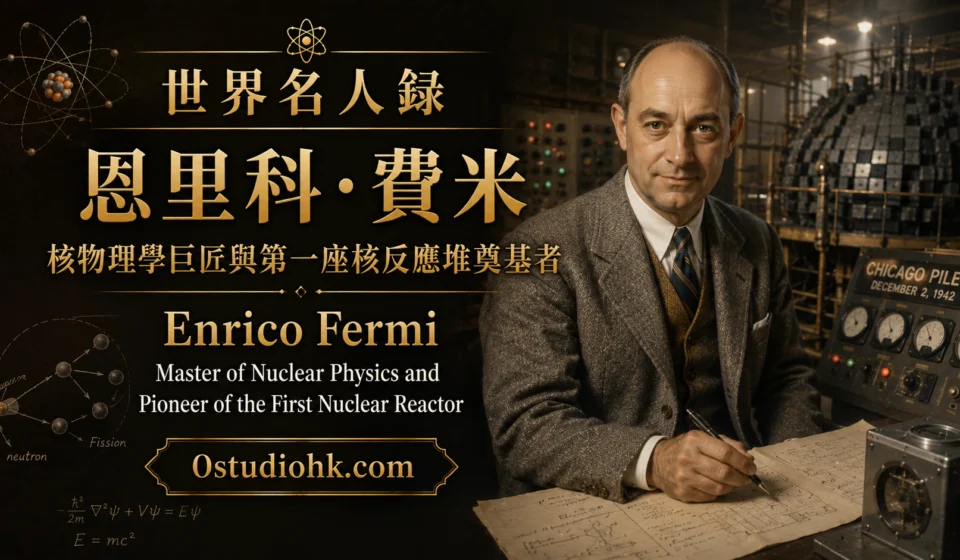
恩里科·費米|核物理學巨匠與第一座核反應堆奠基者 Enrico Fermi | Master of Nuclear Physics and Pioneer of the First Nuclear Reactor

恩里科·費米是20世紀最重要的物理學家之一。他在量子物理、核物理及中子研究方面作出重大突破,並領導建造世界上第一座可持續運作的核反應堆,對現代核能與粒子物理學產生深遠影響。
Enrico Fermi was one of the greatest physicists of the twentieth century. His work in quantum physics, nuclear physics, and neutron research transformed modern science, while his leadership in constructing the first self-sustaining nuclear reactor opened a new era in nuclear energy.
中文版本
恩里科·費米(Enrico Fermi)於1901年9月29日出生於意大利羅馬,是20世紀最傑出的理論物理學家與實驗物理學家之一。他自幼便對數學及科學表現出非凡興趣,年輕時已展現出驚人的計算能力與物理直覺。費米在比薩高等師範學校接受教育,1922年取得物理學博士學位。完成學業後,他先後在意大利多所大學任教及研究,逐漸成為歐洲新一代物理學家的重要人物。1926年,費米提出著名的「費米-狄拉克統計」,用來描述一類遵循量子力學規律的粒子,這套理論後來成為研究電子、質子、中子等粒子的重要基礎。1928年,他與勞拉·卡蓬結婚,兩人後來育有一子一女。1930年代,費米開始將研究重點轉向原子核物理。他尤其關注中子,並發現慢中子在某些核反應中具有特殊的重要性。1934年,他與研究團隊展開一系列以中子轟擊元素的實驗,研究人工放射性及核反應。這些研究令他成為當時核物理學最重要的科學家之一。1938年,費米因「發現由中子照射產生的新放射性元素,以及與慢中子引起的核反應有關的發現」獲得諾貝爾物理學獎。然而,同一年,意大利法西斯政府通過種族法令,而費米的妻子勞拉具有猶太血統。費米一家在前往斯德哥爾摩領取諾貝爾獎後,沒有返回意大利,而是直接前往美國。這個決定不僅改變了費米一家的人生,也令美國獲得了一位世界級核物理學家。抵達美國後,費米先後在哥倫比亞大學及芝加哥大學工作。第二次世界大戰期間,科學家開始研究如何利用核裂變產生巨大能量。1942年12月2日,在芝加哥大學的斯塔格球場下方,費米領導團隊成功啟動「芝加哥一號堆」(Chicago Pile-1),實現人類歷史上第一次受控、持續的核鏈式反應。這座裝置並不是今天人們熟悉的大型核電站,而是一個由石墨磚及鈾等材料組成的實驗性核反應堆,但它證明了核裂變鏈式反應可以受到控制。這項突破成為現代核反應堆技術的重要起點。費米其後參與美國的曼哈頓計劃,與其他科學家合作研究核裂變及原子武器相關技術。他在核物理領域的經驗,對計算中子反應及理解鏈式反應具有重要作用。1945年,世界第一枚原子彈試爆成功。戰後,費米繼續在芝加哥大學進行研究,並重新將大量精力投入基礎物理學。他對粒子物理學同樣作出重要貢獻,包括對β衰變及弱相互作用的研究。早在1934年,他提出「費米理論」描述β衰變,成為研究弱核力的重要基礎。費米的特色在於他並不嚴格區分理論與實驗。他既能利用數學建立理論模型,又能親自設計實驗、分析數據,因此被視為少數真正兼具理論與實驗能力的物理學家。他亦是一位非常出色的教師,培養了不少後來成為著名物理學家的學生。1954年11月28日,費米因胃癌在芝加哥逝世,享年53歲。雖然生命相對短暫,但他的研究橫跨量子力學、核物理、粒子物理及核能等多個領域,影響極其深遠。後來,元素100被命名為「鐨」(Fermium),以紀念這位科學家;世界各地亦有以費米命名的研究中心、實驗室及物理學獎項。恩里科·費米的一生,代表了20世紀物理學一次巨大的轉變:人類不再只是觀察自然界,而開始能夠深入原子核,控制核反應,並利用基本粒子的規律探索宇宙。與此同時,他的故事亦提醒後人,科學突破可以帶來巨大的能源與技術進步,同時也伴隨著戰爭及核武器等嚴肅的倫理問題。費米留下的,不只是核反應堆或一套物理理論,而是一整套影響現代科學發展的思想與方法。
English Version
Enrico Fermi was born in Rome, Italy, on September 29, 1901, and became one of the most influential physicists of the twentieth century. From an early age, he demonstrated extraordinary mathematical ability and a deep fascination with science. He studied at the Scuola Normale Superiore in Pisa and earned his doctorate in physics in 1922. During the following years, he established himself as one of Europe’s leading young physicists. In 1926, Fermi developed what became known as Fermi-Dirac statistics, a fundamental framework describing particles that obey the exclusion principle of quantum mechanics. The theory became essential to understanding the behavior of electrons and many other particles. Fermi later turned increasingly toward nuclear physics, where he became particularly interested in neutrons and nuclear reactions. In 1934, he and his research group conducted pioneering experiments in which elements were bombarded with neutrons. These experiments produced artificial radioactivity and revealed important features of nuclear reactions. Fermi also discovered that slow neutrons could be especially effective in producing certain nuclear reactions, an insight that would later become extremely important in nuclear reactors. In 1938, he received the Nobel Prize in Physics for his discoveries concerning new radioactive elements produced by neutron irradiation and nuclear reactions caused by slow neutrons. The same year, however, Italy’s Fascist government introduced racial laws that affected Fermi’s Jewish wife, Laura. After traveling to Stockholm to receive his Nobel Prize, the family chose not to return to Italy. Instead, they emigrated to the United States, where Fermi would play a central role in the development of American nuclear physics. He worked at Columbia University before moving to the University of Chicago. During the Second World War, scientists began exploring the enormous energy released by nuclear fission. Fermi became one of the leading figures in this research. On December 2, 1942, beneath the stands of Stagg Field at the University of Chicago, Fermi and his team successfully achieved the world’s first controlled, self-sustaining nuclear chain reaction. The device, known as Chicago Pile-1, was an experimental reactor constructed largely from graphite and uranium. It was not a commercial power plant, but its successful operation demonstrated that a nuclear chain reaction could be controlled. This achievement became one of the foundations of modern nuclear reactor technology. Fermi subsequently joined the Manhattan Project, contributing his expertise in nuclear reactions and neutron behavior to the wartime effort to develop atomic weapons. His work helped scientists understand how a chain reaction could be maintained and controlled. After the war, Fermi returned his attention to fundamental physics and continued research at the University of Chicago. His contributions extended far beyond nuclear reactors. In 1934, he had developed a theory of beta decay that became an important foundation for understanding the weak interaction, one of the fundamental forces of nature. He also contributed to particle physics and cosmic-ray research. One of Fermi’s greatest strengths was his unusual ability to combine theory with experiment. He could develop mathematical models while also designing experiments and interpreting their results. This combination made him exceptionally effective at solving difficult physical problems. He was also an influential teacher whose students included several future leaders of modern physics. Fermi died of stomach cancer in Chicago on November 28, 1954, at only fifty-three years of age. Despite his relatively short life, his achievements transformed several major branches of physics. The chemical element fermium was later named in his honor, as were numerous laboratories, research institutions, and scientific awards. Fermi’s legacy represents a major turning point in human understanding of nature. Scientists had moved beyond simply observing matter and had begun to investigate, manipulate, and control processes occurring inside the atomic nucleus. His work helped create the scientific foundations of nuclear energy and modern particle physics, while also contributing to the development of nuclear weapons during wartime. That dual legacy makes Fermi an especially important figure in the history of modern science. His achievements demonstrate the extraordinary power of scientific knowledge, while also reminding later generations that discoveries involving enormous energy can carry equally enormous responsibilities.
總評
恩里科·費米將理論與實驗完美結合,在核物理、量子力學及粒子物理學留下重要成果。1942年首次實現受控核鏈式反應,更成為核能時代的重要起點。
Summary
Enrico Fermi combined theoretical insight with experimental skill to transform modern physics. His work on nuclear reactions and the first controlled nuclear chain reaction helped usher humanity into the nuclear age.