
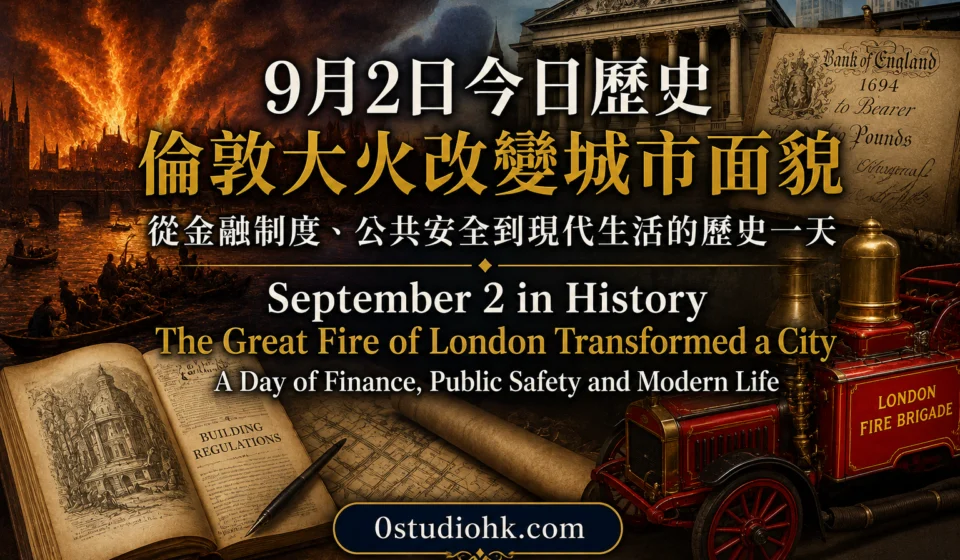
9月2日今日歷史|倫敦大火改變城市面貌|從金融制度、公共安全到現代生活的歷史一天|September 2 in History|The Great Fire of London Transformed a City|A Day of Finance, Public Safety and Modern Life

9月2日見證倫敦大火、金融制度建立與公共生活轉變,歷史也在災難後重新塑造城市。
English:September 2 connects a devastating London fire with financial institutions, civic change and ideas that helped shape modern society.
中文版本
9月2日是一個充滿轉折意義的歷史日子,其中最令人難忘的事件之一,是1666年爆發的倫敦大火。當年的倫敦經歷過長時間炎熱乾燥的夏季,城市內大量房屋以木材建造,而且街道狹窄、房屋密集,許多倉庫又存放容易燃燒的貨物,城市本身就像一個巨大的火種庫。1666年9月2日凌晨,位於Pudding Lane的麵包店發生火災,火勢在強勁東風推動下迅速蔓延。當時倫敦並沒有現代消防隊,市民主要依靠水桶、簡單的水泵及拆除房屋等方法阻止火勢。火災很快從一條街蔓延到另一條街,燃燒範圍不斷擴大。英國國家檔案館保存的當時《London Gazette》記錄顯示,9月2日凌晨約兩時,倫敦已經發生一場猛烈的大火,並有大量房屋被燒毀。 火災持續數日,最終大部分倫敦城受到嚴重破壞,超過13,000座房屋被摧毀,大量教堂及重要建築化為灰燼,約10萬人失去家園。倫敦消防隊的歷史資料指出,大火摧毀了13,200座房屋、87座教區教堂,以及皇家交易所、Guildhall和原來的聖保羅大教堂。 當時身處倫敦的塞繆爾・佩皮斯(Samuel Pepys)在日記中留下了大量第一手記錄,讓後世可以透過一個普通市民的視角了解災難如何一步步逼近城市。有人急忙把財物搬走,有人把珍貴物品埋藏起來,也有人乘船離開。火災最終在風勢減弱及人們採取拆屋、建立防火隔離帶等措施後逐漸受到控制。 倫敦大火雖然是一場巨大災難,卻也成為城市發展的重要轉捩點。災後,人們開始重新思考城市建築、街道規劃、消防安全以及建築材料的重要性。後來由克里斯多佛・雷恩(Christopher Wren)設計的新聖保羅大教堂,便成為倫敦重建後最具代表性的建築之一。倫敦博物館指出,大火摧毀了當時城市大約80%的核心區域,而重建過程也深刻改變了倫敦的城市景觀。 9月2日另一個重要歷史里程碑發生於1789年。美國國會正式成立財政部(Department of the Treasury),負責管理聯邦政府的財政事務。亞歷山大・漢密爾頓(Alexander Hamilton)後來成為第一任財政部長,建立早期美國政府的金融管理架構。美國財政部的官方歷史資料記載,1789年9月2日國會通過法案,正式建立財政部這個永久政府機構,負責國家財政管理。 這件事情看似與倫敦大火完全不同,但兩者其實都反映了人類社會面對大型問題時,如何建立更有系統的制度。災難會暴露城市管理的不足,而國家財政則需要透過制度、規則及專業人員來維持運作。到了1901年9月2日,美國副總統西奧多・羅斯福(Theodore Roosevelt)在明尼蘇達州博覽會發表演說,其中使用了後來非常著名的「Speak softly and carry a big stick」一句話,成為他政治思想最廣為人知的表達之一。羅斯福的演說原稿至今仍由相關歷史收藏保存。 不過,9月2日的歷史並不只有政治與災難。1912年,Arthur Rose Eldred獲得美國童軍組織第一個Eagle Scout最高級別稱號,成為童軍發展史上的一個重要人物。童軍運動所強調的責任、自律、服務與戶外技能,後來影響了不同世代的年輕人。 9月2日亦與文化及現代娛樂產業有關。1902年,法國導演喬治・梅里愛(Georges Méliès)的《月球旅行記》上映,常被視為早期科幻電影的重要作品之一。雖然電影技術仍處於非常早期的階段,但梅里愛已經開始利用布景、剪接及特殊效果創造出現實世界不存在的幻想場景,為後來的電影特效與科幻電影發展留下重要影響。另一方面,9月2日也是不少藝術家、作家、運動員及電影工作者的出生日期,例如英國足球名帥比爾・香克利(Bill Shankly)、網球名將吉米・康諾斯(Jimmy Connors)、演員基努・李維斯(Keanu Reeves)及莎瑪・海耶克(Salma Hayek)等,都在這一天出生。 從1666年的倫敦大火,到1789年的財政制度建立,再到20世紀的公共文化與娛樂發展,9月2日呈現出一個很有意思的歷史脈絡:城市可能因一場災難而改變,國家可以透過制度建立更穩定的運作方式,而科技與文化則會不斷創造新的生活形態。歷史並不是單純記錄過去發生過甚麼,而是讓我們理解今天熟悉的城市、制度、安全規範和文化娛樂,是如何一步一步形成。倫敦大火提醒人們重視城市安全,財政部的成立反映現代政府對制度管理的需要,而早期電影則展示了人類如何利用新科技創造想像世界。回望9月2日,我們看到的不只是某一場災難,而是一個社會如何從問題中學習,再把經驗轉化成新的制度、建築與生活方式。這也正是歷史最值得我們記住的地方。
English Version
September 2 brings together a remarkable collection of stories about disaster, rebuilding, government, culture and the gradual development of modern society. The most dramatic event associated with this date is the Great Fire of London, which began in the early hours of September 2, 1666. London was already a crowded and vulnerable city. Many buildings were constructed from timber, streets were narrow, houses stood extremely close together and warehouses contained large quantities of combustible materials. The summer had also been unusually dry, leaving wooden buildings and other materials highly susceptible to fire. Shortly after midnight, a fire broke out at the bakery of Thomas Farriner on Pudding Lane. Strong easterly winds helped the flames move rapidly from building to building. London had no organised modern fire brigade, so people relied on basic equipment such as leather buckets, water squirts and attempts to demolish buildings to create gaps between the flames. Contemporary records preserved by the National Archives describe a major fire already spreading through the city during the early hours of September 2. What initially appeared to be a local fire soon became a catastrophe. Flames moved through the City of London, destroying thousands of homes and many important public and religious buildings. The London Fire Brigade records that 13,200 houses and 87 parish churches were destroyed, along with major landmarks including the Royal Exchange, Guildhall and the original St Paul’s Cathedral. Around 100,000 people were left homeless, and the fire transformed the physical appearance of the city. One of the most valuable sources from the disaster is the diary of Samuel Pepys. His observations provide an unusually personal picture of the crisis: people rushed through the streets carrying possessions, hired carts, moved valuables onto boats and searched for places where their belongings might survive. Pepys also recorded efforts to stop the flames by removing buildings and eventually using controlled explosions to create firebreaks. The fire gradually came under control as the wind weakened and authorities became more effective in preventing the flames from advancing. Although the Great Fire was devastating, it became an important turning point in the history of London. The disaster exposed the dangers of poorly planned streets, densely packed timber buildings and inadequate firefighting systems. Rebuilding created an opportunity to reconsider architecture, urban planning and public safety. Christopher Wren’s new St Paul’s Cathedral eventually became one of the most recognisable symbols of the rebuilt city. The London Museum notes that roughly 80 percent of the City of London was affected by the disaster, while the rebuilding process permanently altered London’s skyline and character. September 2 also marks an important development in government and finance. On September 2, 1789, the United States Congress established the Department of the Treasury, creating a permanent institution responsible for managing the financial affairs of the federal government. Alexander Hamilton subsequently became the first Secretary of the Treasury and played a central role in developing the financial structure of the early United States. The official history of the U.S. Treasury confirms that Congress created the department on September 2, 1789. The contrast between the Great Fire and the creation of a financial institution is striking, but both reveal something important about how societies respond to complex problems. A disaster can expose weaknesses in infrastructure and organisation, while a government needs institutions, rules and professional systems to manage public resources over the long term. Another memorable September 2 occurred in 1901, when Vice President Theodore Roosevelt delivered a speech at the Minnesota State Fair. During the address, he used the phrase “Speak softly and carry a big stick,” which later became one of the most recognisable expressions associated with his political philosophy. The original speech is preserved in historical collections, allowing researchers to study how the phrase appeared in its original context. September 2 also has a place in the history of youth development. In 1912, Arthur Rose Eldred received the first Eagle Scout award from the Boy Scouts of America. The award became the organisation’s highest rank and came to represent qualities such as responsibility, leadership, service and personal development. The date also connects with the early history of cinema. In 1902, Georges Méliès released A Trip to the Moon, a pioneering work that became an important landmark in early science-fiction filmmaking. Méliès used theatrical sets, editing techniques and visual effects to create imaginary worlds that could not exist in ordinary life. His work demonstrated that cinema could do more than record reality: it could construct entirely new experiences through visual storytelling. September 2 is also the birthday of many people who later became influential in entertainment, sport and culture, including football manager Bill Shankly, tennis champion Jimmy Connors, actor Keanu Reeves and actress Salma Hayek. When these stories are placed together, September 2 reveals a broader pattern in human history. Cities change after disasters. Governments develop institutions to manage increasingly complex societies. New forms of entertainment expand the boundaries of imagination, while individuals influence culture through sport, art and public life. The Great Fire of London is therefore more than a story about flames and destruction. It is also a story about rebuilding and learning from failure. The establishment of the U.S. Treasury demonstrates the importance of stable institutions, while the development of early cinema shows how technology can transform the way people imagine and communicate ideas. Looking back at September 2 reminds us that history is not simply a collection of dates. It is a record of how people respond to challenges, create systems, rebuild what has been lost and use new ideas to shape the future. Some historical moments begin with tragedy, while others begin with an invention, an institution or an individual achievement. Together, they reveal how modern life was gradually built from countless decisions and experiences across generations.
總評
中文版本:9月2日從倫敦大火的重建,到金融制度、城市安全及電影創新,展現人類如何從危機中學習,並以制度與創意塑造現代社會。
English Version:September 2 reveals how societies learn from disaster, build stronger institutions and embrace creativity, connecting London’s reconstruction with finance, public safety and the early development of cinema.