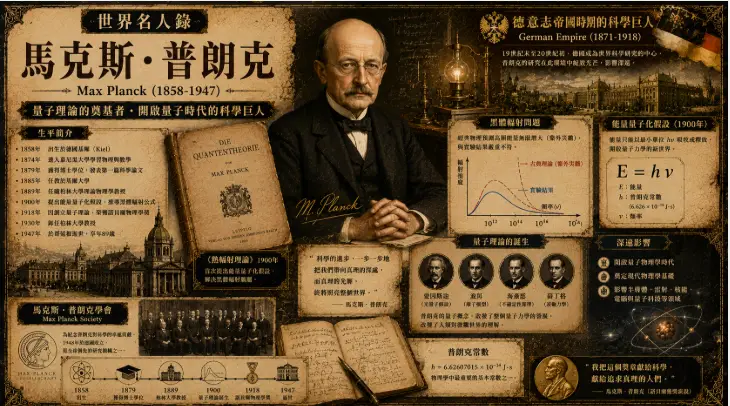
馬克斯·普朗克與德國:開啟量子時代的物理學革命者 | Max Planck and Germany: The Physicist Who Opened the Quantum Age | 世界名人錄
馬克斯·普朗克以量子理論改變現代物理學,他提出能量量子化概念,徹底顛覆傳統科學觀念,也為二十世紀的量子力學與現代科技發展奠定重要基礎。
Max Planck transformed modern physics by introducing quantum theory, a revolutionary idea that reshaped humanity’s understanding of energy and matter and paved the way for the scientific breakthroughs of the twentieth century.
中文版本
馬克斯·普朗克出生於1858年的德國基爾,當時德意志地區仍處於統一前夕的動盪時代。普朗克來自知識分子家庭,父親是法學教授,家族成員中也有不少學者與神職人員。這樣的成長環境讓他從小受到嚴格教育與文化薰陶。年輕時的普朗克不僅對數學與物理展現濃厚興趣,也熱愛音樂,尤其擅長鋼琴演奏。他曾考慮成為音樂家,但最終仍選擇投身科學研究。十九世紀後期的德國正迅速崛起為歐洲科學與工業強國,大學制度與研究環境十分先進,也為普朗克提供良好學術舞台。普朗克先後於慕尼黑大學與柏林大學學習,接觸到當時最重要的物理學理論,包括熱力學與電磁學。當時的物理學界普遍認為,自然界的基本規律已大致被發現,只剩少數細節問題等待補充。然而,普朗克卻對熱輻射問題產生濃厚興趣。科學家當時無法合理解釋「黑體輻射」現象,也就是物體受熱後所釋放能量的分布規律。根據傳統物理理論,高頻能量應該會無限增加,導致所謂「紫外災難」,但實際實驗結果卻完全不同。這個問題困擾當時許多頂尖科學家。1900年,普朗克在研究黑體輻射時提出革命性假設。他認為能量並非連續流動,而是以極小單位形式被吸收與釋放,這些能量單位後來被稱為「量子」。普朗克利用這個概念成功推導出符合實驗結果的黑體輻射公式。雖然他最初只是將量子視為數學工具,並未完全意識到其哲學與物理意義,但這項發現卻成為現代量子物理學的起點。後來愛因斯坦、波耳、海森堡與薛丁格等科學家進一步發展量子理論,徹底改變人類對微觀世界的理解。普朗克提出的「普朗克常數」也成為物理學最基本的重要常數之一。量子理論的誕生不僅改變物理學,也深刻影響二十世紀科技發展。從半導體、雷射、核能到現代電腦與量子科技,其理論基礎都能追溯至普朗克的研究。然而,在普朗克提出理論初期,許多科學家難以接受量子概念,因為它挑戰了牛頓物理學以來對自然連續性的傳統理解。普朗克本人其實性格保守,他尊重古典物理,也對量子理論帶來的哲學衝擊感到矛盾。但隨著越來越多實驗證據出現,他逐漸接受世界在微觀層面存在與日常經驗截然不同的規律。1918年,普朗克因創立量子理論獲得諾貝爾物理學獎,正式確立其在科學史上的地位。除了學術研究之外,普朗克在德國科學界也具有極高影響力。他長期擔任柏林大學教授,並參與德國科學院與威廉皇帝學會運作。後來該學會更以他名字改稱「馬克斯·普朗克學會」,成為德國最重要的科研機構之一。普朗克與愛因斯坦私交深厚,雖然兩人在量子理論哲學問題上有不同看法,但彼此始終保持尊重。二十世紀前半葉的德國經歷兩次世界大戰與納粹統治,普朗克的人生也因此充滿悲劇。第一次世界大戰奪走他長子性命,而第二次世界大戰期間,他的另一名兒子因參與反希特勒行動而遭納粹處決。面對政治動盪與科學界受到極權壓迫,普朗克努力維持德國學術傳統與科研環境。他雖未公開激烈反抗納粹,但曾試圖保護猶太科學家與維持科學獨立性。晚年的普朗克親眼見證德國戰敗與社會崩潰,但他對科學與理性的信念始終未曾動搖。1947年,馬克斯·普朗克於德國哥廷根逝世,享年89歲。今日,他被普遍視為現代量子物理學的奠基者之一,也是二十世紀最偉大的科學家之一。歷史學家認為,普朗克的發現不只是解決物理問題,更徹底改變人類對宇宙本質的理解。從原子世界到現代科技文明,量子理論早已深深影響現代社會,而這場革命的起點,正來自馬克斯·普朗克在德國實驗室中的關鍵思考。
English Version
Max Planck was born in 1858 in Kiel, within the German Confederation during a period of political transformation and scientific advancement. He came from a highly educated family deeply connected to academia, law, and theology. His father was a respected professor of law, and several relatives were scholars or religious leaders. Growing up in this intellectual environment, Planck developed strong discipline and a lifelong appreciation for knowledge, music, and philosophy. As a young man, he displayed remarkable talent in both science and music, particularly piano performance. Although he once considered pursuing a musical career, he ultimately chose physics, believing it offered a path toward understanding the deepest laws of nature. During the late nineteenth century, Germany was rapidly emerging as one of the world’s leading scientific and industrial powers. German universities became centers of groundbreaking research, attracting brilliant minds from across Europe. Planck studied at the universities of Munich and Berlin, where he focused on thermodynamics and theoretical physics. At the time, many scientists believed classical physics had already explained most natural phenomena, leaving only minor details unresolved. Yet one stubborn mystery continued troubling physicists: blackbody radiation. Experiments showed that heated objects emitted energy in ways that existing theories could not explain. Classical physics predicted that radiation intensity should increase infinitely at high frequencies, a contradiction later known as the “ultraviolet catastrophe.” This problem became one of the greatest scientific puzzles of the era. In 1900, Planck proposed a radical solution that would forever change physics. He suggested that energy was not emitted continuously but instead released in tiny discrete packets, which he called quanta. By introducing this revolutionary assumption, Planck successfully derived a mathematical formula that perfectly matched experimental observations of blackbody radiation. Initially, he viewed the idea mainly as a mathematical device rather than a profound statement about reality. Nevertheless, his proposal marked the birth of quantum theory. Later scientists including Albert Einstein, Niels Bohr, Werner Heisenberg, and Erwin Schrödinger expanded upon Planck’s work and transformed it into the full framework of quantum mechanics. Planck also introduced what became known as the Planck constant, one of the most fundamental constants in modern physics. The emergence of quantum theory reshaped scientific understanding of matter, energy, and the microscopic universe. Technologies that define modern civilization—including semiconductors, lasers, nuclear energy, computers, and quantum technologies—ultimately trace their origins back to Planck’s discovery. Yet when quantum theory first appeared, many scientists struggled to accept it because it challenged centuries of classical thinking established since Newton. Interestingly, Planck himself possessed a conservative scientific temperament. He respected classical physics deeply and initially felt uneasy about the philosophical implications of quantum mechanics. However, as experimental evidence accumulated, he gradually accepted that nature behaved according to principles radically different from ordinary human intuition. In 1918, Planck received the Nobel Prize in Physics for founding quantum theory, securing his place among the greatest scientific pioneers in history. Beyond his own research, Planck played a major role in German scientific life. He spent much of his career at the University of Berlin and held influential positions within Germany’s scientific institutions. He became closely associated with the Kaiser Wilhelm Society, which was later renamed the Max Planck Society in his honor and remains one of the world’s leading research organizations today. Planck also maintained a strong friendship with Albert Einstein. Although the two scientists sometimes disagreed on philosophical interpretations of quantum mechanics, they shared deep mutual respect. Planck lived through one of the most turbulent periods in German history, including two world wars and the rise of Nazi rule. His personal life was marked by tragedy. One son died during the First World War, while another was executed by the Nazis after participating in a plot against Adolf Hitler. Throughout these difficult years, Planck attempted to preserve German scientific culture and protect academic independence. Although he did not openly lead political resistance, he quietly tried to defend persecuted Jewish scientists and maintain the integrity of scientific research during a period of dictatorship and fear. In his later years, Planck witnessed the destruction of Germany during the Second World War, yet he never abandoned his faith in science and rational inquiry. Max Planck died in Göttingen in 1947 at the age of eighty-nine. Today, he is recognized as one of the founding fathers of modern physics and among the most influential scientists of the twentieth century. Historians often regard his quantum hypothesis as one of the greatest turning points in scientific history because it fundamentally altered humanity’s understanding of the universe. From atomic structure to advanced digital technology, the modern world continues to depend upon principles that began with Planck’s revolutionary insight into the quantum nature of reality.