
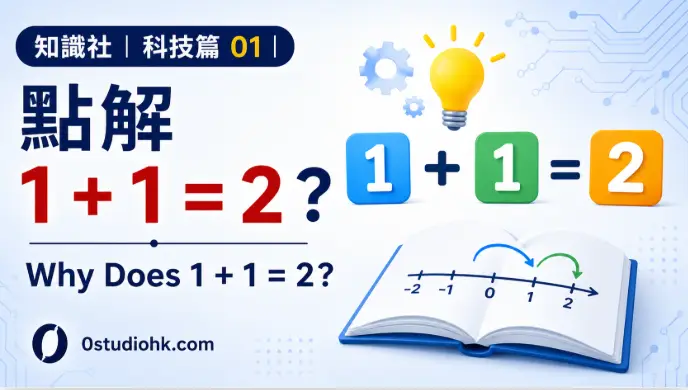
知識社|科技篇 01|點解 1+1=2? Why Does 1 + 1 = 2?
我們從小就知道 1+1=2,但有沒有想過,為什麼一定等於 2?這看似最簡單的數學問題,其實曾經令數學家花了數百頁文字來證明,也是現代科技與電腦世界最重要的基礎之一。
Everyone learns that 1 + 1 = 2 in childhood, yet few ask why it must be true. Although it appears obvious, proving this simple equation became one of the most famous achievements in the history of mathematics and forms the foundation of modern science and computing.
中文版本
當我們還在學習數數時,老師便會教導「一個蘋果加一個蘋果等於兩個蘋果」,因此大部分人都認為 1+1=2 是理所當然的事情。然而,在數學家眼中,「看起來正確」並不足夠,每一個數學定理都必須建立在嚴謹的邏輯與證明之上。十九世紀末,英國哲學家兼數學家伯特蘭.羅素與阿爾弗雷德.諾夫.懷特海希望建立一套完整的數學基礎,證明所有數學都可以由最基本的邏輯一步一步推導出來。他們花了多年時間完成三冊巨著《數學原理》(Principia Mathematica),而令人意外的是,直到第一冊後段,才正式證明出「1+1=2」這個看似最簡單的算式。這並不是因為 1+1 很困難,而是因為他們必須先定義什麼是「數字」、「集合」、「等於」及「加法」,再逐步建立整個數學系統。從日常生活來看,我們可以用最簡單的方法理解:一顆球加另一顆球,共有兩顆球;一元加一元,共有兩元。但在數學裡,「2」並不只是兩件物件,而是一種抽象概念,用來表示數量。正因為數學能夠脫離實際物件,才能應用到工程、金融、醫學及人工智能等不同領域。對電腦而言,雖然它們最終只認識 0 與 1 的二進位,但所有加法、乘法、程式運算甚至人工智能演算法,都建立在數學規則之上。當電腦執行「1+1」時,實際上會透過電子訊號及邏輯電路完成運算,再把結果轉換成我們熟悉的數字「2」。換句話說,沒有最基本的數學規則,就沒有今天的電腦、智能手機、網際網路,甚至人工智能。值得一提的是,在某些特殊情況下,「1+1」亦未必等於 2。例如在二進位中,1 加 1 的結果會寫成「10」,代表十進位的 2;而在布林代數中,1+1 可以表示「真加真仍然是真」,結果依然是 1。這並不是數學錯誤,而是因為不同數學系統有不同的運算規則。正因如此,看似簡單的「1+1=2」,其實蘊含著整個數學世界的基礎,也是人類理解宇宙規律的重要起點。
English Version
Most people first encounter mathematics by learning that one plus one equals two. It feels so obvious that few stop to question why it must always be true. Yet mathematicians require more than intuition—they demand rigorous proof. At the beginning of the twentieth century, British philosopher and mathematician Bertrand Russell and mathematician Alfred North Whitehead set out to build mathematics entirely from formal logic. Their monumental work, Principia Mathematica, filled thousands of pages. Surprisingly, the formal proof that 1 + 1 = 2 did not appear until well into the first volume. This was not because the equation itself was difficult, but because every concept had to be carefully defined first, including numbers, sets, equality, and addition. Only after establishing these foundations could the statement be proven logically. In everyday life, the idea is easy to understand: one apple plus another apple makes two apples. However, mathematics treats numbers as abstract concepts rather than physical objects, allowing the same rules to describe everything from engineering and finance to physics and artificial intelligence. Computers provide another interesting example. Although digital devices ultimately process only binary digits—zeros and ones—their calculations still depend on mathematical principles. Electronic circuits perform logical operations that ultimately produce results equivalent to familiar arithmetic. Without these basic mathematical rules, modern computers, smartphones, the internet, and AI systems could not function reliably. Interestingly, there are mathematical systems where “1 + 1” is represented differently. In binary notation, one plus one becomes “10,” which still represents the decimal number two. In Boolean algebra, however, adding one and one can produce one because the symbols represent logical truth values rather than quantities. These examples do not contradict mathematics; they simply follow different sets of rules designed for different purposes. The familiar equation 1 + 1 = 2 therefore represents far more than elementary arithmetic. It symbolizes the logical foundations upon which modern mathematics, science, and technology are built.
總評
「1+1=2」看似簡單,卻是數學、科學與電腦世界最基本的規則之一。正因為有這些嚴謹的邏輯基礎,人類才能建立今天高度發展的科技文明。
Summary
The equation 1 + 1 = 2 is more than a lesson from childhood. It represents the logical framework that supports mathematics, computing, science, and nearly every modern technology.