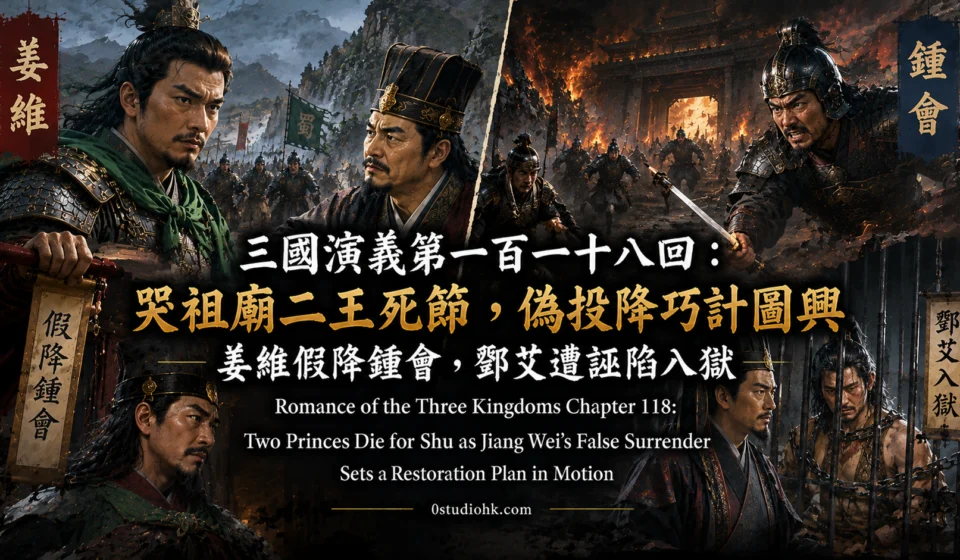
三國演義第一百一十八回:哭祖廟二王死節,偽投降巧計圖興|姜維假降鍾會,鄧艾遭誣陷入獄 |Romance of the Three Kingdoms Chapter 118: Two Princes Die for Shu as Jiang Wei’s False Surrender Sets a Restoration Plan in Motion

蜀漢滅亡後,姜維沒有真正放棄復國。他率部假意投降鍾會,很快看出鍾會與鄧艾之間存在矛盾,於是暗中挑撥兩人關係。鍾會在姜維推動下向司馬昭誣告鄧艾謀反,鄧艾父子被捕押往洛陽,鍾會獨掌蜀地。表面上姜維已經投降,實際上卻正在醞釀一場更大的復國計畫。
After the fall of Shu Han, Jiang Wei refuses to abandon the hope of restoration. He deliberately surrenders to Zhong Hui and quickly recognizes the growing rivalry between Zhong Hui and Deng Ai. Jiang Wei quietly exploits their distrust, encouraging Zhong Hui to accuse Deng Ai of plotting rebellion. Deng Ai and his family are arrested and sent toward Luoyang, leaving Zhong Hui in control of Chengdu. Behind his apparent surrender, Jiang Wei begins preparing an even greater plan to revive Shu Han.
中文版本
蜀漢滅亡之後,成都已經落入魏軍手中,劉禪開城投降,蜀漢四十三年的國祚正式結束。對許多蜀漢將士而言,這一刻代表一切都已經完結;有人悲痛,有人絕望,也有人選擇接受現實。然而姜維卻沒有真正放棄。當他在劍閣得知成都陷落之時,心中雖然悲痛萬分,卻很快想到了一件事情:如果自己此刻戰死,那麼蜀漢最後一線復國希望也將消失。於是,他作出了一個令人難以理解的決定——向鍾會假意投降。表面上,姜維放下兵器,承認魏國取得勝利;但在內心深處,他仍然把復興蜀漢視為自己的使命。鍾會見姜維率部投降,心中十分得意。他早已知道姜維是蜀漢最重要的將領之一,如今這名宿敵竟然向自己低頭,令他感到自己的功業更加顯赫。可是鍾會雖然年輕有才,卻也有一個明顯的弱點,那就是野心。隨著魏軍攻入蜀地,他開始相信自己不只是替司馬昭完成滅蜀任務,更可能成為天下局勢中的重要人物。姜維很快看出了這一點。他沒有急於表露自己的真正目的,而是刻意接近鍾會,觀察他的性格與想法。姜維知道,自己現在沒有軍隊,也沒有蜀漢朝廷可以依靠,唯一可以利用的,就是魏軍內部的矛盾。很快,他便注意到鍾會與鄧艾之間並非真正和睦。鄧艾同樣是魏國功臣,而且在滅蜀之戰中立下巨大戰功。他偷度陰平、直入蜀地,最終迫使成都陷入危機,功勞並不在鍾會之下。鍾會表面上與鄧艾合作,內心卻難免有所比較。兩人都是魏國名將,都有自己的軍功與聲望,也都希望在這場滅蜀戰爭之後獲得更大的地位。姜維看到了這個裂縫,於是開始一步一步加以利用。他並沒有直接說鄧艾一定會反叛,而是透過言語與分析,使鍾會自己產生懷疑。姜維知道,最危險的計謀不是替敵人做決定,而是讓敵人相信那個決定是自己想出來的。鍾會本來就有野心,對鄧艾又有所防備,在姜維的暗中推動下,這份猜疑開始迅速擴大。成都城內的魏軍看似已經取得勝利,實際上卻逐漸出現新的權力鬥爭。鄧艾對姜維的投降同樣保持警惕,但此時他沒有想到,自己真正的危機並不來自姜維,而是來自鍾會。鍾會開始向司馬昭報告鄧艾的種種可疑舉動,甚至進一步指控鄧艾有謀反之意。司馬昭收到消息後,也開始對鄧艾產生懷疑。對司馬昭而言,鄧艾確實是一名功勞極大的將領,但功勞越大,掌握的兵力越多,也越容易成為中央權力的潛在威脅。於是,司馬昭派監軍衛瓘前往成都調查並拘捕鄧艾。鄧艾沒有想到自己在滅蜀之後,竟然會迅速由功臣變成階下囚。當魏軍來到成都,鄧艾父子被逮捕,並被押入囚車,準備送往洛陽。這個結果對鄧艾而言無疑十分突然。他曾經冒死偷渡陰平,翻越荒山,擊破蜀漢後方防線,最終成為攻滅蜀漢的重要功臣,如今卻因為一紙指控而失去自由。鍾會則因此獲得了一個極大的機會。鄧艾被捕之後,蜀地的軍政大權逐漸集中到鍾會手中。他開始真正掌握成都及周邊魏軍,權力迅速膨脹。對其他魏軍將領而言,這種變化同樣令人不安;但對姜維而言,卻正是他等待已久的機會。姜維很清楚,如果鄧艾仍然掌握自己的軍隊,鍾會便不可能完全控制蜀地。如今鄧艾被調走,鍾會獨掌大權,魏軍內部的平衡被打破,反而給了姜維進一步施展計謀的空間。姜維開始更加深入地了解鍾會。他發現鍾會並不是一個甘心只做魏國將領的人。滅蜀的巨大功勞讓他的野心更加膨脹,而掌握蜀地之後,他更容易產生新的想法。姜維便順著這份野心行事,不斷提醒鍾會,如果沒有鄧艾、沒有其他魏將牽制,他將可以真正成為蜀地最高權力人物。姜維並沒有急於提出復國,而是先讓鍾會相信自己擁有更大的前途。這種策略十分危險,因為姜維必須一直保持假意投降的姿態,稍有不慎便會暴露真正目的。一旦鍾會看穿姜維的計畫,姜維不但無法復國,甚至可能立即被殺。然而姜維沒有選擇。他知道正面戰鬥已經無法恢復蜀漢,只有深入魏軍內部,利用敵人的權力鬥爭,才可能尋找最後的機會。成都表面上已經平靜,實際上卻暗流洶湧。鄧艾被押往洛陽,鍾會開始獨攬蜀地軍政大權,姜維則留在鍾會身邊,暗中觀察每一個變化。昔日的敵人,如今變成了表面上的同僚;昔日的蜀漢將領,如今卻身處魏軍核心之中。這一切看似荒謬,卻正是姜維苦心安排的局面。他知道,自己的復國計畫必須從魏軍內部開始。只要能夠進一步利用鍾會的野心,讓魏軍將領彼此猜疑,再尋找適當時機發動行動,或許仍有機會重新舉起蜀漢旗幟。可是這條道路充滿危險。鍾會不是一個容易控制的人,而鄧艾雖然已經被捕,卻仍然是一名具有巨大軍事影響力的魏國名將。姜維必須在極其微妙的平衡中前進。一步走錯,便可能萬劫不復。夜色降臨成都,城中魏軍巡邏不斷,蜀漢的旗幟早已消失。然而在這片看似已經屬於魏國的土地上,姜維心中的復國之火仍然沒有熄滅。他表面向鍾會稱臣,內心卻始終記得諸葛亮留下的遺志。蜀漢雖亡,姜維卻相信,只要還有一個機會,便值得一試。如今鄧艾已被捕,鍾會的野心正在迅速膨脹,而姜維也終於走進魏軍權力核心。這一局棋,比過去任何一次北伐都更加危險。因為這一次,他沒有大軍,沒有城池,也沒有國家作為後盾。他唯一擁有的,就是自己的智慧、膽量,以及對復國的最後執念。成都的夜幕之下,一場新的陰謀正在悄悄展開。姜維假降鍾會,表面上是亡國之臣,實際上卻準備借魏軍之手改變天下局勢。鄧艾被押走只是第一步,真正的計畫,才剛剛開始。
English Version
After the fall of Shu Han, Chengdu was firmly under Wei control. Liu Shan had surrendered, and the forty-three-year history of Shu Han had come to an end. For many Shu soldiers and officials, this was the moment when everything was finished. Some were overwhelmed by grief, some accepted the new reality, and others could only watch helplessly as the Shu banners disappeared. Jiang Wei, however, refused to believe that the cause was truly dead. When he learned that Chengdu had fallen, he was devastated, but he soon realized that dying in a final battle would accomplish nothing. If he died, there would be no one left to carry the hope of restoring Shu. He therefore made a decision that appeared to be an act of surrender but was actually the beginning of a new strategy. Jiang Wei surrendered himself and his remaining forces to Zhong Hui. On the surface, he accepted defeat and submitted to the Wei commander. In his heart, however, he had not abandoned Shu Han. Zhong Hui was delighted to receive Jiang Wei’s surrender. Jiang Wei had been one of Shu’s most important commanders and a long-standing opponent of Wei. Seeing such an experienced enemy finally submit strengthened Zhong Hui’s confidence in his own achievements. Yet Zhong Hui possessed a dangerous weakness: ambition. After participating in the conquest of Shu, he increasingly believed that his achievements could lead to a much greater position within the Wei state. Jiang Wei quickly recognized this ambition. Rather than revealing his intentions, he remained close to Zhong Hui and carefully observed his personality, ambitions, and relationships with other commanders. Jiang Wei understood that he no longer possessed an army or a government of his own. His only possible weapon was the political division within the enemy camp. He soon noticed that Zhong Hui and Deng Ai were not truly united. Deng Ai had also played a decisive role in the conquest of Shu. His daring advance through Yinping had bypassed the main Shu defenses and opened the road toward Chengdu. His achievements were therefore comparable to those of Zhong Hui. Although the two commanders had cooperated during the campaign, both possessed military reputations and both had reason to compare their achievements with one another. Jiang Wei saw the weakness immediately. He did not need to openly accuse Deng Ai of rebellion. Instead, he began carefully encouraging Zhong Hui to question Deng Ai’s intentions. Jiang Wei understood that the most effective form of manipulation was not to make an enemy accept a conclusion, but to make the enemy believe that the conclusion had been reached independently. Zhong Hui was already ambitious and wary of Deng Ai. Under Jiang Wei’s subtle influence, that suspicion gradually grew. Chengdu appeared peaceful after the conquest, but beneath the surface a new struggle for power was developing. Deng Ai remained cautious, but he did not realize that his greatest danger was no longer Jiang Wei. It was Zhong Hui. Zhong Hui began reporting Deng Ai’s behavior to Sima Zhao and gradually suggested that Deng Ai might be planning rebellion. The accusation was serious. Sima Zhao knew that Deng Ai had achieved enormous military success, but great success could also create a dangerous political problem. A commander who possessed fame, troops, and influence could eventually become a threat to central authority. Sima Zhao therefore ordered the inspector Wei Guan to investigate and arrest Deng Ai. Deng Ai had expected to be treated as a victorious general after the fall of Shu. Instead, he suddenly found himself accused of treason. When Wei forces arrived in Chengdu, Deng Ai and his family were arrested and placed in prison carts to be sent toward Luoyang. His transformation from celebrated conqueror to prisoner was extraordinary. He had crossed the dangerous mountains of Yinping, endured enormous hardship, and played a crucial role in destroying Shu Han. Yet a political accusation was enough to strip him of his freedom. For Zhong Hui, however, Deng Ai’s arrest created an extraordinary opportunity. With his rival removed, Zhong Hui began to gain control over the military and political affairs of the conquered Shu territories. His influence expanded rapidly. To many Wei commanders, this concentration of power was unsettling. To Jiang Wei, however, it was exactly the opportunity he had been waiting for. Jiang Wei understood that Zhong Hui could never completely dominate Shu while Deng Ai remained in command of a powerful army. Now Deng Ai had been removed, and Zhong Hui had greater freedom to act. The balance within the Wei army had been disrupted, creating room for Jiang Wei to continue his plan. Jiang Wei began studying Zhong Hui even more carefully. He realized that Zhong Hui was not content merely to serve as another Wei commander. The glory of conquering Shu had increased his ambitions, and controlling the newly conquered territory gave him an even greater sense of power. Jiang Wei therefore encouraged those ambitions. He subtly suggested that without Deng Ai and other commanders limiting his authority, Zhong Hui could become the most powerful figure in Shu territory. Jiang Wei did not immediately speak about restoring Shu Han. Instead, he allowed Zhong Hui to imagine a greater future for himself. This was an extremely dangerous strategy. Jiang Wei had to maintain the appearance of a loyal surrendered commander at all times. If Zhong Hui discovered his true intentions, Jiang Wei could be killed immediately. Yet Jiang Wei had little alternative. A direct military struggle could no longer restore Shu Han. The kingdom had fallen, Chengdu was occupied, and its armies had been destroyed or scattered. The only remaining possibility was to enter the enemy’s political structure and exploit its divisions from within. Chengdu therefore became a city of hidden tension. Deng Ai had been arrested and sent toward Luoyang. Zhong Hui was accumulating authority. Jiang Wei remained beside him, quietly observing every development. Former enemies were now forced to appear as allies. A former Shu commander was now standing inside the heart of the Wei occupation forces. The situation seemed impossible, but it was exactly the position Jiang Wei had deliberately chosen. He understood that his restoration plan had to begin from within the Wei army. If he could continue feeding Zhong Hui’s ambition, deepen the distrust among the Wei commanders, and wait for the right moment, perhaps he could still create an opportunity to restore Shu. But the danger was enormous. Zhong Hui was not a man who could easily be controlled, and Deng Ai, although arrested, remained an influential military figure whose fate could still affect the balance of power. Jiang Wei had to move carefully between competing forces. A single mistake could destroy everything. Night fell over Chengdu. Wei soldiers patrolled the streets, and the Shu banners had disappeared from the city. Yet beneath the appearance of complete Wei control, Jiang Wei’s determination had not disappeared. He bowed before Zhong Hui, but in his heart he still remembered Zhuge Liang’s unfinished mission. Shu Han had fallen, but Jiang Wei believed that if even one opportunity remained, it was worth pursuing. Deng Ai’s arrest was the first step. Zhong Hui’s ambition was growing rapidly, and Jiang Wei had finally entered the center of Wei’s political and military power. This new game was more dangerous than any Northern Expedition he had ever fought. He no longer had a large army, a fortified capital, or a functioning kingdom behind him. His only weapons were his intelligence, courage, patience, and determination to restore Shu. Beneath the darkness covering Chengdu, a new conspiracy was beginning to take shape. Jiang Wei had surrendered to Zhong Hui, but the surrender was only an appearance. He intended to use Wei’s own ambitions and divisions to change the balance of power. Deng Ai’s arrest was merely the beginning. The true plan was about to unfold.