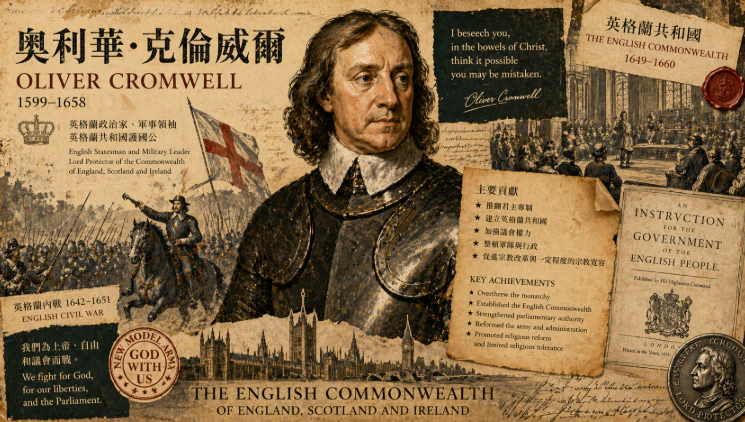
在17世紀的英格蘭,奧利華·克倫威爾推翻君主制度,建立共和政體,成為英國歷史上最具爭議與影響力的政治人物之一。
In 17th-century England, Oliver Cromwell overthrew the monarchy and established a republic, becoming one of the most controversial and influential figures in British history.
中文
在17世紀的政治動盪中,英格蘭經歷了一場深刻改變國家命運的革命,而奧利華·克倫威爾正是這場變革的核心人物。他出生於一個中產階級地主家庭,原本並非顯赫貴族,但在宗教信仰與政治理念的驅動下逐漸崛起。當時的英格蘭國王查理一世推行專制統治,並試圖繞過議會徵稅,引發了嚴重的政治衝突,最終導致了英格蘭內戰的爆發。克倫威爾作為議會軍的重要領袖,建立了紀律嚴明且戰鬥力強大的「新模範軍」,在戰場上屢次擊敗王軍,最終促成查理一世被審判並處決,這一事件震驚整個歐洲,象徵著君權神授觀念的重大動搖。隨著王權被推翻,英格蘭進入了共和時期,即「英格蘭共和國」,但這個政體並未帶來完全的民主制度,反而在某種程度上由克倫威爾集中權力。他後來成為「護國公」,實際上掌握國家最高權力,並以強硬手段維持秩序,包括鎮壓愛爾蘭與蘇格蘭的反抗,這些行動至今仍引發歷史爭議。儘管如此,克倫威爾的統治也帶來了一些制度上的變革,例如加強議會地位、推動行政效率,以及在一定程度上促進宗教寬容(雖然對天主教仍採取嚴厲態度)。他的統治反映了理想與現實之間的矛盾,一方面他為推翻專制而戰,另一方面卻建立了一個高度集權的政權。克倫威爾去世後,英格蘭迅速恢復君主制,查理二世復辟王位,顯示當時共和制度尚未成熟。然而,這段歷史對英國政治發展產生深遠影響,為後來的憲政制度與議會民主奠定基礎。克倫威爾的形象因此極具兩面性,他既被視為自由的捍衛者,也被批評為軍事獨裁者,而英格蘭共和國雖短暫存在,卻成為現代政治轉型的重要里程碑。
English Version
Amid the turbulence of the 17th century, England underwent a profound transformation that reshaped its political destiny, and at the center of this upheaval stood Oliver Cromwell. Born into a relatively modest gentry family, Cromwell did not initially appear destined for greatness, yet his strong Puritan beliefs and political convictions propelled him into prominence during a time of escalating conflict between the monarchy and Parliament. King Charles I pursued policies of absolute rule, including raising taxes without parliamentary consent, which intensified tensions and ultimately ignited the English Civil War. Cromwell emerged as a key military leader for the Parliamentary forces, organizing the highly disciplined New Model Army, whose effectiveness proved निर्णative on the battlefield. Under his leadership, the Royalist forces were defeated, leading to the unprecedented trial and execution of Charles I, a moment that sent shockwaves throughout Europe and fundamentally challenged the long-held doctrine of the divine right of kings. Following the abolition of the monarchy, England was declared a republic known as the Commonwealth, yet this new system did not evolve into a fully democratic state. Instead, Cromwell gradually consolidated power and was later appointed Lord Protector, effectively ruling as the head of state with near-monarchical authority. His government maintained order through strict control and military strength, including harsh campaigns in Ireland and Scotland that remain deeply controversial in historical memory. Despite these authoritarian tendencies, Cromwell’s rule also introduced structural reforms, such as strengthening parliamentary governance, improving administrative efficiency, and allowing limited religious tolerance for certain Protestant groups, though Catholics continued to face persecution. His leadership embodied a tension between revolutionary ideals and political pragmatism, as he sought to dismantle tyranny while simultaneously constructing a centralized regime. After Cromwell’s death, the republican experiment quickly unraveled, leading to the restoration of the monarchy under Charles II, demonstrating that the political conditions for a stable republic had not yet fully matured. Nevertheless, this period left a lasting imprint on British political evolution, contributing to the eventual development of constitutional monarchy and parliamentary democracy. Cromwell remains a deeply polarizing figure, remembered both as a champion of liberty and as a military ruler, while the English Commonwealth stands as a pivotal chapter in the transition toward modern governance.