三國演義第六十六回:劉備入主成都,蜀漢基業正式奠定 | Romance of the Three Kingdoms Chapter 66 Liu Bei Takes Chengdu
多年漂泊之後,劉備終於擁有真正立足之地。然而成都城門開啟的同時,新的天下格局也正式展開。
After years of wandering, Liu Bei finally secures a lasting foundation. Yet as Chengdu opens its gates, a new era of power begins to emerge.
中文
成都城外,陰雲低垂。
連日戰火之後,益州已近極限。
城內百姓不安,將士士氣低落。
而劉璋則獨坐殿中,神情疲憊。
他知道,大勢已去。
自從馬超歸降劉備後,西川局勢便徹底傾斜。
許多原本猶豫不決的人,開始動搖。
有些將領暗中轉向,有些士族則開始為未來鋪路。
而真正可怕的,並不是兵臨城下。
而是人心已散。
城樓之上,風聲掠過旗幟。
守軍沉默地望向遠方。
劉備大軍並未急攻。
營寨井然有序,軍紀嚴整。
這份克制,反而讓成都上下更加不安。
因為所有人都明白——
劉備不是單純為了掠奪而來。
他真正想要的,是益州。
夜裡,劉璋召集群臣。
殿中燭火昏暗,氣氛壓抑。
有人主戰,有人主降。
爭論之聲不斷。
然而劉璋始終沉默。
他回想起當年迎劉備入蜀之時。
那時,他以為只是借兵自保。
卻沒想到,最終竟走到今日。
他並不恨劉備。
甚至某種程度上,他知道自己早已無法掌控益州。
只是這份結局,仍令人難以接受。
終於,他長嘆一聲。
「不忍益州百姓,再受兵火之苦。」
一句話,決定了西川命運。
翌日,成都城門緩緩打開。
風聲穿過古老城樓。
百姓站於街道兩旁,神情複雜。
有人不安,有人期待。
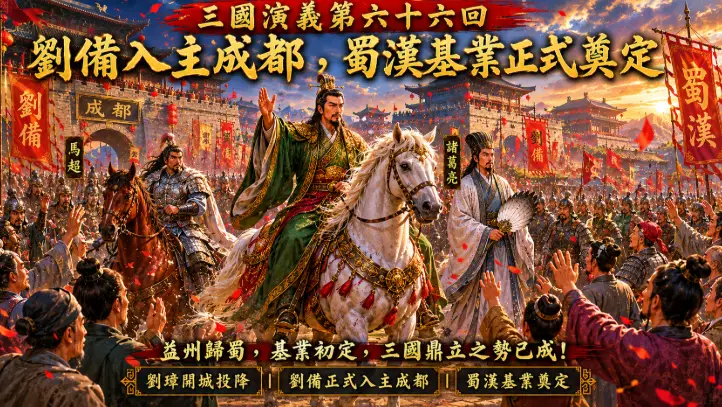
而遠方,劉備率眾緩步而來。
他沒有身披華麗戰甲。
也沒有勝利者的張揚。
只有沉靜。
當他踏入成都時,全城寂靜無聲。
這一刻,並不像征服。
更像一場漫長漂泊後的終點。
多年來,劉備輾轉各地。
寄居荊州、依附他人、四處奔波。
如今,他終於擁有真正屬於自己的根基。
而在其身後,諸葛亮靜靜望向成都城。
他知道,這一步極其重要。
因為從今天開始,蜀漢勢力不再只是流動軍隊。
而是真正擁有土地、人口與資源的政權。
然而,他也明白。
得到益州,不代表天下已定。
北方仍有曹操。
江東仍有孫權。
真正的三國時代,此刻才逐漸成形。
夕陽映照成都城牆。
旌旗在風中緩緩飄動。
新的國度,已開始呼吸。
English Version
The siege of Chengdu did not end with a dramatic final assault.
Instead, it ended with exhaustion.
Months of conflict had drained Yi Province politically, militarily, and emotionally.
Inside the city, fear and uncertainty spread quietly through every level of society.
Liu Zhang sat within the palace halls knowing the truth long before anyone dared say it aloud.
The balance could no longer be restored.
Since Ma Chao’s arrival under Liu Bei’s banner, the psychological collapse of resistance had accelerated rapidly.
Officials who once hesitated now reconsidered their loyalties.
Military commanders doubted whether continued resistance served any purpose at all.
And the people of Chengdu, weary of endless tension, simply wanted stability.
Outside the city walls, Liu Bei’s forces remained disciplined and restrained.
There were no reckless attacks.
No indiscriminate destruction.
That restraint carried its own kind of pressure.
It suggested confidence.
It suggested permanence.
Most importantly, it revealed that Liu Bei sought not temporary victory, but lasting rule.
Within Chengdu’s court, debate intensified.
Some advisers urged continued resistance in defense of honor.
Others argued surrender would spare the population from further suffering.
Liu Zhang listened quietly to both sides.
His thoughts drifted backward to the moment he first invited Liu Bei into Shu.
At the time, it had seemed practical—a political solution to external threats.
Now that decision stood before him in irreversible form.
Yet deep inside, Liu Zhang understood something painful.
Yi Province had already begun slipping beyond his control long before the armies arrived.
Perhaps what he faced now was not sudden defeat, but the final result of years of hesitation.
Eventually, he made his choice.
Not for glory.
Not for survival.
But to prevent Chengdu from becoming another battlefield soaked in blood.
The order was given.
The gates of Chengdu opened.
As Liu Bei entered the city, silence filled the streets.
Citizens watched carefully from both sides of the roads, uncertain of what this new era might bring.
Liu Bei himself advanced without arrogance.
There was no celebration in his expression.
Only gravity.
For years he had wandered across fractured lands, surviving through alliances, retreats, and endless instability.
Now, for the first time, he possessed a true foundation.
A secure territory.
A capital.
A future.
Behind him, Zhuge Liang observed the city with calm awareness.
He recognized the historical weight of the moment immediately.
This was no longer a temporary coalition struggling to survive.
With Shu secured, Liu Bei’s forces had transformed into a legitimate regional power.
Yet victory did not guarantee peace.
To the north stood Cao Cao and the immense strength of Wei.
To the east remained Sun Quan and the carefully balanced power of Wu.
The struggle for the empire was far from over.
But from this point onward, the Three Kingdoms were no longer only an idea.
They had become reality.
As evening sunlight spread across Chengdu’s walls, banners moved gently in the wind.
A new kingdom had begun to rise.