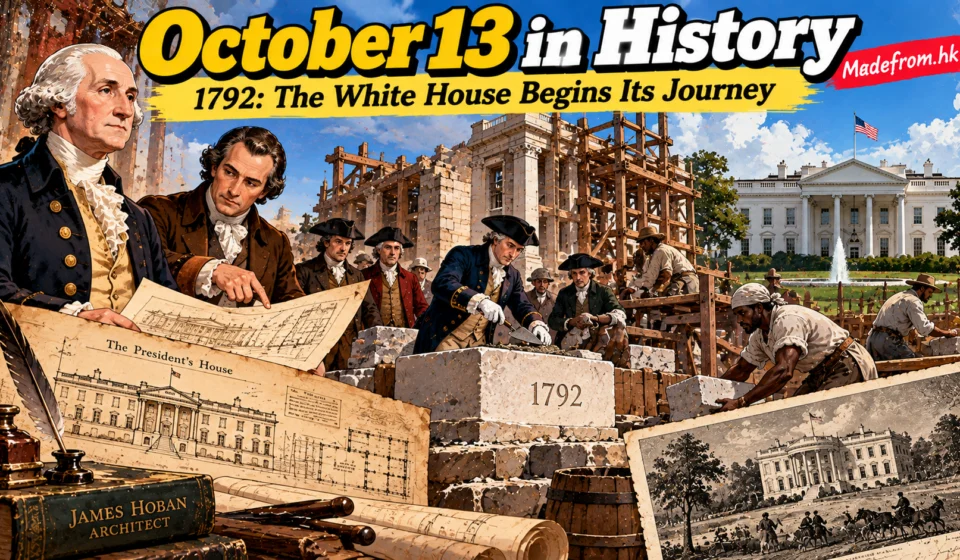
On October 13, 1792, the cornerstone of the future White House was laid in the new federal city that would become Washington, D.C.
The United States had gained independence from Britain, and the young republic was establishing a permanent capital. President George Washington helped oversee the development of the new city and selected the location for the President’s House.
The design competition was won by James Hoban, an Irish-born architect. His design drew on the classical architectural traditions popular in Europe and was approved with Washington’s support.
The cornerstone ceremony marked an important stage in the construction of a residence intended to serve as both a home and an official workplace for the nation’s president.
2. Eight Years of Construction
The White House was not completed overnight. Construction continued for approximately eight years, involving architects, skilled craftsmen, labourers, and other workers.
The building was constructed primarily from sandstone, giving it the distinctive appearance that became familiar to generations of Americans. Its design was influenced by classical architecture, reflecting the aspirations of a young republic seeking to establish a lasting national identity.
President George Washington supervised aspects of the project’s development, but he never lived in the finished residence. President John Adams and First Lady Abigail Adams became its first residents in November 1800, when the building was still unfinished.
The building was initially known as the President’s House or the Executive Mansion. The name “White House” appeared in use in the early nineteenth century and was officially adopted by President Theodore Roosevelt in 1901.
3. The Workers Behind the Monument
The story of the White House also includes a difficult and often overlooked part of American history.
Its construction relied on both paid workers and enslaved African Americans. Enslaved people were hired out by their enslavers to help clear land, transport materials, and perform construction work alongside other labourers.
Their contributions were part of the physical work that created one of the most recognisable buildings in the United States. Remembering this history provides a more complete picture of the people behind the building and the society in which it was constructed.
The White House therefore represents more than presidential authority. Its history also reflects the contradictions of the early United States, a nation founded on ideals of liberty while slavery remained deeply embedded in its society.
4. From Presidential Residence to National Symbol
Over more than two centuries, the White House has witnessed major political decisions, diplomatic meetings, public ceremonies, national crises, and peaceful transfers of presidential power.
It was damaged by fire when British forces burned the President’s House during the War of 1812. The building was subsequently reconstructed and later expanded and renovated as the needs of the presidency changed.
Today, the White House serves as the official residence and workplace of the U.S. president. It is also an internationally recognised symbol of the American presidency and the federal government.
Its importance lies not only in its architecture, but also in the history that has unfolded within its walls.
Conclusion
October 13, 1792, marked the beginning of the White House’s construction—a project that would eventually produce one of the world’s most recognisable political buildings.
Its story brings together architecture, nation-building, labour, and the complicated history of American freedom. By remembering both the leaders who planned it and the workers who built it, we gain a fuller understanding of this enduring landmark.