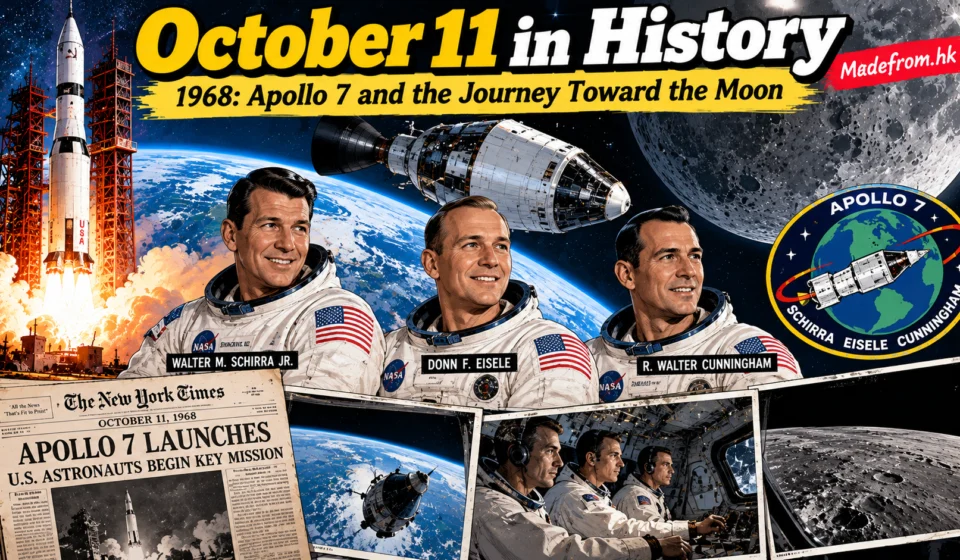
On October 11, 1968, NASA launched Apollo 7, the first crewed mission of the Apollo program. Three astronauts—Walter M. Schirra Jr., Donn F. Eisele, and R. Walter Cunningham—travelled into Earth orbit aboard a Saturn IB rocket.
The mission was an important test of the Apollo Command and Service Module. Before astronauts could safely travel to the Moon, NASA needed to prove that the spacecraft’s systems worked reliably with a crew on board.
Apollo 7 spent approximately 11 days in space, completing its mission objectives and helping restore confidence in the Apollo program following the tragic Apollo 1 fire in 1967, which killed astronauts Gus Grissom, Ed White, and Roger B. Chaffee.
The mission also included the first live television broadcasts from an American crewed spacecraft. Its success helped prepare NASA for Apollo 8, which would send astronauts around the Moon later in 1968, and ultimately for the Apollo 11 Moon landing in 1969.
October 11, 1984 — Kathryn Sullivan Makes History
Sixteen years later, another milestone in space exploration occurred on October 11.
Astronaut Kathryn D. Sullivan became the first American woman to perform a spacewalk while aboard the space shuttle Challenger during mission STS-41G. Working with astronaut David Leestma, she took part in an in-space demonstration involving the transfer of fuel between spacecraft.
A spacewalk, also known as an extravehicular activity (EVA), requires astronauts to work outside their spacecraft while wearing specially designed spacesuits. It is physically demanding and requires careful planning, precise movements, and close coordination with the crew and mission control.
Sullivan’s achievement marked an important step for women in space exploration and demonstrated how astronauts could contribute to complex technical work beyond their spacecraft.
Why These Events Matter
Apollo 7 and Kathryn Sullivan’s spacewalk were different achievements, but both helped expand the possibilities of human spaceflight.
Apollo 7 demonstrated that a crewed Apollo spacecraft could operate successfully in orbit. Sullivan’s spacewalk showed that astronauts could carry out demanding work outside a spacecraft and helped broaden the history of who could take part in space exploration.
Neither achievement happened in isolation. Both depended on engineers, scientists, mission controllers, technicians, and astronauts working together to solve difficult problems.
History is often remembered through dramatic moments—the launch of a rocket or an astronaut floating above Earth. Behind those moments are years of preparation, testing, setbacks, and teamwork.
October 11 offers a reminder that exploration advances one tested step at a time. Apollo 7 helped make the Moon landing possible, while Kathryn Sullivan’s spacewalk opened another chapter in the story of women in space.
Their achievements show that progress is not simply about reaching farther. It is also about learning to work more safely, solving problems, and creating opportunities for those who follow.