
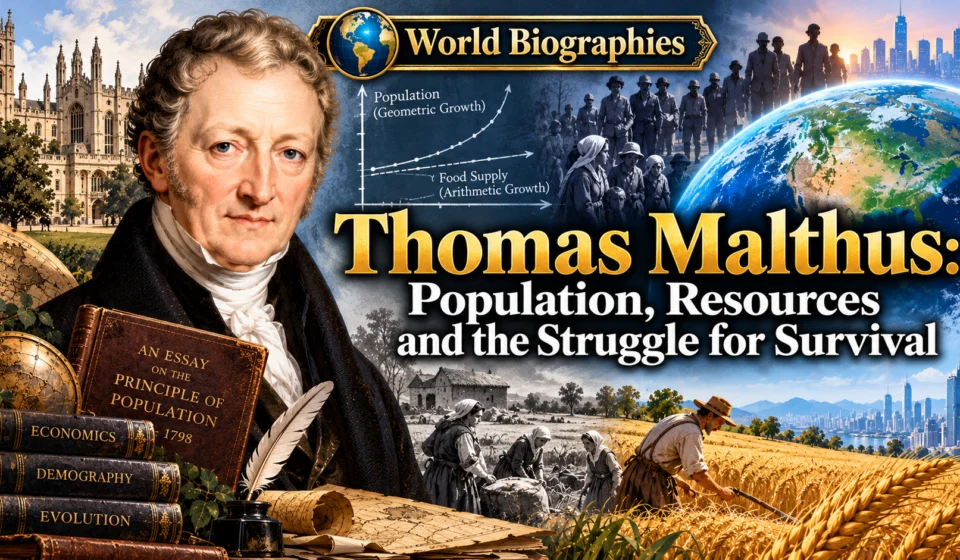
Thomas Malthus: Population, Resources and the Struggle for Survival
Thomas Malthus was a British clergyman, scholar, and political economist whose ideas about population and food supply shaped debates in economics, sociology, and evolutionary theory.
Thomas Robert Malthus was born on February 13, 1766, in Surrey, England, into a wealthy family. His father was a philosopher and a friend of thinkers such as David Hume and Jean-Jacques Rousseau. Malthus was educated at home when he was young and entered Jesus College, Cambridge, in 1784, where he studied a wide range of subjects and received awards for debating, Latin, and Greek. Mathematics became his main field of study. He received his master’s degree in 1791 and became a fellow of Jesus College two years later. In 1797, he was ordained as an Anglican country clergyman. His father had been influenced by Enlightenment ideas and believed that social problems could be solved through changes to social institutions. Malthus took a much more pessimistic position. In response to these optimistic arguments, he anonymously published his famous population essay in 1798. The work was later revised and republished in 1803 after his travels in Europe. In 1804, Malthus married and eventually had three children. In 1805, he became a professor of political economy at the East India Company College, becoming one of the earliest holders of such a position in Britain. His students affectionately called him “Population” Malthus. Malthus also developed a long intellectual relationship with the economist David Ricardo. The two disagreed over economic policy and the Corn Laws, particularly over the effects of high food prices, rents, land development, and agricultural imports, yet their disagreements remained within the bounds of scholarly debate and they eventually became close friends. Malthus is best known for his theory of population. In his 1798 work, he argued that population had a tendency to increase faster than the supply of food needed to support it. His basic model suggested that, without restraints, population could grow geometrically, such as 2, 4, 8, 16, and 32, while food production would increase arithmetically, such as 1, 2, 3, 4, and 5. If population continued to grow beyond the capacity of available resources, pressure on society would eventually increase. Malthus identified several forces that could restrain population growth, including natural causes, war, disease, famine, moral restraint, and other social factors. He particularly advocated moral restraint among the poor and working classes, including delayed marriage and abstinence. His ideas later became highly controversial because critics argued that they placed excessive responsibility for poverty on the poor themselves. Malthus also emphasized that his theory was not simply a prediction of one future catastrophe. Instead, he regarded population pressure and recurring crises as conditions that had existed throughout human history and could continue unless the fundamental physical conditions of human existence changed. At the same time, Malthus acknowledged that human beings possessed an unusual ability to increase the means of subsistence. His ideas extended beyond population studies and influenced economic thought. While teaching at the East India Company College, he developed arguments concerning imbalances between supply and demand and challenged the idea associated with Say’s Law that supply would automatically create its own demand. These ideas were later regarded as an early influence on economic theories concerning major downturns and were discussed by later economists including John Maynard Keynes. Malthus also argued that a high birth rate could increase total production while reducing production per person. His population theory influenced a number of later thinkers, most famously Charles Darwin and Alfred Russel Wallace. Darwin recognized that Malthus’s ideas about population pressure and competition helped him understand the struggle for existence within the natural world. Wallace similarly regarded Malthus’s work as highly important to the development of evolutionary thought. The influence of Malthus therefore extended far beyond economics and population studies, contributing indirectly to the intellectual foundations of modern evolutionary theory. His ideas also influenced discussions about population censuses, food supply, environmental limits, and the long-term capacity of the Earth to support human populations. Later debates about population growth, resource consumption, and the limits of economic expansion continued to echo Malthusian concerns. However, many economists and scholars strongly criticized his conclusions. Technological development, agricultural innovation, international trade, improved production methods, and changing social behavior allowed food production to increase far beyond what his simple model had anticipated. The Green Revolution, for example, dramatically increased agricultural productivity in several parts of the world. Global trade also enabled countries with favorable agricultural conditions to supply food to regions where production was more expensive. Social changes further complicated the relationship between population and resources. Education, urbanization, welfare systems, women’s changing social roles, and the wider availability of contraception contributed to declining birth rates in many developed societies. Critics therefore argued that population growth was not governed by a simple mathematical pattern and that technological progress could transform the relationship between population and available resources. Socialist thinkers such as Karl Marx and Friedrich Engels also rejected Malthus’s interpretation of poverty and population pressure. They argued that economic systems, ownership structures, production relations, unemployment, and inequality could create poverty without population itself being the fundamental cause. Other critics, including classical liberals, emphasized that technological progress and economic development could expand productive capacity alongside population growth. Religious and human-rights perspectives also challenged aspects of Malthusian population control, particularly where such ideas could be used to justify restrictions on individual reproductive rights. Malthus died in Bath, England, in December 1834. His theories did not accurately predict the future in the simple form often attributed to them, yet his central question remains important: how should human societies balance population, resources, production, technology, and the limits of the environment? His legacy therefore lies not only in the predictions that proved incomplete, but also in the questions he raised about the relationship between human growth and the resources available to sustain it.
Malthus remains a controversial but influential thinker whose ideas connected population, economics, resources, and evolution, leaving a lasting mark on modern intellectual history.