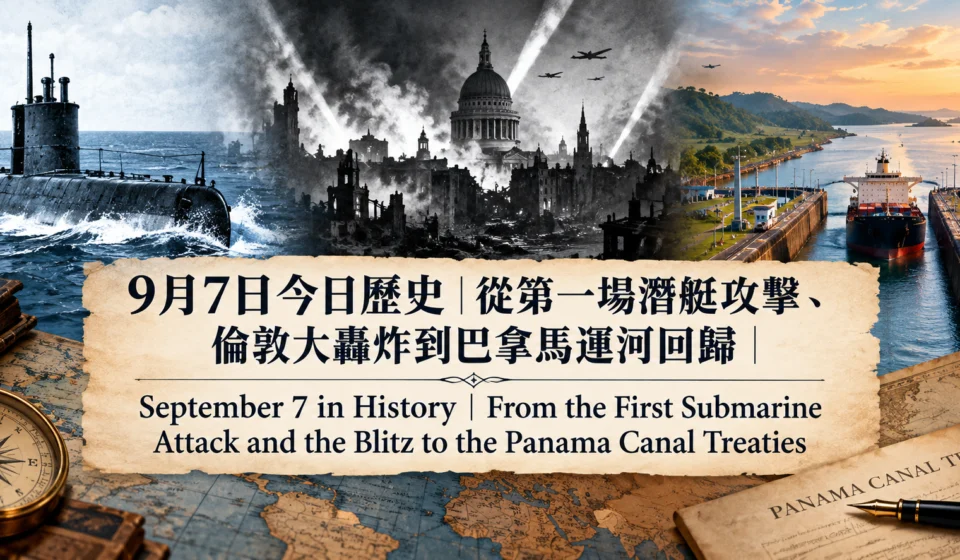
9月7日今日歷史|從第一場潛艇攻擊、倫敦大轟炸到巴拿馬運河回歸|September 7 in History|From the First Submarine Attack and the Blitz to the Panama Canal Treaties

9月7日見證戰爭、科技、國家獨立與國際秩序的轉變,從潛艇首次投入戰爭,到倫敦面對空襲,再到巴拿馬運河主權轉移,歷史在這一天留下深刻印記。
September 7 connects very different chapters of world history, from the birth of submarine warfare and the devastation of the Blitz to Brazil’s independence and the eventual transfer of the Panama Canal.
中文版本
9月7日是一個充滿歷史轉折的日子,從18世紀的戰爭科技,到20世紀的世界大戰、民族獨立與國際政治,都可以在這一天找到重要的足跡。1776年9月7日,美國獨立戰爭期間,一艘名為「Turtle」的早期潛水艇在紐約港嘗試接近英國軍艦 HMS Eagle,企圖將定時炸彈固定在船體之下。雖然行動最終沒有成功,但這次嘗試通常被視為歷史上第一次以潛艇發動的軍事攻擊,顯示人類已經開始探索如何從水面以下發動戰爭,也預示了後來潛艇在海軍戰略中的重要地位。 1822年9月7日,另一個影響深遠的歷史時刻出現在南美洲。葡萄牙王室與巴西的政治關係逐漸緊張,佩德羅王子在聖保羅附近的伊皮蘭加溪畔宣布巴西脫離葡萄牙,這一事件後來成為巴西獨立的重要象徵。巴西獨立並不是一場瞬間完成的革命,而是一段涉及王室、殖民地利益、地方政治與國家認同的漫長轉變;9月7日因此成為巴西最重要的國家紀念日之一。 1901年9月7日,中國近代史上的另一個重大轉折發生。清政府與多國簽署《辛丑條約》,標誌著義和團運動及相關衝突正式進入外交善後階段。這份條約帶來巨額賠款、外交與軍事方面的重大限制,也進一步加深了清朝面對列強壓力的困境。它不只是一紙外交文件,更反映出19世紀末中國在內憂外患之下所面對的國際秩序與主權危機。 1936年9月7日,塔斯馬尼亞虎最後一隻已知圈養個體在澳洲霍巴特動物園死亡。這種有袋類肉食動物曾分布於澳洲及塔斯馬尼亞,但在長期捕殺、棲息地變化及其他人類活動影響下逐漸消失。最後一隻塔斯馬尼亞虎的死亡,成為人類與野生動物關係史上一個令人惋惜的象徵,也讓「物種滅絕」不再只是遙遠的自然現象,而成為現代社會必須面對的環境問題。 1936年同一天出生的還有美國音樂家 Buddy Holly。他的生命雖然只有短短二十二年左右,但他對後來搖滾樂的影響極其深遠。Buddy Holly的歌曲、舞台形象以及樂隊編制,對後來披頭四、滾石樂隊等音樂人產生重要影響,使他成為早期搖滾樂發展史上的代表人物之一。 然而,9月7日最令人難忘的歷史畫面之一,發生在1940年的倫敦。第二次世界大戰期間,納粹德國空軍在9月7日開始對倫敦進行大規模空襲,這場持續多月的轟炸行動後來被稱為「倫敦大轟炸」或 The Blitz。當天大量德國轟炸機襲擊倫敦,原本主要集中於軍事與工業目標的空戰逐漸把英國城市及平民帶入戰爭核心。倫敦居民需要面對警報、爆炸、火災、建築倒塌以及長時間躲藏於防空洞的生活。這場轟炸延續至1941年,造成大量平民死亡與城市破壞,但同時也成為英國戰時社會堅持抵抗的重要象徵。 1940年的倫敦大轟炸尤其值得今日重新回望,因為它提醒我們,現代戰爭早已不只是士兵在戰場上的對抗。當航空科技、遠程武器與工業生產能力結合之後,城市本身也可能成為戰場,而普通市民則直接承受戰爭的代價。倫敦的經歷後來成為第二次世界大戰城市戰爭的重要歷史記憶,也影響了防空、城市規劃、民防及戰時社會組織的發展。 到了1963年9月7日,美國職業美式足球名人堂在俄亥俄州坎頓正式開放,首批17名入選者包括著名運動員 Jim Thorpe。這件事看似只是體育史上的一個里程碑,但其實反映了現代職業運動逐漸建立自己的文化記憶與歷史制度。體育明星不再只是比賽紀錄上的名字,而開始成為一個時代的象徵。 1977年9月7日,歷史再次把焦點帶到國際政治與國家主權。美國總統 Jimmy Carter 與巴拿馬領導人 Omar Torrijos 在華盛頓簽署《巴拿馬運河條約》及相關中立條約,為巴拿馬最終重新取得運河控制權奠定基礎。巴拿馬運河於1914年正式通航,長期具有極高的軍事及商業戰略價值,美國在運河及運河區擁有長期控制權。1977年的條約則改變了這種政治安排,最終在1999年12月31日完成控制權移交。這不只是一次行政上的交接,更代表國際社會對主權、殖民遺產與國家自主權的重新思考。 1986年9月7日,南非聖公會歷史上出現重要突破,Desmond Tutu正式成為南部非洲聖公會首位黑人領袖。他後來成為反種族隔離運動的重要人物之一,以宗教信仰、非暴力理念與人權立場在南非社會產生巨大影響。 1996年9月7日,美國拉斯維加斯發生震動全球流行文化的槍擊事件,著名饒舌歌手及演員 Tupac Shakur 在觀看拳擊比賽後遭槍擊,數日後傷重不治。Tupac的音樂生涯雖然短暫,但他的作品涉及貧窮、種族、社會不平等、暴力與個人身份等議題,使他成為1990年代嘻哈文化最具影響力的人物之一。 進入21世紀,9月7日仍然不斷出現新的歷史節點。2021年,薩爾瓦多正式把比特幣列為法定貨幣,成為世界上第一個採取這項政策的國家之一,這次政策實驗引起全球對數字貨幣、金融科技及國家貨幣制度的廣泛討論。 回望9月7日,可以看到一條十分有趣的歷史線索:1776年的潛艇代表戰爭科技開始進入水下空間;1822年的巴西獨立代表殖民地尋求建立自己的國家身份;1901年的《辛丑條約》反映帝國主義時代的國際權力;1936年的塔斯馬尼亞虎則提醒人類自然環境的脆弱;1940年的倫敦大轟炸展示現代戰爭對平民社會的巨大衝擊;1977年的巴拿馬運河條約則展示主權與國際關係如何重新調整。這些事件看似互不相關,但放在同一天觀察,卻能看見人類歷史一直在科技、權力、國家、社會與環境之間不斷變化。9月7日因此不只是日曆上的一天,它像一個窗口,讓我們看見不同時代的人如何面對戰爭、自由、科技、身份與未來。
English Version
September 7 brings together an extraordinary range of stories from world history, linking technological experimentation, national independence, international diplomacy, war, environmental loss, popular culture and changing ideas of sovereignty. One of the earliest and most fascinating events associated with this date took place in 1776, during the American Revolutionary War, when the experimental submarine Turtle attempted to attack a British warship in New York Harbor. Operated by Ezra Lee, the small vessel tried to approach HMS Eagle and attach an explosive charge beneath the ship. The attempt failed, but it is widely remembered as the first recorded attempt to use a submarine in warfare. The experiment demonstrated an entirely new way of thinking about naval combat: instead of confronting an enemy on the surface, an attacker could potentially approach unseen from beneath the water. Submarine technology would develop dramatically over the following centuries, eventually transforming naval strategy and becoming one of the most important forms of military technology. September 7 also marks a defining moment in the history of Brazil. In 1822, Pedro, the Prince Regent of Brazil, declared independence from Portugal near the Ipiranga Brook in São Paulo. The declaration became the symbolic beginning of Brazil as an independent nation, although the political separation involved a much broader process involving the Portuguese royal court, local elites, economic interests and competing ideas about Brazil’s future. Today, September 7 is celebrated as Brazil’s Independence Day, demonstrating how a historical event can gradually become part of a country’s national identity and collective memory. On September 7, 1901, another major turning point occurred in East Asian history when the Qing government and foreign powers signed the Boxer Protocol, formally bringing the Boxer conflict and its diplomatic aftermath to a conclusion. The settlement imposed severe financial and political consequences on China and reflected the unequal balance of power between the Qing Empire and the foreign powers operating in China at the beginning of the twentieth century. The agreement became part of a wider period of crisis in which China faced military pressure, foreign intervention, domestic instability and growing demands for reform. September 7, 1936, is remembered for a very different reason. The last known captive thylacine, commonly called the Tasmanian tiger, died at Hobart Zoo in Tasmania. The thylacine was a carnivorous marsupial once found across parts of Australia and Tasmania, but human persecution and environmental pressures contributed to its disappearance. The death of the final known animal became a powerful symbol of extinction and a reminder that species can vanish within a relatively short period when human activity overwhelms natural ecosystems. The thylacine remains one of the most famous extinct animals of the modern era, and its story continues to influence discussions about conservation, biodiversity and humanity’s responsibility toward wildlife. The same date also marks the birth of Buddy Holly in 1936. Although his career lasted only a few years, Holly became one of the most influential early figures in rock and roll. His songwriting, vocal style and approach to performing with a small band helped shape the sound and structure of popular music that followed. His influence extended well beyond his lifetime, reaching later generations of musicians and contributing to the development of modern rock music. Perhaps the most powerful historical image associated with September 7 is London during the Second World War. On September 7, 1940, Nazi Germany launched a massive bombing campaign against London, beginning what became known as the Blitz. Large numbers of German aircraft attacked the British capital, and the bombing campaign continued through the following months. Civilians suddenly found themselves at the centre of modern industrial warfare, facing air-raid sirens, explosions, fires, destroyed buildings and long nights spent in shelters. The Blitz demonstrated how advances in aviation and military technology had transformed the nature of war. Cities could now become major targets, and ordinary people far from the battlefield could face the direct consequences of military strategy. The bombing of London also became an important part of Britain’s wartime memory. The campaign continued into 1941 and caused extensive destruction and civilian casualties, but it did not achieve the political collapse that German leaders had hoped to force. Instead, the experience became associated with endurance and civilian resilience. The Blitz remains a major subject in the history of the Second World War because it shows that warfare is not simply a confrontation between armies. Modern conflicts can reshape entire cities, economies, families and societies, leaving memories that last for generations. On September 7, 1963, the Pro Football Hall of Fame opened in Canton, Ohio, with its first group of 17 inductees. Among them was Jim Thorpe, one of the most celebrated American athletes of the early twentieth century. The creation of the Hall of Fame represented more than recognition for individual players. It showed how professional sport was becoming an important part of modern cultural history, with institutions created to preserve achievements, celebrate sporting legends and build a shared historical memory around competition. Fourteen years later, September 7 became significant in the history of international diplomacy. In 1977, U.S. President Jimmy Carter and Panama’s leader Omar Torrijos signed the Panama Canal Treaty and the Neutrality Treaty in Washington. The agreements established a new framework for the future of the Panama Canal and eventually led to the transfer of control from the United States to Panama at the end of 1999. The canal had opened in 1914 and had enormous commercial and military importance because it created a shortcut between the Atlantic and Pacific Oceans. The 1977 agreements therefore represented not simply an administrative change, but a major shift in the relationship between a powerful country and a smaller nation seeking greater control over its territory and strategic infrastructure. September 7, 1986, also marked an important moment in the history of South Africa and the Anglican Church in Southern Africa when Desmond Tutu became its first Black leader. Tutu would become one of the most prominent religious voices against apartheid, combining moral leadership with advocacy for human rights and reconciliation. His role demonstrated how religious institutions could become important platforms for challenging racial injustice and defending human dignity. In 1996, September 7 became associated with one of the most significant tragedies in modern popular culture. Rapper and actor Tupac Shakur was shot in Las Vegas after attending a boxing match. He died several days later from his injuries. Tupac had become one of the most influential voices of 1990s hip-hop, using music to explore poverty, racism, violence, inequality, identity and the realities of life in American communities. His career was brief, but his cultural influence continued long after his death, making him one of the defining figures of his generation. The historical significance of September 7 continued into the twenty-first century. In 2021, El Salvador adopted Bitcoin as legal tender, becoming the first country to take such a step. The decision attracted worldwide attention and sparked debate about digital currencies, financial technology, monetary policy and the future of traditional banking systems. Whether viewed as an experiment, a technological milestone or a controversial economic policy, the decision demonstrated how rapidly the meaning of money was changing in the digital age. Looking across the centuries, September 7 reveals a surprisingly coherent story. The submarine experiment of 1776 represented a new frontier in military technology. Brazil’s declaration of independence in 1822 reflected the transformation of colonial societies into modern nations. The Boxer Protocol of 1901 revealed the unequal international system of the imperial era. The disappearance of the thylacine in 1936 reminded the world of the irreversible consequences of extinction. The Blitz of 1940 showed how modern warfare could place entire civilian populations under attack. The Panama Canal treaties of 1977 demonstrated that strategic territory and infrastructure could change hands through diplomacy, while the rise of Bitcoin in 2021 reflected another transformation in the way societies think about money and national financial systems. These events occurred in different countries and under completely different circumstances, yet together they reveal a common pattern: history is shaped by people adapting to technological change, struggles over power and sovereignty, changing social values and humanity’s attempts to respond to new challenges. September 7 is therefore more than another date on the calendar. It is a doorway into the past, showing how inventions, wars, independence movements, environmental losses, cultural figures and political agreements can all leave consequences that extend far beyond the day on which they happened.
總評
9月7日的歷史橫跨科技、戰爭、獨立、環境與國際政治,從潛艇到巴拿馬運河,每件往事都反映人類社會如何改變世界,也改變自己。
September 7 offers a remarkable cross-section of history, connecting technological innovation, war, independence, conservation, culture and diplomacy while showing how decisions made on one day can shape generations.