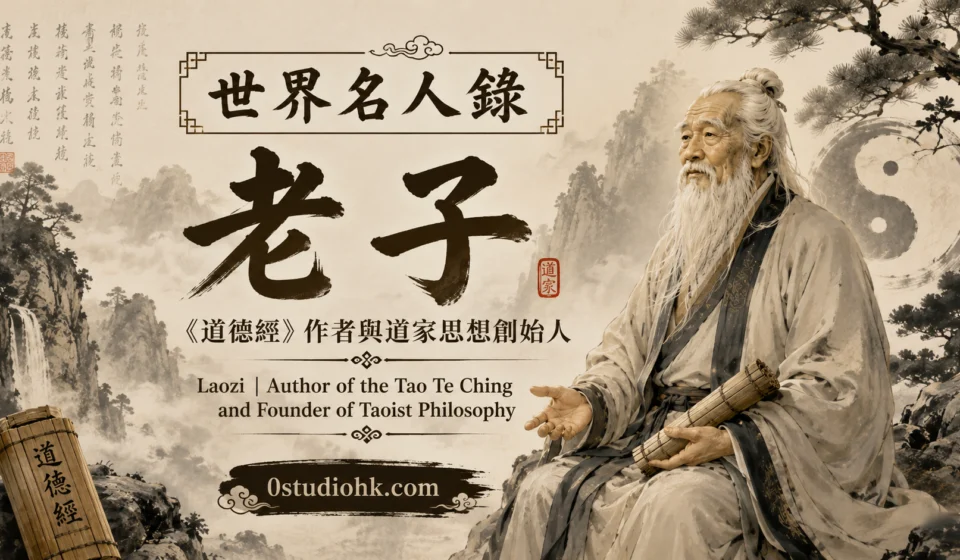
老子|《道德經》作者與道家思想創始人 Laozi | Author of the Tao Te Ching and Founder of Taoist Philosophy

老子是中國古代最具影響力的思想家之一,《道德經》以「道法自然」、「無為而治」等思想,探索人生、社會與宇宙的根本規律,影響中國文化兩千多年。
Laozi stands among the most influential thinkers of ancient China. His Tao Te Ching offers a philosophy of simplicity, balance, humility, and harmony with nature that continues to influence people around the world.
中文版本
老子是中國古代最著名的哲學家之一,也是道家思想最具代表性的奠基人物。關於他的真實生平,由於距今年代久遠,歷史資料並不完整,後世對他的出生年代、人生經歷甚至是否存在於單一歷史人物,都曾有不同討論。傳統記載一般認為老子姓李,名耳,字聃,又稱老聃,生活於春秋時期,曾在周朝擔任守藏室史,負責管理王室典籍。這份工作讓他有機會接觸大量古代文獻,也使他逐漸形成對政治、社會及人性的深刻觀察。相傳孔子曾經向老子請教禮制,兩位思想家雖然後世分別成為儒家與道家的重要象徵,但他們對人生與社會的思考方向各有不同。老子並不相信人類可以單靠制定更多規則來解決天下問題,反而認為過度干預往往會帶來新的混亂。當時周王朝日漸衰落,社會動盪不安,老子據說看透政治環境後決定離開中原。傳說他騎著青牛向西而行,來到函谷關時,守關令尹喜知道他是一位有學問的人,希望他在離開之前留下自己的思想,因此老子寫下約五千字的《道德經》,之後便離去,從此行蹤不明。《道德經》篇幅雖然不長,卻包含極為深遠的哲學思想,核心概念之一就是「道」。「道」並不是單純指一條道路,而是宇宙萬物運行的根本原則,是人類難以完全以語言描述的自然秩序。老子認為真正的智慧,不是強行控制一切,而是理解事物本身的規律,順勢而行。他提出的「無為」因此並不是懶惰或甚麼都不做,而是避免過度干預、過度追求及違反自然規律。對統治者而言,「無為而治」代表政府不應以繁複命令壓迫人民,而應減少不必要的干涉,使社會保持自然運作。老子的思想同樣重視「柔弱」的力量。他以水作為重要象徵,水看似柔軟,卻能長時間沖刷堅硬的岩石;它不與萬物爭奪位置,卻可以流向最低處,最終遍及大地。這種謙遜、包容與順勢而行的智慧,成為道家思想的重要特色。老子亦強調少私寡欲、知足、節制及簡樸,認為人如果不斷追逐權力、財富與名聲,反而容易失去內心的平衡。他提出「上善若水」等思想,提醒人們真正高尚的力量未必表現為強硬,而可能存在於謙讓與包容之中。《道德經》後來成為中國哲學史上的經典,對政治思想、文學、藝術、養生、武術及中國人的人生觀均產生深遠影響。隨著歷史發展,道家思想逐漸形成不同傳統,東漢以後道教興起,老子亦逐漸被宗教化、神格化,成為道教極其重要的尊神之一,並被尊稱為太上老君。到了後世,《道德經》不再只是一部中國哲學著作,而逐漸成為世界性的思想經典。它被翻譯成多種語言,在不同文化背景下被重新理解。有人從中研究自然哲學,有人用它思考領導與管理,也有人把其中關於簡樸、平衡及順應自然的思想應用於個人生活。老子的特別之處,在於他的思想並不要求人類征服世界,而是鼓勵人重新理解自己與世界的關係。在一個講求速度、競爭與控制的時代,「少一點強求、多一點順勢」仍然是一種值得思考的人生智慧。老子的歷史身世或許永遠存在謎團,但《道德經》留下的思想卻跨越兩千多年仍然具有生命力。從古代中國到今天的世界,老子所提出的自然、謙遜、節制與平衡,仍然讓不同時代的人重新思考:人究竟應該如何生活,才能與自己、與他人,以及與這個世界保持真正的和諧。
English Version
Laozi is remembered as one of the most important philosophical voices of ancient China, although the historical details surrounding his life remain uncertain. Traditional accounts identify him as Li Er, also known as Lao Dan, and place him during the Spring and Autumn period. He is said to have served as a keeper of the Zhou royal archives, a position that would have given him access to an extensive collection of ancient writings. Whether every detail of this traditional biography is historically accurate remains debated, but the ideas associated with Laozi have had an enormous and lasting influence. One famous story tells of a meeting between Laozi and Confucius. According to later tradition, Confucius sought Laozi’s advice about ritual and learning. Their philosophies eventually developed in very different directions, with Confucianism emphasizing social relationships, responsibility, and ethical order, while Laozi’s philosophy placed greater emphasis on natural harmony and avoiding unnecessary interference. As the political world around him became increasingly unstable, tradition says that Laozi eventually decided to leave the Zhou realm. Riding westward on an ox, he reached the Hangu Pass, where the guardian Yin Xi recognized his wisdom and asked him to leave behind his teachings. Laozi then composed the short but extraordinary work known as the Tao Te Ching. Afterward, he reportedly continued his journey and disappeared from the historical record. The Tao Te Ching is built around the idea of the Tao, often translated as “the Way.” The Tao is not simply a road or a method. It represents the underlying process and order through which the natural world unfolds. Laozi suggests that human beings often create problems when they try too hard to control what cannot be controlled. Wisdom therefore involves understanding circumstances, recognizing natural patterns, and responding without unnecessary force. This principle is closely connected with wu wei, commonly translated as “non-action” or “effortless action.” The concept does not mean doing nothing. Instead, it describes action that avoids excessive interference and works with the natural movement of events. In government, Laozi’s ideal ruler would avoid burdening society with excessive rules and interventions. In personal life, the same principle can mean knowing when to act, when to step back, and when to allow circumstances to develop naturally. Laozi also challenged conventional ideas about strength. He repeatedly used water as a metaphor because water appears soft and yielding but possesses remarkable persistence. It flows around obstacles, moves toward low places, and can gradually reshape even hard stone. For Laozi, this apparent weakness represents a deeper form of strength. Humility, flexibility, patience, and restraint can accomplish what force cannot. The Tao Te Ching also encourages simplicity and moderation. Excessive desire for wealth, status, power, and recognition can create dissatisfaction and conflict, while a simpler way of living can restore balance. These ideas became central to later Taoist philosophy and influenced Chinese approaches to literature, painting, medicine, martial arts, self-cultivation, and political thought. Over the centuries, philosophical Taoism developed alongside religious Taoist traditions. From the later Han period onward, Laozi became increasingly revered within Taoism and was eventually associated with the divine figure Taishang Laojun, or the Grand Supreme Elder Lord. His influence also extended far beyond China. The Tao Te Ching has been translated into numerous languages and remains one of the most widely studied Chinese philosophical classics in the world. Readers from very different cultures have interpreted its teachings through the lenses of philosophy, spirituality, leadership, psychology, environmental thought, and everyday life. What makes Laozi particularly enduring is the way his philosophy questions the assumption that progress always requires greater control. Instead of asking how humanity can dominate nature, his ideas invite us to consider how human beings might live in greater harmony with it. In a modern world shaped by constant competition, speed, consumption, and pressure to achieve more, his emphasis on simplicity, balance, humility, and restraint can feel surprisingly relevant. The historical Laozi may remain partly hidden behind centuries of legend, but the philosophical voice associated with him has survived remarkably well. More than two thousand years after the Tao Te Ching was written, its central questions remain alive: how should people act without creating unnecessary conflict, how can strength exist without aggression, and how can human life remain connected to the larger order of nature? These questions explain why Laozi continues to be read not simply as an ancient Chinese philosopher, but as one of the enduring thinkers of world civilization.
總評
老子以《道德經》留下深邃哲學智慧,主張順應自然、謙遜知足與無為而治。其思想跨越時代與文化,至今仍影響世界。
Summary
Laozi’s philosophy offers a powerful alternative to force, excess, and constant control. His vision of harmony, simplicity, and natural action continues to resonate across cultures and generations.