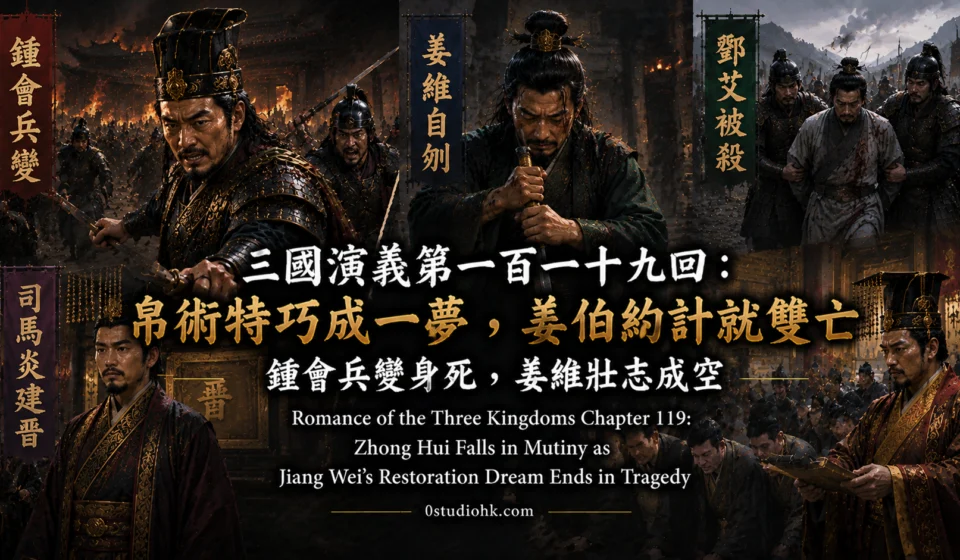
三國演義第一百一十九回:帛術特巧成一夢,姜伯約計就雙亡|鍾會兵變身死,姜維壯志成空 |Romance of the Three Kingdoms Chapter 119: Zhong Hui Falls in Mutiny as Jiang Wei’s Restoration Dream Ends in Tragedy

鍾會圖謀起兵反魏,卻因部下不願追隨而陷入孤立。魏軍兵變爆發,鍾會最終死於亂軍之中,姜維眼見復國大計無望,自刎而死。鄧艾亦遭衛瓘派人殺害。司馬炎繼承司馬氏大業,建立西晉,曹魏正式滅亡。三國至此只剩東吳。
Zhong Hui’s rebellion collapses when his soldiers refuse to follow him. During the ensuing mutiny, Zhong Hui is killed, while Jiang Wei takes his own life after realizing that his restoration plan has failed. Deng Ai is also killed on the orders of Wei Guan. Sima Yan later establishes the Western Jin dynasty, bringing Wei to an end and leaving Eastern Wu as the final surviving kingdom of the Three Kingdoms.
中文版本
成都城中,表面上已經歸於平靜,實際上卻正醞釀著一場足以改變天下局勢的最後風暴。姜維自從蜀漢滅亡之後,便假意投降鍾會,暗中利用鍾會的野心,希望借魏軍內部的矛盾重新建立蜀漢。鄧艾被捕之後,鍾會逐漸獨掌蜀地兵權,權勢日益膨脹,而姜維也不斷在旁邊推動他的野心。鍾會本來就不甘心只做一名普通將領,滅蜀的巨大功勞更令他相信自己已經具備改變天下局勢的力量。姜維看準這一點,開始鼓動鍾會進一步反抗司馬昭,希望讓魏軍內部先發生劇烈衝突,再尋找復國的機會。鍾會終於下定決心,準備起兵反抗魏國。可是,事情並沒有按照姜維所預想的方向發展。鍾會雖然掌握成都及蜀地大部分兵權,但魏軍將士並不是人人願意跟隨他。許多將領雖然表面服從,心中卻對鍾會的野心充滿疑慮。他們知道司馬昭才是魏國真正的權力核心,也不願因為鍾會的個人野心而背負謀反之罪。鍾會的計畫逐漸出現裂痕,而姜維也開始感受到危險。只要消息洩漏,鍾會與自己都可能陷入絕境。果然,鍾會密謀起兵的消息很快傳入魏軍將領耳中。魏軍部將決定先下手為強,發動兵變,率軍向成都宮殿發起攻擊。城中頓時陷入混亂,原本掌握大權的鍾會突然失去局勢控制。宮門之外,魏軍士兵大聲呼喊,刀槍交錯,整個成都再次陷入戰火。鍾會試圖指揮部下抵抗,但許多士兵根本不願為他的計畫而戰。當局勢完全失控後,鍾會最終死於亂軍之中。這位曾經率領魏軍攻破漢中、與姜維在劍閣對峙,最後進入成都的名將,竟然在自己掌握的城市中走向末路。鍾會的死亡,也意味著姜維苦心策劃的復國計畫遭受致命打擊。姜維原本希望借鍾會之力推翻魏軍在蜀地的統治,再重新扶立蜀漢政權。可是鍾會一死,魏軍內部的計畫全面瓦解,蜀漢復國的最後希望也隨之破滅。姜維站在混亂之中,眼看多年心血全部化為烏有。他從諸葛亮去世之後便一直背負北伐使命,經歷一次又一次失敗,甚至在蜀漢滅亡後仍然不肯放棄。如今,他終於走到了最後一步。姜維明白,自己已經沒有軍隊,也沒有國家,更沒有足以重新集結力量的條件。面對不可挽回的局勢,他最終選擇拔劍自刎。姜維一生最大的願望,是完成諸葛亮未竟的北伐理想,復興漢室。可是這個願望最終未能實現。他沒有死在與魏軍正面決戰的戰場上,而是在復國計畫破滅之後,以自己的生命結束了這段漫長的道路。據說魏軍在他死後剖開他的腹部,發現其膽大如雞卵,這個傳說後來更成為後人形容姜維膽略的象徵。姜維雖然失敗,但他一生所表現出的堅持與膽識,仍然成為三國後期最令人感慨的人物之一。可是成都的悲劇還沒有完全結束。鄧艾雖然已經被押解離開,但他的命運同樣沒有逃過政治鬥爭。衛瓘奉命處理鄧艾的事情,最終派人將鄧艾父子殺害。這名曾經偷度陰平、翻越荒山、直入蜀漢腹地,並親手促成蜀漢滅亡的魏國名將,最後竟然也死於自己陣營的權力鬥爭之中。鄧艾、鍾會、姜維,三名後期最重要的軍事人物,竟然先後走向悲劇結局。三人的命運各不相同,但都被捲入魏國權力重新分配的巨大漩渦之中。與此同時,司馬昭也已經走到了人生最後階段。他多年來逐步控制曹魏朝廷,削弱皇室權力,為司馬氏取代曹魏打下了最後基礎。可是司馬昭還未真正完成篡位,便因病去世。司馬氏的大業並沒有因此停下來,他的兒子司馬炎繼承了晉王之位,並迅速完成最後的權力轉移。到了公元265年,司馬炎逼迫魏帝曹奐禪讓,正式建立晉朝,國號為「晉」。曹魏自曹丕代漢建立以來,經歷數代皇帝,最終也在司馬氏手中走向滅亡。曹奐被迫退位,曹魏皇權正式結束。曾經與蜀漢、東吳共同形成三國鼎立局面的魏國,也成為歷史的一部分。劉禪則被封為安樂公,昔日蜀漢皇帝的人生也從此進入另一個階段。至此,天下局勢已經發生根本改變。蜀漢已亡,曹魏亦亡,昔日三國之中只剩下東吳仍然存在。孫吳依然據守江東,但它所面對的已經不是三國鼎立,而是一個正在逐漸形成的新天下。西晉建立之後,司馬炎很清楚,東吳就是最後一個尚未被納入統一版圖的政權。於是,晉朝開始積極準備水師與兵馬,研究長江水道,整頓軍隊,為將來南下攻吳作準備。從成都到洛陽,從蜀漢滅亡到曹魏終結,天下的棋局已經重新排列。姜維用生命完成了自己最後的抵抗,鄧艾死於政治鬥爭,鍾會則在自己的野心之中走向滅亡。曾經叱吒天下的英雄們,一個接一個退出歷史舞台。可是戰爭並沒有結束。三國雖然已經只剩一國,但最後的東吳仍然屹立江東。西晉的水師正在集結,新的戰爭即將開始。從此,天下即將迎來三國時代最後的一場征伐,而這一次,目標只有一個——東吳。
English Version
Chengdu appeared to have become quiet after the fall of Shu Han, but beneath the surface, a final political storm was gathering. Since the destruction of Shu, Jiang Wei had deliberately surrendered to Zhong Hui while secretly using Zhong Hui’s ambition to create an opportunity for restoration. Deng Ai had been arrested, Zhong Hui had gained control over much of the conquered Shu territory, and Jiang Wei believed that the growing rivalry within Wei might eventually allow him to rebuild Shu Han. Zhong Hui was already ambitious before the conquest, but his enormous achievements in the campaign strengthened his belief that he deserved a greater position. Jiang Wei understood this weakness and carefully encouraged it. He suggested that Zhong Hui did not have to remain merely a servant of Sima Zhao. If he could break away from the existing Wei power structure, he might become the dominant figure in the newly conquered Shu territories. Zhong Hui eventually decided to take the dangerous step of rebelling against Wei. Yet Jiang Wei’s plan depended on something that he could not fully control: the loyalty of the Wei soldiers. Zhong Hui possessed authority, but many of the officers under his command were not personally committed to his ambitions. Some obeyed because they had no choice, while others feared that following Zhong Hui into rebellion would bring destruction upon themselves and their families. As rumors of the plan spread, resistance began forming within the Wei army. Eventually, the commanders decided to act before Zhong Hui could complete his preparations. A mutiny erupted, and Wei soldiers moved against the palace and Zhong Hui’s headquarters in Chengdu. The city quickly descended into chaos. Men shouted through the streets, weapons clashed, and the army that had appeared victorious only days earlier suddenly turned against itself. Zhong Hui attempted to regain control, but many of the soldiers refused to fight for his rebellion. His authority collapsed almost immediately. In the confusion, Zhong Hui was killed by the mutinous troops. The man who had commanded the Wei armies through Hanzhong, confronted Jiang Wei at Jiange, and eventually entered Chengdu as one of the conquerors of Shu was now dead inside the very city he had controlled. His death destroyed Jiang Wei’s carefully constructed restoration plan. Jiang Wei had hoped to use Zhong Hui’s power to eliminate the Wei commanders in Shu, then turn against Zhong Hui himself and revive the Shu Han government. But with Zhong Hui dead and the Wei army in control once again, the final opportunity had disappeared. Jiang Wei had spent decades carrying Zhuge Liang’s unfinished mission. He had fought campaign after campaign, suffered repeated defeats, and continued resisting even after Shu Han itself had fallen. Now he finally reached the end of his path. He no longer possessed a kingdom, an army, or a realistic means of rebuilding the state. His final plan had failed, and there was no longer any path through which he could achieve restoration. Jiang Wei therefore chose to take his own life. His greatest ambition had been to complete Zhuge Liang’s dream of restoring the Han and reviving Shu. That dream had remained alive through years of hardship, but it ultimately could not overcome the changing political and military reality. Jiang Wei did not die in a final victorious battle. Instead, he died after his last attempt at restoration collapsed. Later tradition tells that Wei soldiers opened his body after his death and found his gall bladder unusually large, giving rise to the famous image of Jiang Wei as a man of extraordinary courage. Although he failed to restore Shu, his determination, loyalty, and willingness to continue fighting made him one of the most memorable figures of the final period of the Three Kingdoms. But the tragedy in Chengdu was not yet finished. Deng Ai, despite having played a decisive role in the destruction of Shu, had also become a victim of political conflict. Wei Guan was ordered to deal with him, and Deng Ai was eventually killed along the road together with his family. The general who had crossed the impossible mountains of Yinping, bypassed the strongest Shu defenses, and opened the road toward Chengdu ultimately died because of political struggles within his own side. Deng Ai, Zhong Hui, and Jiang Wei—the three major military figures of the final struggle for Shu—had now all met tragic ends. Their personalities and ambitions were different, but each had been caught in the enormous political transformation taking place within Wei. At the same time, Sima Zhao had reached the final stage of his own rise to power. For years, he had steadily weakened the authority of the Cao imperial family and strengthened the Sima clan’s control over the Wei government. Yet he died before personally completing the final transfer of the throne. His death did not end the Sima family’s ambition. His son Sima Yan inherited the position of Prince of Jin and quickly continued the process of consolidating power. In 265 AD, Sima Yan forced Emperor Cao Huan to abdicate and formally established the Jin dynasty. The Wei state founded by Cao Pi had now come to an end. The Cao imperial family lost its political authority, and the dynasty that had once been one of the three great powers of China became part of history. Cao Huan was given a reduced title, while Liu Shan, the former ruler of Shu Han, was made the Duke of Anle. The political landscape had now changed completely. Shu Han was gone, Wei was gone, and only Eastern Wu remained from the original Three Kingdoms. Sun Wu still controlled the lands south of the Yangtze, but the strategic situation was no longer one of three competing kingdoms. It was becoming a struggle between a newly established Jin dynasty and the final surviving kingdom of the old order. Sima Yan understood that Wu was now the last obstacle to unification. Jin therefore began preparing its armies and naval forces. Shipbuilding, river warfare, military logistics, and the routes along the Yangtze became increasingly important. The next campaign would not be another border conflict. It would be an attempt to destroy the final kingdom of the Three Kingdoms. From the fall of Shu Han to the collapse of Wei, the old political order had disappeared almost completely. Jiang Wei had ended his life after his final restoration plan failed. Deng Ai had died because of political intrigue. Zhong Hui had been destroyed by the very ambition that Jiang Wei had tried to exploit. One by one, the great commanders of the final Three Kingdoms era had disappeared. Yet the wars were not finished. Eastern Wu still stood in Jiangdong, and the new Jin dynasty was already preparing for its final campaign. Naval forces were being organized, soldiers were being trained, and plans for a southern invasion were beginning to take shape. The age of the Three Kingdoms was approaching its final chapter. The next war would determine whether Eastern Wu could survive or whether the long division of the realm would finally come to an end. The armies of Jin were preparing, and the final target was clear: Eastern Wu.