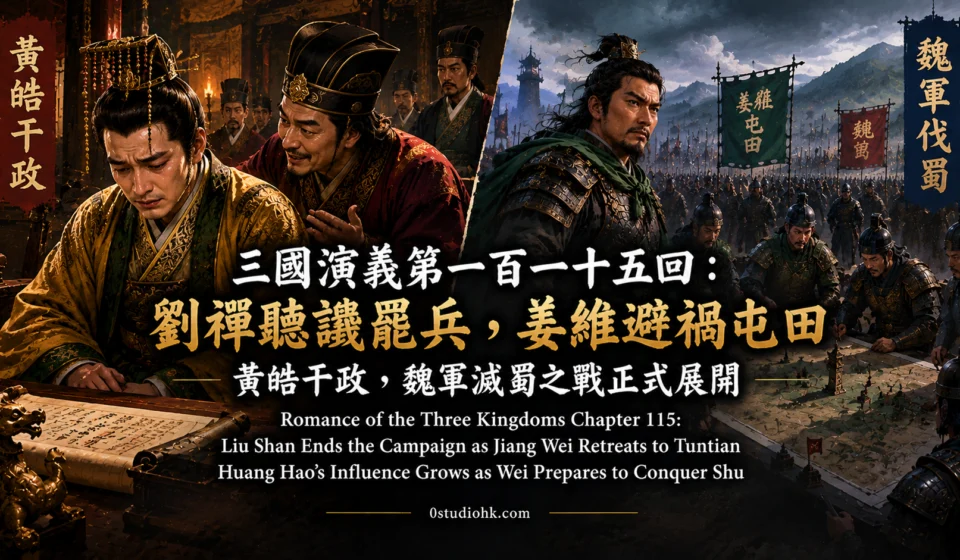
三國演義第一百一十五回:劉禪聽讒罷兵,姜維避禍屯田|黃皓干政,魏軍滅蜀之戰正式展開 |Romance of the Three Kingdoms Chapter 115: Liu Shan Ends the Campaign as Jiang Wei Retreats to Tuntian|Huang Hao’s Influence Grows as Wei Prepares to Conquer Shu

姜維多年北伐,卻因黃皓干政與朝廷猜疑而屢受牽制。當姜維試圖除掉黃皓時,劉禪反而出面保護,使姜維深感危機。為避禍並保存軍力,他採納郤正之策,率軍前往沓中屯田。姜維離開成都,看似遠離政治風暴,卻也令蜀漢本土防務出現空隙。與此同時,司馬昭認定伐蜀時機成熟,任命鍾會統領大軍,並與鄧艾共同策劃滅蜀之戰。魏軍兵分三路南下,蜀漢真正的生死大戰終於拉開序幕。
After years of Northern Expeditions, Jiang Wei finds himself increasingly constrained by court politics and the growing influence of Huang Hao. When Jiang Wei attempts to remove Huang Hao, Liu Shan protects the eunuch, forcing Jiang Wei to reconsider his position. Following Qiao Zhou’s strategy, Jiang Wei withdraws to Tazhong to establish agricultural settlements, both preserving his forces and avoiding political danger. But his departure leaves Shu Han’s homeland more vulnerable. Sima Zhao now believes the moment to conquer Shu has arrived. Zhong Hui is appointed to command the campaign, while Deng Ai prepares alongside him. Wei’s armies advance in three directions, and the final war against Shu Han begins.
中文版本
蜀漢的局勢,在姜維一次又一次北伐之後,已經逐漸走到一個非常危險的階段。前線的魏軍沒有被真正擊潰,後方的蜀漢卻已經開始承受長年戰爭帶來的沉重壓力。姜維明白,自己多年來率軍出征,雖然曾經取得不少局部勝利,但始終無法完成諸葛亮留下的復興漢室大業。更令他感到不安的,是成都朝廷內部的變化。黃皓在劉禪身邊的影響力越來越大,朝中不少事情都開始受到他的干預。姜維身在前線多年,十分清楚軍國大事不能受到宦官左右,因此他決定設法除掉黃皓。可是,姜維低估了黃皓在劉禪心中的地位。當姜維提出黃皓干政的問題時,劉禪不但沒有採納他的意見,反而出面保護黃皓。姜維見到這個結果,心中頓時感到一陣寒意。他知道自己若繼續與黃皓正面衝突,很可能不但無法除掉對方,反而會令自己成為朝廷中的眼中釘。自己多年掌握兵權,本來就容易受到猜疑,如今再得罪深受皇帝信任的黃皓,將來一旦有人進讒,後果不堪設想。姜維因此開始重新思考自己的處境。他不能完全離開軍隊,因為蜀漢仍然需要防備魏國;可是如果繼續留在成都,又可能深陷朝廷鬥爭。就在這個時候,郤正提出了一個看似退讓、實際上十分務實的辦法。既然成都已經不適合姜維久留,不如率領軍隊前往沓中屯田。沓中位於蜀漢西北方向,遠離成都朝廷,卻又接近魏蜀邊境。姜維若能在那裡屯田,一方面可以利用軍隊開墾土地,解決部分糧草問題;另一方面又可以保持軍事力量,隨時防備魏國的進攻。更重要的是,離開成都可以避開黃皓等人的政治鬥爭。姜維思考再三,最終接受了這個建議。他率領一支大軍離開成都,向沓中進發。一路之上,姜維心中十分複雜。他知道自己並不是因為戰場失敗而離開,而是因為朝廷中的政治環境已經令他難以安心。昔日諸葛亮在成都掌握軍政大權,能夠得到劉備與劉禪的充分信任;如今的姜維,卻需要時刻提防來自朝廷內部的猜疑。抵達沓中之後,姜維立即安排屯田。他命士兵開墾土地、種植糧食,同時加強軍營防禦與邊境巡查。表面上看,這是一種退守;實際上,姜維仍然保留著軍事力量。只要魏軍出現異動,他便可以迅速作出反應。可是,姜維離開成都所帶來的問題,也逐漸浮現出來。蜀漢本土原本就缺乏足夠的軍力,如果姜維率領大軍長期駐紮沓中,成都與漢中一帶的防禦便會變得更加空虛。姜維自己也明白這一點,但他已經沒有更好的選擇。他若留在成都,可能遭受政治打擊;他若回到北伐前線,又必須承受長年作戰的壓力。沓中屯田,成為他在軍事責任與政治自保之間找到的一個平衡點。可是,就在姜維忙於屯田的時候,魏國正在進行一場足以改變天下局勢的軍事部署。司馬昭經過多年權力經營,已經牢牢掌握魏國朝政。曹魏皇室的力量越來越弱,蜀漢則因長年北伐而逐漸疲憊。司馬昭開始認為,伐蜀的時機終於成熟。過去魏國面對姜維的北伐,多數時候採取防守策略;如今情況不同,蜀漢內部出現政治矛盾,姜維又離開成都,正是魏國主動出擊的大好機會。司馬昭開始召集重要將領商議南征計畫。其中,鍾會逐漸成為最重要的人物之一。鍾會年輕而有才略,善於分析全局,也有統領大軍的能力。司馬昭於是任命鍾會為鎮西將軍,讓他負責統領伐蜀大軍。與此同時,鄧艾亦成為這場軍事行動中的重要力量。鄧艾熟悉蜀漢西線山川地勢,尤其善於從看似難以通行的地方尋找突破口。他與鍾會的作戰風格不同,卻能形成互補。鍾會負責大軍部署與正面壓力,鄧艾則可以尋找蜀漢防線中最薄弱的地方。司馬昭知道,蜀漢最難攻克的地方不是成都,而是通往蜀地的險關。如果正面硬攻,魏軍即使兵力強大,也可能付出巨大代價。因此,真正的伐蜀戰略不能只是大軍直線南下,而必須從多個方向同時施壓。魏國於是開始秘密調集兵馬、準備糧草,並重新研究蜀漢各處關隘。蜀漢方面卻沒有完全察覺這場巨大危機。姜維身在沓中,主要注意力放在屯田與邊境防禦;成都朝廷則仍然受到黃皓影響,部分重要軍情甚至可能被隱瞞。這種資訊上的落差,使蜀漢失去了最寶貴的準備時間。當魏軍開始正式調動時,蜀漢才逐漸發現事情已經不再是普通的邊境衝突。魏軍兵分三路,浩浩蕩蕩向蜀漢方向推進。一路大軍由鍾會統領,準備從主要方向施加壓力;鄧艾則帶領另一支力量,尋找突破蜀漢防線的機會;其他魏軍亦從不同方向配合行動。整個伐蜀計畫逐漸形成一張巨大的網。姜維在沓中收到消息時,已經感受到事情的嚴重性。他知道魏國這一次不是普通的進攻,而是一次有計畫、有準備的大規模南征。他立即開始思考是否應該率軍回援。可是此時的他已經陷入兩難。如果帶領沓中大軍離開,屯田與防線便會受到影響;如果繼續留在沓中,成都一帶便可能更加危險。更重要的是,他不知道朝廷對魏軍的真實情況掌握到多少。黃皓是否會如實上報?劉禪是否會相信前線將領?這些問題令姜維心中充滿不安。姜維終於明白,自己原本為了避開政治鬥爭而選擇屯田,卻可能在無意之間令蜀漢本土防線出現巨大漏洞。這不是他希望看到的結果,但歷史已經沒有給他太多時間。魏軍正在南下,鍾會的大軍逐漸逼近,鄧艾也正在尋找蜀漢防線的弱點。司馬昭則坐鎮魏國,等待這場精心策劃的戰爭開始發揮作用。昔日劉備建立蜀漢時,曾經擁有雄心、人才與軍隊;諸葛亮則以一生心血維持這個國家的生存。到了姜維這一代,北伐理想仍然存在,但國力已經遠遠不如從前。姜維站在沓中的軍營之外,望著遠方山脈,心中第一次真正感受到一種難以言喻的壓力。他原本只是想避開黃皓,保住自己,也保住軍隊;可是如今,真正的敵人已經出現在國門之外。蜀漢的最後一場大戰,正在逼近。魏軍三路南下,戰鼓聲即將響遍蜀地。姜維知道,從這一刻開始,他已經沒有多少退路。
English Version
The situation in Shu Han had become increasingly dangerous after years of Northern Expeditions. Jiang Wei had continued Zhuge Liang’s unfinished mission, but the repeated campaigns had failed to produce a decisive breakthrough against Wei. Instead, Shu Han was gradually losing the strength required to sustain prolonged warfare. Grain was becoming harder to secure, soldiers were increasingly difficult to replace, and the court in Chengdu was becoming more divided. One of Jiang Wei’s greatest concerns was the growing influence of Huang Hao. The eunuch had gained increasing access to Emperor Liu Shan and was becoming deeply involved in political affairs. Jiang Wei had spent years on the frontier and understood how dangerous it could be when military decisions were influenced by court politics. He therefore attempted to remove Huang Hao from power. But Jiang Wei soon discovered that confronting Huang Hao directly could place his own position in danger. Liu Shan protected the eunuch instead of accepting Jiang Wei’s criticism. For Jiang Wei, this was a deeply troubling sign. He had spent years commanding armies and defending Shu Han, but his influence at court was now becoming a political liability. If he continued to oppose Huang Hao, rumors and accusations could easily be turned against him. He therefore began considering another solution. He could not abandon military affairs because Wei remained a constant threat, yet remaining in Chengdu would expose him to increasingly dangerous political struggles. At this moment, Qiao Zhou proposed a practical alternative: Jiang Wei should lead his forces to Tazhong and establish agricultural settlements there. Tazhong was far from the political center of Chengdu but remained close enough to the western frontier to serve a military purpose. By settling troops there and developing agriculture, Jiang Wei could maintain his army while producing part of the food it required. At the same time, he would be removed from the immediate political struggles surrounding Huang Hao. Jiang Wei considered the proposal carefully and eventually accepted it. He led a large force away from Chengdu and toward Tazhong. His departure was not caused by defeat on the battlefield. Instead, he was retreating from a political environment in which his position had become increasingly insecure. Jiang Wei remembered the earlier days of Zhuge Liang, when the great Chancellor had enjoyed strong political authority and could coordinate military and government affairs with greater confidence. Jiang Wei’s position was different. He now had to consider not only the enemy beyond the frontier, but also suspicion within his own court. After reaching Tazhong, Jiang Wei immediately organized the troops into agricultural settlements. Soldiers cleared land, planted crops, and prepared food supplies while maintaining military patrols and defensive positions. On the surface, the move appeared to be a retreat from active warfare. In reality, Jiang Wei was preserving a military force that could still respond quickly if Wei attacked. Yet his departure from Chengdu created another problem. Shu Han already had limited manpower. If Jiang Wei kept a large army in Tazhong, the defenses around the heartland could become thinner. Jiang Wei understood the danger, but he believed he had few alternatives. Remaining in Chengdu could expose him to political attacks. Returning immediately to the northern battlefield would place even greater pressure upon an army already exhausted by years of campaigning. Tazhong offered a temporary balance between military responsibility and political survival. While Jiang Wei focused on agriculture and frontier defense, however, Wei was preparing for a campaign that could completely change the political map of the Three Kingdoms. Sima Zhao had spent years consolidating his control over Wei. The Cao imperial family had become increasingly powerless, while Shu Han had been weakened by decades of war. Sima Zhao now believed that the moment to conquer Shu had finally arrived. In earlier years, Wei had mostly responded to Jiang Wei’s Northern Expeditions by defending its territory and allowing Shu to exhaust itself. The situation had now changed. Shu was politically divided, Jiang Wei was far from Chengdu, and the kingdom’s military resources were increasingly strained. These conditions created an opportunity for Wei to take the initiative. Sima Zhao therefore summoned his leading commanders and began planning a large-scale southern campaign. Among the most important figures was Zhong Hui. Young, intelligent, and ambitious, Zhong Hui possessed strong strategic abilities and had the potential to command a major army. Sima Zhao appointed him as General Who Guards the West and entrusted him with the main responsibility for the invasion of Shu. Deng Ai would also play a critical role. He had spent years studying the western mountains and the geography of the Shu frontier. Deng Ai was particularly skilled at finding routes that conventional armies considered too difficult or dangerous. His style was different from Zhong Hui’s, but the two commanders could complement each other. Zhong Hui could organize a large army and apply pressure against the main Shu defenses, while Deng Ai could search for unexpected routes and weaknesses in the defensive system. Sima Zhao understood that the greatest obstacle to conquering Shu was not Chengdu itself. The real problem was the natural terrain and fortified passes protecting the kingdom. A direct assault could cost Wei enormous numbers of soldiers even with its superior resources. The campaign therefore needed to attack Shu from several directions at once. Wei began secretly gathering troops, preparing supplies, and studying the defensive routes leading into Shu. Shu Han, however, did not fully understand the scale of the danger. Jiang Wei was far away in Tazhong, concentrating on agriculture and frontier security. In Chengdu, political influence remained heavily shaped by Huang Hao, and important military information was not necessarily reaching the right people quickly enough. The gap between the battlefield and the capital became increasingly dangerous. When Wei forces finally began moving, Shu Han gradually realized that this was not another ordinary border conflict. The Wei army advanced in three major directions. Zhong Hui commanded a powerful force intended to create pressure along the main approaches. Deng Ai prepared his own force and looked for opportunities to bypass Shu defenses. Other Wei troops moved in coordination, creating a large strategic net around the kingdom. The invasion plan was no longer merely an idea. It was becoming a reality. When reports of the movement reached Jiang Wei in Tazhong, he immediately understood the seriousness of the situation. This was not simply another Wei attack designed to contain Shu. It was a carefully prepared campaign aimed at destroying the kingdom. Jiang Wei began considering whether he should abandon the agricultural settlements and return with his army to defend the heartland. But once again, he faced an impossible choice. If he moved the Tazhong army immediately, the frontier settlements and defenses could be weakened. If he remained where he was, the heartland could become increasingly exposed. More troubling was his uncertainty about the information reaching Chengdu. Would Huang Hao report the military situation accurately? Would Liu Shan trust the warnings from the frontier? Jiang Wei realized that the decision he had made to escape political danger might have unintentionally created a serious weakness in Shu Han’s national defenses. He had not intended to abandon the kingdom. He had intended to preserve his army and protect himself from a hostile political environment. But history was giving him very little time to reconsider. Wei forces were already moving south. Zhong Hui’s army was approaching the main defensive areas, while Deng Ai was searching for weaknesses elsewhere. Sima Zhao remained behind in Wei, waiting for the carefully prepared campaign to unfold. Jiang Wei thought about the history of Shu Han. Liu Bei had founded the kingdom with ambition, military strength, and a generation of talented commanders. Zhuge Liang had then spent his life trying to preserve it and complete the dream of restoring the Han. Now, in Jiang Wei’s generation, the dream remained alive, but the kingdom supporting that dream had become far weaker. Standing outside the military settlements at Tazhong, Jiang Wei looked toward the distant mountains. For the first time, he felt the full weight of the coming danger. He had originally withdrawn to avoid Huang Hao and protect both himself and his army. Now the real enemy was approaching the gates of Shu. The final great war against Shu Han was beginning. Wei’s armies were advancing from three directions. The drums of war were about to echo across the Shu lands. Jiang Wei understood that from this moment forward, there would be very little room for retreat.