三國演義第六十五回:馬超歸降劉備,蜀漢勢力震動西川 | Romance of the Three Kingdoms Chapter 65 Ma Chao Joins Liu Bei
亂世之中,真正改變天下的不只是戰爭,還有人心的歸向。當馬超選擇歸降,西川局勢也徹底傾斜。
In an age of chaos, battles alone do not decide history. Loyalty and allegiance reshape the balance of power, and Ma Chao’s decision changes Shu forever.
中文
成都之外,戰火仍未停息。
劉備大軍步步進逼,益州局勢已岌岌可危。
而在另一邊,一支來自西涼的鐵騎,也正悄然接近蜀地。
那是馬超。
自潼關兵敗後,他輾轉流亡。
昔日震動關中的西涼猛將,如今卻失去根基。
父仇未報,舊部凋零。
天下雖大,卻難有真正容身之地。
馬超投靠過張魯。
但漢中勢力終究有限。
而張魯對他既敬且防。
這種壓抑,使馬超心中越發不安。
他不甘心就此沉寂。
因為他仍相信,自己還能改變局勢。
就在此時,劉備攻取益州的消息傳來。
西川震動。
許多人開始觀望。
有人選擇堅守,有人則開始尋找新的歸屬。
而馬超,也開始動搖。
夜裡,營帳燈火微暗。
馬超獨坐案前,沉默不語。
過往的榮耀與失敗,在腦海之中反覆交錯。
他曾單槍匹馬震懾曹軍。
也曾率西涼鐵騎橫掃關中。
然而如今,卻只能寄居他人之下。
這種落差,比戰敗更難接受。
而此時,諸葛亮已開始布局。
他深知,若能讓馬超歸降,不只可增強兵力。
更能震動西川人心。
因為馬超之名,在西北與蜀地皆極具威望。
於是,一封書信送往漢中。
字句不多,卻直指人心。
信中沒有威脅,也沒有誇耀。
只有對英雄處境的理解。
這反而讓馬超沉默許久。
因為他第一次感覺到,有人真正明白他的不甘。
數日之後,馬超終於下定決心。
率部南下,投向劉備。
當消息傳至成都時,城中上下震動。
劉璋更是神色大變。
因為他知道,馬超若加入劉備,局勢將徹底失衡。
果然,西川守軍士氣開始動搖。
不少將領甚至萌生退意。
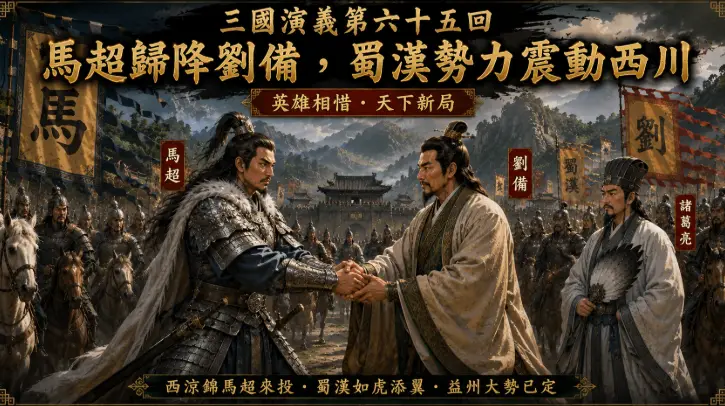
而劉備則親自出迎。
沒有高高在上的姿態。
只有誠意。
馬超翻身下馬。
兩人對視片刻。
那一刻,沒有太多言語。
因為彼此都明白——
這不只是歸降。
更是一場新的開始。
遠方戰鼓聲再次響起。
成都城牆在暮色之中若隱若現。
而蜀地的命運,也正在這場會面之後,悄然改變。
English Version
The struggle for Yi Province was nearing its decisive stage.
Liu Bei’s forces continued advancing toward Chengdu, while the political structure of Shu weakened with every passing day.
Yet another shift was about to reshape the balance entirely.
Far from Chengdu, Ma Chao stood at a crossroads.
Once feared across the northwest, the legendary cavalry commander had lost nearly everything after his defeat at Tong Pass.
His father was dead.
His alliances had collapsed.
The powerful cavalry armies that once thundered across Liang Province were scattered remnants of the past.
Though he later sought refuge under Zhang Lu in Hanzhong, the arrangement never truly satisfied either side.
Zhang Lu respected Ma Chao’s reputation but feared his ambition.
And Ma Chao, proud by nature, struggled to endure dependence without purpose.
The frustration slowly consumed him.
Then came news from Shu.
Liu Bei’s campaign was succeeding.
Cities were falling.
Support inside Yi Province was beginning to fracture.
For the first time in years, Ma Chao sensed the possibility of reclaiming influence.
Zhuge Liang recognized the opportunity immediately.
Winning Ma Chao would mean more than gaining another general.
It would send a message across western China.
Ma Chao’s name carried immense symbolic weight.
He represented martial prestige, resistance, and legitimacy among many frontier regions.
So Zhuge Liang chose persuasion rather than pressure.
A carefully written letter was sent to Hanzhong.
Its tone was restrained and respectful.
There were no grand promises.
No manipulation.
Only an understanding of Ma Chao’s isolation and unrealized potential.
That honesty reached him more deeply than threats ever could.
For perhaps the first time since his fall, Ma Chao felt recognized rather than used.
The decision came quietly, but its impact was enormous.
Ma Chao agreed to join Liu Bei.
When the news spread into Yi Province, morale shifted instantly.
Even Liu Zhang understood the danger immediately.
The addition of Ma Chao changed perception as much as military strength.
If such a famous warrior had chosen Liu Bei, many wondered whether the outcome of the war had already been decided.
Inside Chengdu, confidence began to weaken.
Outside the city, Liu Bei personally rode out to welcome Ma Chao.
There was no arrogance in the meeting.
Only mutual recognition.
Ma Chao dismounted slowly, standing face to face with the man who might finally offer him purpose again.
Few words were needed.
Both understood the significance of that moment.
This was not simply surrender.
It was alignment.
As war drums echoed across the plains beyond Chengdu, the political future of Shu quietly transformed.
And with Ma Chao’s arrival, Liu Bei’s dream of establishing a lasting kingdom moved one step closer to reality.