
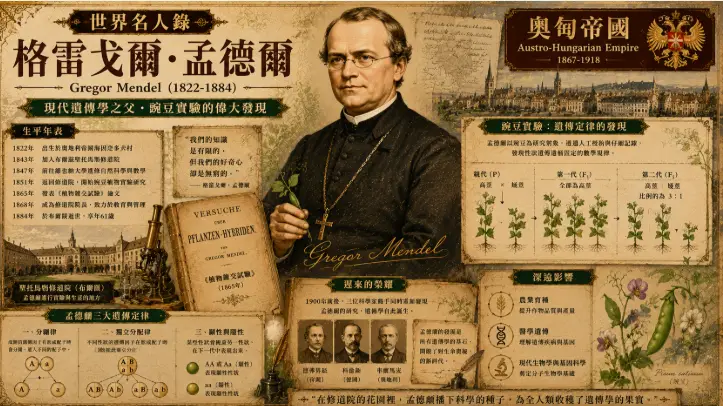
格雷戈爾·孟德爾與奧匈帝國:現代遺傳學之父的科學革命 | Gregor Mendel and the Austro-Hungarian Empire: The Father of Modern Genetics | 世界名人錄
格雷戈爾·孟德爾透過豌豆實驗揭開遺傳規律,改變人類對生命與生物繁殖的理解。這位來自奧匈帝國修道院的學者,後來被譽為現代遺傳學之父。
Gregor Mendel revolutionized biology through his experiments on heredity and inheritance. Working quietly in a monastery within the Austro-Hungarian Empire, he uncovered genetic principles that later became the foundation of modern genetics.
中文版本
格雷戈爾·孟德爾出生於1822年的海因岑多夫村,當時屬於奧地利帝國領土,後來成為奧匈帝國的一部分,今日則位於捷克境內。孟德爾出身農民家庭,自幼便接觸農作與植物栽培,這段成長經歷後來深深影響他對自然與生物變化的興趣。雖然家境並不富裕,但他在學校展現優秀學習能力,特別擅長數學與自然科學。年輕時的孟德爾希望透過教育改變人生,於是進入奧爾穆茨哲學學院求學。然而,經濟壓力與健康問題讓他的學習過程相當艱辛。1843年,孟德爾加入布爾諾的聖托馬斯修道院,成為奧古斯丁會修士,並取名「格雷戈爾」。這座修道院不只是宗教場所,同時也是當時重要的知識與研究中心。院內收藏大量書籍,修士們對哲學、農業、科學與教育均有濃厚興趣。孟德爾在此獲得穩定生活與學術資源,也開始真正投入自然科學研究。後來修道院安排他前往維也納大學進修,在那裡他接觸到更嚴謹的科學方法與數學統計概念。當時的歐洲科學界正快速發展,物理、化學與生物學逐漸進入以實驗與數據為核心的新時代,而孟德爾也深受這股科學精神影響。返回修道院後,孟德爾開始進行改變世界的研究。他選擇以豌豆植物作為實驗對象,因為豌豆容易種植、生長快速,而且具有明顯且穩定的特徵,例如花朵顏色、種子形狀與莖高等。他花費多年時間進行人工授粉與繁殖實驗,仔細記錄每一代植物特徵的變化。與當時許多生物學家不同,孟德爾不只是觀察現象,更利用數學比例分析遺傳結果。透過大量數據整理,他發現某些特徵會以固定比例出現在下一代。1865年,孟德爾在布爾諾自然科學學會發表研究成果,後來整理成《植物雜交試驗》論文。他提出著名的遺傳定律,包括顯性與隱性特徵概念,以及後來被稱為「分離律」與「獨立分配律」的重要原理。孟德爾認為,生物遺傳並非完全混合,而是由某種獨立因子控制,這些因子會在繁殖過程中傳遞給下一代。這種觀念徹底挑戰當時流行的「混合遺傳」理論。然而,孟德爾的研究在當時幾乎沒有受到重視。十九世紀中期的生物學界尚未建立遺傳學概念,大部分學者無法理解他以數學方式分析生物遺傳的做法。再加上他的研究發表於地方性學術刊物,影響力十分有限,因此長期被忽視。孟德爾本人也逐漸停止主要實驗研究,轉而負責修道院行政工作。1868年,他成為修道院院長,需要處理教育、財政與宗教事務,科學研究時間大幅減少。晚年的孟德爾依然關心自然科學,但他的研究始終未能在生前獲得真正肯定。1884年,孟德爾於布爾諾去世,享年61歲。直到1900年前後,三位歐洲植物學家幾乎同時重新發現他的論文,才讓世界重新認識這位修士科學家。隨著二十世紀遺傳學快速發展,孟德爾的理論被證明是理解生命遺傳的關鍵基礎。後來科學家發現染色體、DNA與基因結構時,孟德爾的研究更被視為整個現代生物學的重要起點。今日,人類從農業育種、醫學遺傳到基因工程與生物科技,都建立在孟德爾提出的遺傳原理之上。歷史學家普遍認為,孟德爾不只是植物學家,更是將數學與實驗方法帶入生命科學的重要先驅。他在修道院花園中的安靜研究,最終改變了人類對生命本質的理解,也讓來自奧匈帝國的小修士成為世界科學史最偉大的名字之一。
English Version
Gregor Mendel was born in 1822 in the small village of Heinzendorf, then part of the Austrian Empire and later associated with the Austro-Hungarian Empire. Today, the region lies within the Czech Republic. Raised in a farming family, Mendel grew up surrounded by crops, orchards, and agricultural work, experiences that later influenced his fascination with plant life and biological variation. Although his family possessed limited financial resources, Mendel showed remarkable intelligence from an early age and excelled in mathematics, philosophy, and the natural sciences. Education offered him a path beyond rural hardship, and he eventually entered the Philosophical Institute at Olomouc. His studies, however, were repeatedly interrupted by illness and financial difficulties, forcing him to struggle for academic survival. In 1843, Mendel joined the Augustinian Abbey of St. Thomas in Brno, adopting the name Gregor upon entering monastic life. The monastery was far more than a religious institution; it served as a center of scholarship, science, and intellectual exchange. Its library, scientific interests, and educational culture provided Mendel with the stable environment he needed to pursue learning. The abbey encouraged research in agriculture, meteorology, philosophy, and natural science, allowing Mendel to explore scientific questions in depth. Recognizing his talents, the monastery later sent him to the University of Vienna for advanced study. There, Mendel encountered modern scientific methods and became deeply influenced by mathematics, experimental design, and statistical analysis. These influences would later shape the precision of his groundbreaking experiments. After returning to Brno, Mendel began the work that would eventually transform biology forever. He selected pea plants as the focus of his experiments because they were easy to cultivate, reproduced quickly, and displayed clearly distinguishable traits such as flower color, seed texture, and plant height. Over many years, Mendel carefully crossbred thousands of pea plants and meticulously recorded the characteristics of successive generations. Unlike many naturalists of his era, he approached biology with mathematical rigor. By analyzing numerical patterns within inherited traits, Mendel discovered that heredity followed predictable laws rather than random blending. In 1865, he presented his findings to the Natural Science Society of Brno, later publishing them in a paper titled “Experiments on Plant Hybridization.” Within this work, Mendel introduced concepts that became known as dominant and recessive traits, along with the principles later called the Law of Segregation and the Law of Independent Assortment. He proposed that inherited characteristics were controlled by discrete units passed from parents to offspring. These ideas directly challenged the prevailing belief that traits blended completely between generations. Despite the brilliance of his discoveries, Mendel’s work attracted little attention during his lifetime. Mid-nineteenth-century biology lacked a clear understanding of heredity, and many scientists failed to appreciate the significance of applying mathematics to biological inheritance. Furthermore, his paper appeared in a relatively obscure regional journal, limiting its visibility within the wider scientific community. As years passed, Mendel gradually shifted away from active research and assumed greater administrative responsibilities within the monastery. In 1868, he became abbot of St. Thomas Abbey, overseeing financial, educational, and religious affairs that consumed much of his time. Although he continued observing natural phenomena, he never witnessed the scientific recognition his discoveries deserved. Gregor Mendel died in 1884 at the age of sixty-one. For more than a decade after his death, his research remained largely forgotten. Around 1900, however, several European scientists independently rediscovered Mendel’s work while conducting their own studies on heredity. Suddenly, the importance of his experiments became unmistakable. As genetics emerged as a scientific discipline during the twentieth century, Mendel’s principles formed its essential foundation. Later discoveries involving chromosomes, DNA, and genes only reinforced the extraordinary accuracy of his conclusions. Today, Mendel is universally recognized as the father of modern genetics. His ideas underpin fields ranging from agriculture and medicine to biotechnology and genetic engineering. Historians often describe him not merely as a monk or botanist, but as one of the first scientists to successfully combine mathematics, experimentation, and biology into a unified scientific method. Working quietly within a monastery garden in the Austro-Hungarian world, Gregor Mendel uncovered the hidden mechanisms of heredity and forever changed humanity’s understanding of life itself.