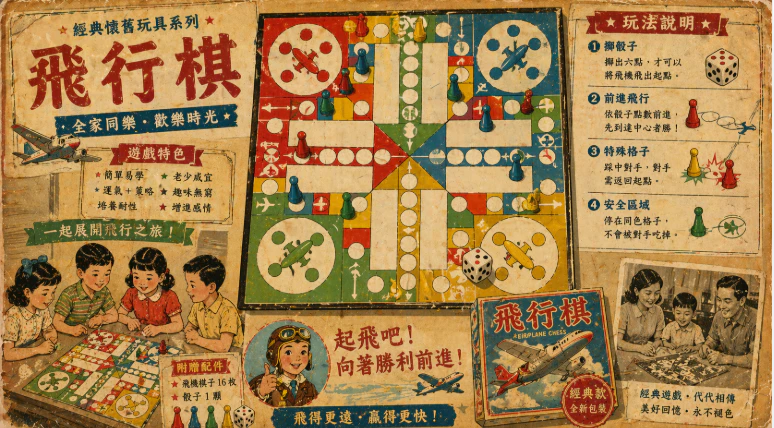
飛行棋是一種結合運氣與策略的經典桌上遊戲,玩家透過擲骰推進棋子,在棋盤上展開競賽與互動,簡單規則中蘊藏著緊張與歡樂
Aeroplane Chess is a classic board game that blends luck and strategy, where players roll dice to advance pieces across the board, creating moments of tension, excitement, and shared fun through simple gameplay
中文
飛行棋是一種深受華人社會喜愛的傳統桌上遊戲,無論在家庭聚會還是童年娛樂中,都佔有重要地位,它的玩法建立在簡單而直觀的規則之上,通常由二至四名玩家參與,每人擁有一組顏色相同的棋子,透過擲骰子決定前進步數,目標是將所有棋子從起點移動至終點,完成整個棋盤的旅程,遊戲過程中充滿變數與互動,例如擲出特定點數才能起飛、停在特定格子可以快速前進,或是踩到對手棋子令其返回起點,這些設計使遊戲不僅依賴運氣,也帶有一定的策略性,玩家需要在前進與風險之間作出選擇,決定是否加速或分散棋子,以避免被對手擊退,飛行棋的棋盤設計通常色彩鮮明,以十字形或圓形路徑構成,四個角落分別代表不同玩家的基地,中間區域則象徵終點,整體視覺充滿童趣與辨識度,使人一眼便能投入其中,在過去的年代,飛行棋常見於家庭之中,一張簡單的棋盤與幾枚棋子,就能讓一家人圍坐一起,度過長時間的互動時光,孩子在遊戲中學習輪流、遵守規則以及面對輸贏的態度,而大人則在輕鬆的氛圍中享受陪伴與交流,這種跨年齡的互動,使飛行棋不只是遊戲,更是一種連結家庭的媒介,隨著電子遊戲的興起,桌上遊戲一度被冷落,但近年來,隨著人們重新重視面對面的交流,飛行棋等傳統遊戲再次受到關注,它所提供的不只是娛樂,而是一種真實的互動體驗,讓人們在擲骰與移動之間建立情感與記憶,回顧飛行棋,我們看到的不只是棋盤上的競賽,而是一段關於等待、期待與分享的過程,每一次擲骰都充滿未知,每一次前進都帶來希望,而這種簡單卻真實的樂趣,正是它歷久不衰的原因.
English Version
Aeroplane Chess is a beloved traditional board game widely played in Chinese communities, often associated with family gatherings and childhood entertainment, its appeal lies in a set of simple yet engaging rules, typically involving two to four players, each controlling a set of colored pieces, the objective is to move all pieces from the starting base to the central destination by rolling a die and advancing accordingly, despite its straightforward structure, the game is filled with dynamic elements that create excitement and unpredictability, certain rolls are required to launch pieces onto the board, special spaces allow rapid movement, and landing on an opponent’s piece can send it back to the start, introducing both risk and opportunity, while luck plays a major role, players must also make strategic decisions, choosing whether to advance aggressively or spread their pieces to minimize vulnerability, the board itself is visually distinctive, often featuring bright colors and a cross-shaped layout, with each corner representing a player’s base and the center serving as the final goal, this design is not only functional but also inviting, making it easy for players of all ages to engage, in earlier times, Aeroplane Chess was a common household game, requiring only a board, a few pieces, and a die to bring people together, families would gather around, sharing laughter, competition, and moments of anticipation, children learned patience, turn-taking, and sportsmanship, while adults enjoyed the simple pleasure of spending time together, this cross-generational appeal is one of the game’s defining qualities, as digital entertainment became more dominant, traditional board games experienced a decline, yet in recent years there has been a renewed appreciation for physical games that encourage face-to-face interaction, Aeroplane Chess has found its place once again, valued not only as a game but as a shared experience that fosters connection, looking back, the game represents more than movement across a board, it captures a rhythm of waiting, hoping, and reacting, where each roll of the die carries possibility, and each step forward brings a sense of progress, this enduring simplicity is what keeps the game relevant across generations.