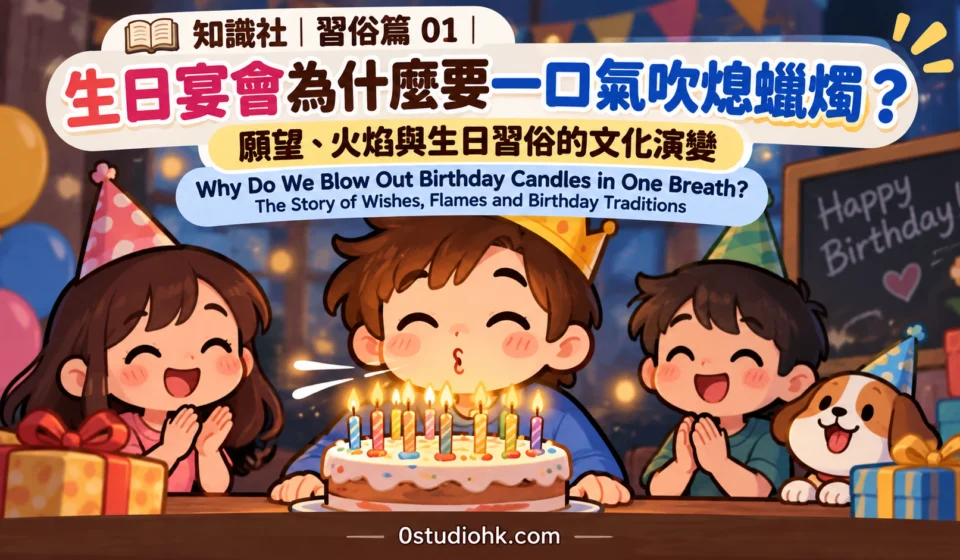
知識社|習俗篇 01|生日宴會為什麼要一口氣吹熄蠟燭?|願望、火焰與生日習俗的文化演變 | Why Do We Blow Out Birthday Candles in One Breath?|The Story of Wishes, Flames and Birthday Traditions

生日蛋糕上的蠟燭,看似只是慶祝生日的小儀式,卻蘊藏着悠久的文化想像。從火焰、願望到祝福,一口氣吹熄蠟燭,早已成為世界各地熟悉的生日習俗。
Blowing out the candles on a birthday cake feels like a simple moment of celebration, yet it carries a surprisingly long cultural story. Fire, wishes and good fortune gradually became connected, turning a small act into one of the most recognisable birthday traditions around the world.
中文版本
每逢生日,很多人都會面對一個熟悉得不能再熟悉的畫面:蛋糕放在桌上,上面插着幾根點燃的蠟燭,壽星閉上眼睛許一個願,然後深深吸一口氣,嘗試把所有蠟燭一次過吹熄。當火焰全部消失,旁邊的人便會拍手、歡呼,接着切蛋糕、唱生日歌。這個動作看起來十分簡單,但為什麼偏偏要「一口氣」吹熄?其實,生日吹蠟燭並沒有一個可以完全確定、單一來源的答案,它更像是不同時代的火焰象徵、祈願文化和生日慶祝方式逐步融合而成的習俗。火在古代文化中一直具有特殊意義,人們經常把火焰視為光明、生命、保護與神聖力量的象徵。當人們在重要日子點燃蠟燭時,蠟燭便不只是照明工具,也可以代表祝福與願望。生日這個特別日子,自然很容易與這些象徵聯繫起來。關於生日蠟燭的歷史,經常有人提到古希臘人向月亮女神阿耳忒彌斯獻上以蠟燭裝飾的圓形蛋糕,並把煙霧向天空升起與祈願聯繫起來。不過,現代生日蛋糕吹蠟燭直接源自這個傳統,並沒有足夠證據可以簡單地下定論。較接近現代生日慶祝形式的生日蛋糕和蠟燭習俗,在歐洲近代逐漸發展起來。到了十八、十九世紀,德語地區的生日慶祝文化經常被認為對現代生日蠟燭傳統產生重要影響。蠟燭數量可以對應年齡,而生日蛋糕上的火焰則成為生日慶祝的重要視覺象徵。至於「許願後吹熄蠟燭」這個規矩,真正有趣的地方就在於它把願望和行動連在一起。壽星在吹蠟燭之前通常不能把願望說出來,因為願望一旦說出口,就失去了神秘感;閉上眼睛許願,再用一口氣吹熄火焰,則像是把自己的願望送向未知的未來。有人相信,如果能夠一次過吹熄所有蠟燭,願望便比較容易實現。這種說法屬於民間信念,而不是科學規律,但正正因為帶有一點神秘色彩,才令生日儀式更加有趣。從另一個角度看,一口氣吹熄蠟燭也具有非常實際的效果。當一個人站在生日蛋糕前,大家都等待火焰同時熄滅,便形成了一個清楚的「慶祝高潮」:點蠟燭代表開始,許願代表期待,而吹熄蠟燭則代表願望正式送出。完成這個動作後,大家便可以一起唱歌、拍照和分享蛋糕。隨着生日文化透過家庭、學校、電影、電視和商業社會傳播,這套儀式逐漸跨越不同國家與文化。即使每個地方對生日的理解不同,吹蠟燭卻成為一種容易理解的共同語言。今天,我們甚至不一定知道這項習俗的歷史背景,也不一定真的相信「吹熄蠟燭願望就會成真」,但當生日蛋糕出現、燈光稍微調暗、蠟燭被點燃,大家仍然會自然地等待那一刻。孩子會認真閉上眼睛,大人也可能故意提醒壽星「要一口氣呀!」,然後大家一起期待最後一根蠟燭熄滅。這就是習俗有趣的地方:它不一定需要每個人相信同一個故事,卻可以透過重複的動作,把一個普通日子變成值得記住的時刻。從古代人對火焰的想像,到近代生日蛋糕文化,再到今天全球化的生日儀式,蠟燭已經由實用的照明工具,變成承載祝福與願望的象徵。一口氣吹熄蠟燭,其實不只是「吹走火焰」,而是在人生每一個生日的交界,給自己一個短短的時間,閉上眼睛,想一想自己希望得到什麼、希望未來變成怎樣。也許願望是否成真並不由蠟燭決定,但那一刻的期待、祝福和笑聲,卻確實會成為生日記憶的一部分。這也正是這項小小習俗能夠流傳至今的原因。
English Version
A birthday cake with glowing candles is one of those images that seems almost universal. The birthday person closes their eyes, makes a wish, takes a deep breath and tries to blow out all the candles in one go. Once the flames disappear, everyone celebrates, the birthday song ends and the cake is ready to be shared. But why do we do this, and why is making the candles go out with a single breath considered special? There is no single historical explanation that can completely account for the modern tradition. Instead, birthday candles appear to be the result of several cultural ideas coming together over time, particularly the symbolism of fire, the custom of making wishes and the development of modern birthday celebrations. Fire has carried powerful meanings in human societies for thousands of years. It can represent light, life, protection, hope and something that connects the human world with the spiritual or unknown. Candles developed from practical sources of light into objects that could also carry symbolic meaning. When candles became part of special celebrations, their flames naturally became associated with hope, blessing and important moments. The history of birthday candles is sometimes connected with ancient Greek traditions involving cakes and candles offered to Artemis, the goddess associated with the moon. Some accounts suggest that candlelight and rising smoke were connected with prayers or wishes. However, it would be too simple to say that the modern birthday cake tradition directly comes from this ancient practice. The evidence does not establish such a straightforward line of development. A more immediate influence on modern birthday celebrations is often associated with German-speaking Europe, particularly eighteenth- and nineteenth-century customs in which birthdays were celebrated with cakes and candles. The number of candles could represent a person’s age, helping create the basic visual language that we still recognise today. The most charming part of the tradition is the connection between candles and wishes. Before blowing them out, the birthday person is normally encouraged to make a silent wish. The wish is kept secret, because saying it aloud is traditionally thought to reduce its chance of coming true. Closing the eyes and blowing out the flames then becomes a symbolic action: the wish has been made, and the candlelight disappears as if the hope has been released into the future. The idea that a wish will come true if all the candles are extinguished in one breath is a folk belief rather than a scientific rule. Yet that little element of mystery makes the ritual much more enjoyable. There is also a practical reason why the tradition works so well as a celebration. Blowing out the candles creates a clear moment of climax. Lighting the candles begins the ceremony, making a wish creates anticipation, and extinguishing the flames marks the moment when everyone can cheer and move on to cutting the cake. It is short, visual and easy for everyone to understand. As birthday customs spread through families, schools, popular entertainment and commercial culture, the candle ritual travelled far beyond the communities in which earlier versions of the tradition had developed. Different societies may celebrate birthdays in very different ways, but the act of blowing out candles has become a remarkably familiar shared ritual. Today, many people do not know the history behind the tradition, and plenty of people do not seriously believe that a wish will come true simply because every candle has gone out. Nevertheless, when a birthday cake appears and the candles are lit, people instinctively wait for the same moment. Children close their eyes with great seriousness, while friends may remind the birthday person to make sure they blow hard enough to get every flame at once. Everyone watches the final candle disappear, followed by applause, laughter and photographs. This is one of the reasons traditions survive: people do not necessarily need to believe exactly the same story behind them. Repeated actions can still create a shared emotional experience. Birthday candles have therefore changed from simple sources of light into symbols of hope, celebration and personal wishes. The single breath is not really about controlling the future, nor is it a guarantee that a secret wish will come true. Instead, it creates a tiny pause in the middle of a busy life. For a few seconds, the birthday person stops, closes their eyes and thinks about what they hope for in the year ahead. The candles then go dark, and the celebration begins. Perhaps the real magic of the tradition is not whether the wish is granted, but the fact that everyone present pauses together to celebrate another year of someone’s life. A simple breath, a few small flames and a silent wish have become a ritual shared by generations, showing how an ordinary object such as a candle can become a lasting symbol of memory, hope and celebration.
總結
生日蠟燭並非單純裝飾。火焰象徵祝福與希望,而許願後一口氣吹熄,則把生日變成一個充滿期待與記憶的特別時刻。
Birthday candles are more than decoration. Their flames represent hope and celebration, while the silent wish followed by one breath creates a memorable ritual that connects generations through a simple moment of joy.