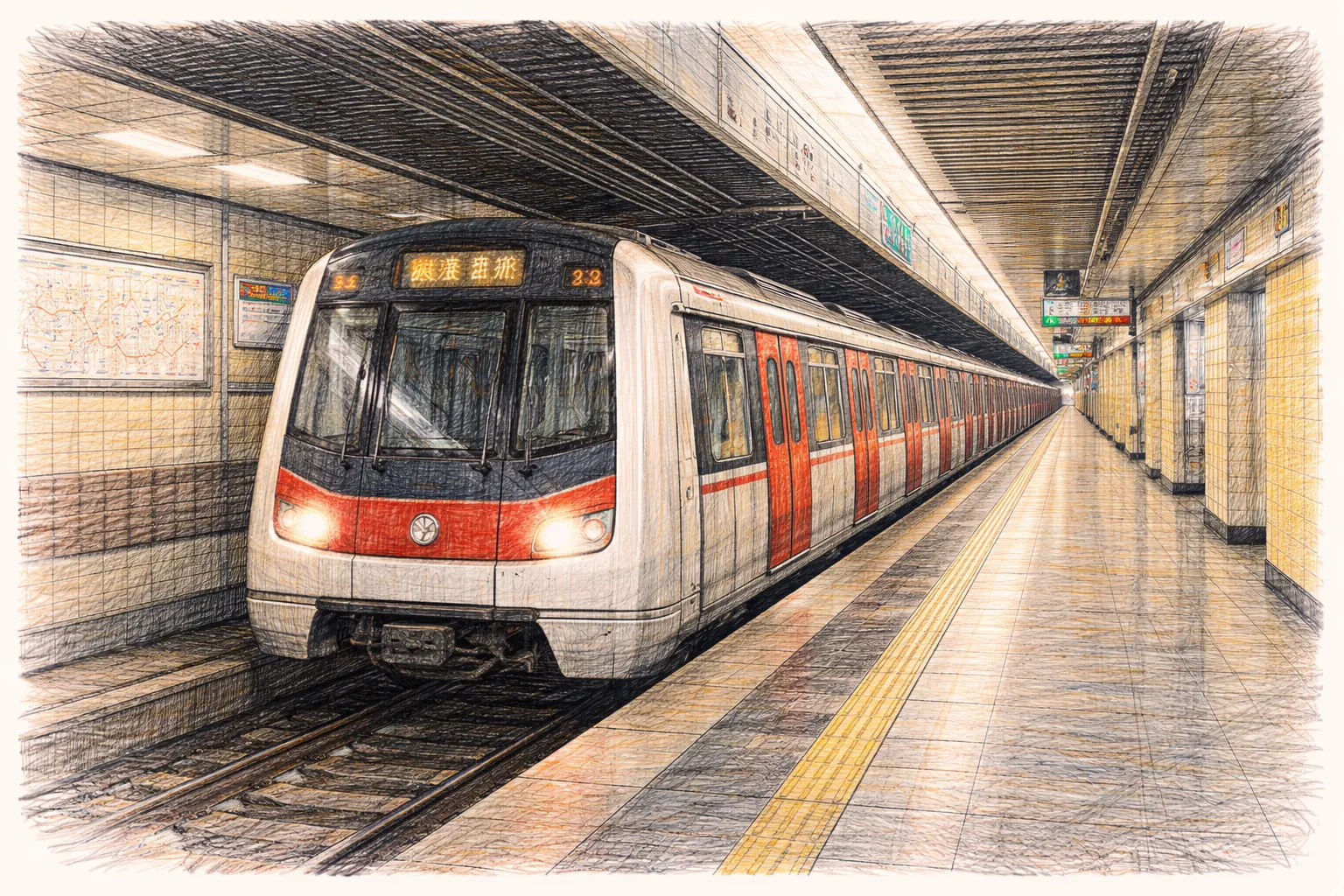
香港地鐵|一座城市如何把生活收納進效率之中|Hong Kong MTR|How a City Compresses Time and Movement【包羅萬有】第 13 章

地鐵作為現代城市交通的重要組成部分,其高效運行和科學設計對於城市的發展與居民的生活方式產生了深遠影響。地鐵系統以高效、準確和穩定為核心價值,其運行時間表精確至分鐘,車站佈局經過嚴密規劃,乘客流量管理更是依賴先進技術與數據分析。這些特點使地鐵成為城市居民日常通勤的首選工具,並成為現代都市交通管理的典範。
地鐵的存在不僅改變了人們的出行習慣,也重新塑造了城市空間的概念。傳統上,地面上的道路與建築物構成了人們熟悉的地理標誌,而地鐵系統則引入了一套全新的座標系統。乘客只需記住地鐵站名稱及出口編號即可到達目的地,這種空間重構大幅簡化了城市中的導航過程,提高了移動效率。然而,這種便利性也伴隨著一定的代價,例如對地理記憶的削弱以及對偶然性的抹去。
此外,地鐵空間的設計充分考量了都市人群的心理需求。車廂內部以功能性與簡潔為主,旨在提高空間利用效率,同時兼顧乘客的舒適度。高峰時段,車廂內的人群密集,但乘客通常透過低頭使用手機或閱讀來維持心理上的私人空間。這種行為模式展現了都市生活中的默契,也反映了地鐵空間對人際互動的潛在影響。
然而,地鐵系統在提供便利的同時,也可能削弱了城市生活中的某些特質。例如,在高度規劃和預測的運行模式下,偶然性和探索性被壓縮。地鐵車廂內缺乏鮮明的視覺特徵或文化元素,使得人們對乘車經歷的記憶較為模糊,從而削弱了交通工具作為文化載體的潛力。
總體而言,地鐵作為一種高度功能化的現代交通工具,不僅體現了技術與管理的結合,也反映了城市對效率與秩序的追求。在享受其便利與準時性的同時,我們也應關注其對城市生活中偶然性、記憶與自由探索可能帶來的影響。未來,如何在高效運行與人性化需求之間取得平衡,將是城市交通發展的重要課題。
English Version
In a city where efficiency defines both expectation and experience, the Mass Transit Railway, commonly known as the MTR, represents the most refined expression of speed, precision, and systemized movement within Hong Kong’s urban structure, operating as a network that compresses distance and time into a seamless flow that underpins the daily lives of millions. Unlike surface-level transportation that unfolds within the visible fabric of the city, the MTR exists largely beneath it, creating an alternative layer where movement is detached from street-level complexity and reorganized into a controlled, predictable, and highly efficient environment. Stations function as nodes within this system, carefully designed to manage large volumes of passengers through clearly defined pathways, where signage, timing, and spatial organization work together to minimize uncertainty and maximize flow. The experience of entering the MTR is marked by a transition from the variability of the city above to a structured environment where movement is guided and standardized, allowing individuals to navigate with minimal friction. Trains arrive and depart with precision, reducing waiting time and creating a rhythm that aligns closely with the expectations of a fast-paced urban population. This reliability transforms time into a resource that can be measured, predicted, and optimized, reinforcing the role of the MTR as a system that not only moves people but also shapes how they perceive and use time. The absence of external visual cues during most journeys further distinguishes the MTR from other forms of transport, as passengers are removed from the immediate context of the city, experiencing movement as a sequence of stations rather than a continuous visual landscape. This abstraction of space allows for rapid transit across long distances, but it also creates a different relationship with the city, where awareness of surroundings is replaced by familiarity with routes, lines, and connections. The efficiency of the system is not only technological but also behavioral, as passengers collectively adapt to its logic, forming patterns of movement that contribute to the smooth functioning of the network. Queuing, boarding, and transferring become coordinated actions, reflecting a shared understanding of how to operate within a high-density environment. In this sense, the MTR is both a physical infrastructure and a social system, where individual behavior aligns with collective efficiency to maintain balance within a complex network. Historically, the development of the MTR marked a significant shift in how Hong Kong expanded and organized itself, enabling faster connections between districts and influencing patterns of urban growth, residential development, and economic activity. Its presence reshaped the city not only by reducing travel time but by redefining the relationship between distance and accessibility, making previously distant areas more integrated into the urban core. In contrast to slower modes of transport that emphasize observation and experience, the MTR prioritizes function, allowing passengers to move quickly and reliably, often with little attention to the journey itself. This focus on destination over experience reflects a broader aspect of modern urban life, where speed becomes a defining value, shaping both infrastructure and behavior. Yet, even within this efficiency, there remains a subtle human dimension, as shared spaces, fleeting interactions, and the collective rhythm of movement create a sense of connection that, while less visible, is nonetheless present. The MTR thus embodies the dual nature of contemporary cities, where systems are designed for maximum efficiency while still accommodating the complexities of human experience. In a broader sense, the existence of such a system highlights the evolution of urban mobility, demonstrating how technology, planning, and collective behavior can converge to create environments that support large-scale movement with remarkable precision. Ultimately, the MTR is not only a means of transport, but a representation of how a city organizes itself around time, transforming movement into a coordinated flow where distance is minimized, predictability is maximized, and the rhythm of daily life is shaped by the invisible infrastructure that operates beneath the surface.