
Skip to content
madefrom.hk madefrom.hk madefrom.hk

多元內容出版平台,涵蓋漫畫、原創故事、文學改編、香港文化、歷史、科技及影音作品,連結本地與世界各地的故事。

madefrom.hk madefrom.hk madefrom.hk

多元內容出版平台,涵蓋漫畫、原創故事、文學改編、香港文化、歷史、科技及影音作品,連結本地與世界各地的故事。

  • English
    • Comics
      • Strange Tales
      • Myths of the Constellations
    • Games
      • Famicom Disk System
    • Column
      • Life & Technology
      • Toy Club
      • DAY
    • History
      • Old Newspaper Digests
      • History in 80 Seconds
    • Audiobooks
    • Adapted Stories
      • romance of the three kingdoms
      • hong kong places
      • dream of the red chamber
      • strange tales
      • The house on the borderland
      • usherhouse
      • Theblackcat
  • 繁體中文
    • 漫畫
      • 碧廬冤孽
      • 十三號的約定
    • 學習筆記
    • 專欄
      • 生活與科技
    • 歷史
      • 當年報章摘要
    • ACG
      • Winter 2026 Anime
      • Summer 2026 Anime
      • ACGHK
        • 2016
        • 2018
        • 2019
        • 2023
        • 2024
      • 創天綜合同人祭
        • 同人表演
      • 音樂
      • 電玩
        • 玩具資訊
        • 遊戲資訊
    • 原創小說
      • 不可思議故事
      • 十三號的約定
      • 星座宮神話
      • 香港山怪談
      • 香港都市靈異傳說
    • 旅行
      • Macau Travel
      • International Travel
      • 日本旅遊
      • Taiwan Travel
      • Thailand Travel
      • Hong Kong Travel
        • 土瓜灣
        • 舊建築
        • 街道
        • 單車
        • 文化
        • 交通
        • 香港書展
        • 表演
        • 廟宇
        • 教堂
        • 香港書展
        • 分享會
        • 紀念活動
        • 文化活動
        • 活動
        • 寵物
        • 巴士
        • 電車
        • 機場
        • 飲食
          • 上環
          • 中環
          • 筲箕灣
          • 西環
          • 天后
          • 旺角
          • 荔枝角
          • 佐敦道
          • 太子
          • 大角咀
          • 深水埗
          • 油麻地
          • 長沙灣
          • 黃大仙
          • 尖沙咀
          • 油塘
          • 葵芳
          • 屯門
          • 元朗
          • 上水
          • 粉嶺
          • 荃灣
          • 渡輪
    • 心理測驗
    • 節目重溫
      • 文化生活
      • 莎拉有約
      • 尾尾道來
  • 遊戲
    • SNK Neo Geo
    • PlayStation 2
    • Arcade
    • NEWS
  • Column
    • Knowledge Hub
      • 生活篇
      • 食品篇
      • 科技篇
      • 超市篇
    • Hong Kong Guide
    • Today in History
    • City Stories
    • Anime & Manga
    • Game Magazine
    • 遊戲誌
    • Language of Flowers
    • Street Notes
    • All Things
    • Music Memories
    • Chinese Idioms
    • Cantonese Sayings
    • Movie Magazine
  • History
    • 香港歷史
    • 世界名作家
    • World Biographies
  • Movies
    • USA
    • japan
    • Korea
    • Taiwan
    • HONGKONG
    • India
    • china
    • france
    • Tunisia
    • Germany
    • Jordan
    • Switzerland
    • sweden
    • Spain
    • Palestine
    • Norway
    • Argentina
    • Brazil
  • English
    • Comics
      • Strange Tales
      • Myths of the Constellations
    • Games
      • Famicom Disk System
    • Column
      • Life & Technology
      • Toy Club
      • DAY
    • History
      • Old Newspaper Digests
      • History in 80 Seconds
    • Audiobooks
    • Adapted Stories
      • romance of the three kingdoms
      • hong kong places
      • dream of the red chamber
      • strange tales
      • The house on the borderland
      • usherhouse
      • Theblackcat
  • 繁體中文
    • 漫畫
      • 碧廬冤孽
      • 十三號的約定
    • 學習筆記
    • 專欄
      • 生活與科技
    • 歷史
      • 當年報章摘要
    • ACG
      • Winter 2026 Anime
      • Summer 2026 Anime
      • ACGHK
        • 2016
        • 2018
        • 2019
        • 2023
        • 2024
      • 創天綜合同人祭
        • 同人表演
      • 音樂
      • 電玩
        • 玩具資訊
        • 遊戲資訊
    • 原創小說
      • 不可思議故事
      • 十三號的約定
      • 星座宮神話
      • 香港山怪談
      • 香港都市靈異傳說
    • 旅行
      • Macau Travel
      • International Travel
      • 日本旅遊
      • Taiwan Travel
      • Thailand Travel
      • Hong Kong Travel
        • 土瓜灣
        • 舊建築
        • 街道
        • 單車
        • 文化
        • 交通
        • 香港書展
        • 表演
        • 廟宇
        • 教堂
        • 香港書展
        • 分享會
        • 紀念活動
        • 文化活動
        • 活動
        • 寵物
        • 巴士
        • 電車
        • 機場
        • 飲食
          • 上環
          • 中環
          • 筲箕灣
          • 西環
          • 天后
          • 旺角
          • 荔枝角
          • 佐敦道
          • 太子
          • 大角咀
          • 深水埗
          • 油麻地
          • 長沙灣
          • 黃大仙
          • 尖沙咀
          • 油塘
          • 葵芳
          • 屯門
          • 元朗
          • 上水
          • 粉嶺
          • 荃灣
          • 渡輪
    • 心理測驗
    • 節目重溫
      • 文化生活
      • 莎拉有約
      • 尾尾道來
  • 遊戲
    • SNK Neo Geo
    • PlayStation 2
    • Arcade
    • NEWS
  • Column
    • Knowledge Hub
      • 生活篇
      • 食品篇
      • 科技篇
      • 超市篇
    • Hong Kong Guide
    • Today in History
    • City Stories
    • Anime & Manga
    • Game Magazine
    • 遊戲誌
    • Language of Flowers
    • Street Notes
    • All Things
    • Music Memories
    • Chinese Idioms
    • Cantonese Sayings
    • Movie Magazine
  • History
    • 香港歷史
    • 世界名作家
    • World Biographies
  • Movies
    • USA
    • japan
    • Korea
    • Taiwan
    • HONGKONG
    • India
    • china
    • france
    • Tunisia
    • Germany
    • Jordan
    • Switzerland
    • sweden
    • Spain
    • Palestine
    • Norway
    • Argentina
    • Brazil
Close

Search

Life and Technology Season 3 Computer Series | The Birth of AI: When Computers Began to Explore Human Intelligence| Madefrom.hk
EnglishLife & Technology

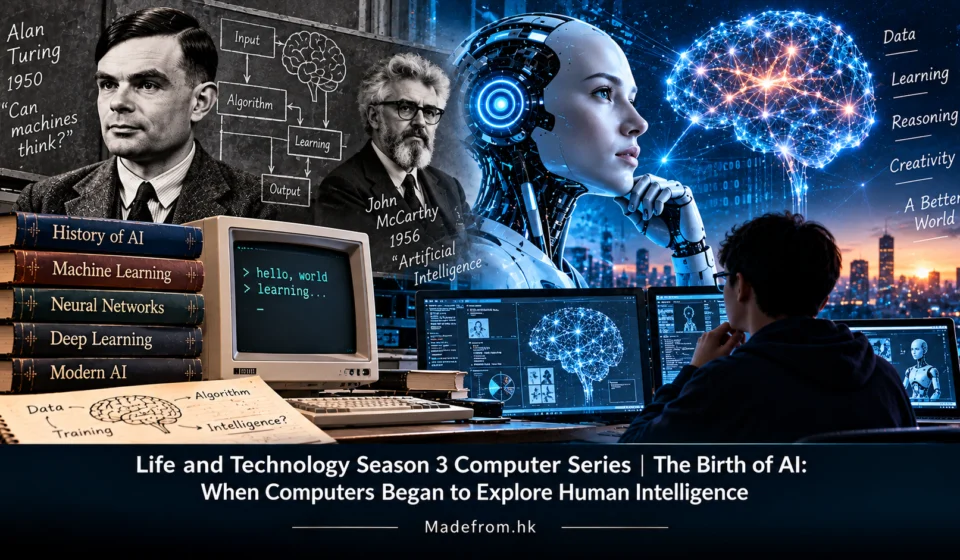
Life and Technology Season 3 Computer Series | The Birth of AI: When Computers Began to Explore Human Intelligence

2026-10-16

Early computers were built primarily to calculate numbers faster and more accurately. Yet researchers soon began asking a much more ambitious question: could a computer learn, reason, solve problems and perhaps imitate aspects of human intelligence? That question eventually gave rise to artificial intelligence and opened a completely new chapter in computing history.


The birth of artificial intelligence did not happen suddenly in the modern era. Long before today’s generative AI systems could write articles, create images or generate computer code, scientists were already asking whether machines could reproduce some aspects of human intelligence. After the Second World War, electronic computers became increasingly powerful, and researchers began to see them as more than calculating machines. They could potentially become experimental platforms for studying reasoning, learning and problem-solving. One of the important early intellectual foundations came in 1943, when Warren McCulloch and Walter Pitts published influential work describing how neural activity could be represented through mathematical logic. Their ideas later became part of the intellectual history behind artificial neural networks. By 1950, British mathematician Alan Turing had taken the discussion much further. In his paper “Computing Machinery and Intelligence”, he asked the famous question: “Can machines think?” Rather than spending the entire discussion trying to define what thinking actually meant, Turing proposed the “imitation game”, which later became widely associated with the Turing Test. The basic idea was to consider whether a human could distinguish a machine from a person through communication. This was an important change in perspective. Instead of treating machine intelligence purely as a philosophical question, Turing turned it into something that could be discussed in terms of observable behaviour and computation. If a machine could produce intelligent-looking behaviour, how should scientists understand and measure it? During the early 1950s, researchers began building experimental programmes that attempted to reproduce specific forms of human problem-solving. Marvin Minsky and Dean Edmunds developed SNARC in 1951, an early neural-network machine designed to explore learning-like behaviour. In 1952, researchers including Allen Newell and Herbert A. Simon developed programmes such as Logic Theorist, which attempted to reproduce aspects of human reasoning through computation. These systems were extremely limited compared with modern AI, but they introduced an important new possibility: computers did not necessarily have to be limited to numerical calculation. They could also be designed to work with logic, rules, patterns and problems that appeared to require reasoning. The decisive milestone came in 1955, when John McCarthy, Marvin Minsky, Nathaniel Rochester and Claude Shannon proposed a research project called “A Proposal for the Dartmouth Summer Research Project on Artificial Intelligence”. It was in this proposal that the term “artificial intelligence” was introduced. The following summer, in 1956, a group of researchers gathered at Dartmouth College for the Dartmouth Summer Research Project on Artificial Intelligence. The workshop is widely regarded as the birth of artificial intelligence as a formal field of research. The researchers proposed that learning and other aspects of intelligence might be described precisely enough for a machine to simulate them. The ambition was remarkable considering the technology available at the time. Computers were enormous, expensive and extremely limited by modern standards. Memory was tiny, processing power was scarce, and programming was difficult. Yet researchers were already imagining machines that could reason, solve problems, understand language and perhaps learn. Following the Dartmouth workshop, artificial intelligence research expanded across universities and laboratories. Researchers explored symbolic reasoning, games such as chess, natural language, problem-solving and neural networks. Much of early AI relied on rules written by humans. Researchers attempted to represent knowledge and logic in a form that a computer could process. For certain well-defined problems, this approach could be surprisingly effective. But it also exposed a major limitation. The real world contains enormous amounts of knowledge and uncertainty, while human language is full of ambiguity and context. It is extremely difficult for people to write down every rule that another machine would need in order to behave intelligently. This helped encourage another approach: instead of telling a computer every rule explicitly, perhaps the computer could learn patterns from data and experience. In 1957, psychologist and computer scientist Frank Rosenblatt developed the Perceptron, an early artificial neural network capable of learning weights for pattern recognition. Although the Perceptron was limited and could not solve every kind of problem, it became an important milestone in the longer history of neural networks and machine learning. The development of AI was not a straight path towards today’s technology. Early researchers were often extremely optimistic about how quickly machines might achieve human-like abilities, but practical limitations in computing power, data and algorithms repeatedly slowed progress. AI research went through periods of reduced funding and enthusiasm before later technological advances changed the situation. Faster processors, enormous digital datasets, specialised hardware such as GPUs, improved algorithms and advances in machine learning and deep learning eventually transformed what computers could do. The AI systems of today may appear radically different from the machines imagined in the 1950s, but the underlying question remains surprisingly similar. Can aspects of human intelligence be represented, learned or simulated by machines? Modern generative AI can produce text, images, audio, video and computer code, capabilities that would have seemed extraordinary to the researchers at Dartmouth. In 2026, Dartmouth is marking the seventieth anniversary of the 1956 workshop, looking back at how the field developed from its original question about whether machines could simulate intelligence into today’s systems capable of generating content and making complex predictions. The birth of AI, therefore, was not the moment when one particular computer suddenly became intelligent. It was the result of a gradual change in how scientists imagined computers. First, computers were built primarily as calculating machines. Then they became programmable systems capable of handling increasingly complex tasks. Eventually, researchers began treating them as experimental platforms for exploring learning, reasoning, language and intelligence itself. From Turing’s question in 1950, through the Dartmouth workshop of 1956, to today’s generative AI, the history of artificial intelligence can be understood as one long attempt to answer a remarkably simple but profound question: if humans can use computers to simulate aspects of intelligence, how far can machines ultimately go?


The birth of AI marked a major change in the history of computing. From Turing’s question about whether machines could think to the Dartmouth workshop of 1956, computers became more than calculating machines. They became experimental platforms for exploring learning, reasoning and intelligence, eventually leading to today’s generative AI.


Views: 32
延伸閱讀
AI 自媒體學習筆記|第一季・第03篇 | 做內容之前,為什麼要先研究市場?
很多人開始做自媒體,第一件事可能就是: 「我想拍片!」 然後開始想: 拍什麼? 用什麼工具? 要不要買相機? 要不要做 Shorts? …
AI 自媒體學習筆記|第一季・第02篇 | 什麼是內容主題?從受眾與內容開始定位
做自媒體,找到一個主題並不只是問自己:「我想拍什麼?」 真正需要思考的,是一個主題能不能長期發展、自己有沒有興趣持續研究、自己有沒有能力…
AI 自媒體學習筆記|第一季・第01篇 做自媒體,第一步不是拍片,而是找對主題
很多人開始做自媒體,第一個想法都是:「我要拍什麼影片?」 但真正開始研究自媒體之後,會發現一個更重要的問題: 不是先想拍什麼,而是先想清…
October 5 in History|The Day Pop Culture Began Changing the World
On October 5, 1962, The Beatles released “Love Me Do” while the firs…

Tags:

AIComputers
Author

admin

Follow Me
Other Articles
《莎拉有約》第十六集|陪伴孩子成長:面對反叛期、情緒與親子溝通 | 主持 : 莎拉 嘉賓 : Points Of You® 認證教練及培訓師 GiGi
Previous

《莎拉有約》第十六集|陪伴孩子成長:面對反叛期、情緒與親子溝通 | 主持 : 莎拉 嘉賓 : Points Of You® 認證教練及培訓師 GiGi

Next

《十三號的約定》第四章|訊息裡的溫度 | 漫畫版本

  • Patreon
  • Facebook
  • Instagram
  • YouTube
  • Bluesky
  • Tumblr
  • LinkedIn

Register|Lost your password?

  • Terms of Service
  • Privacy Policy
  • Contact
  • About Us
  • Register
  • Login
  • Password Reset
  • Advertising
  • Column Sponsorship
  • plus member

Content & Corrections

This website covers films, animation, games, cultural columns, and other related content and information. Our information is primarily based on publicly available sources, official announcements, and editorial research. Content may be revised or updated when new information becomes available.
If you notice any errors, believe that information needs to be corrected, or have updated official information that may be added, please contact us by email:
📧 [email protected]
We will review the information and make updates as soon as possible after verification.
Thank you for your help and understanding.

  • 《莎拉有約》第十七集|認識 DISC 性格與女性心理:從性格分析到「思覺敏感」主持 莎拉 嘉賓 Points Of You® 認證教練及培訓師 GiGi
  • 《十三號的約定》第四章|訊息裡的溫度 | 漫畫版本
  • Life and Technology Season 3 Computer Series | The Birth of AI: When Computers Began to Explore Human Intelligence
  • 《莎拉有約》第十六集|陪伴孩子成長:面對反叛期、情緒與親子溝通 | 主持 : 莎拉 嘉賓 : Points Of You® 認證教練及培訓師 GiGi
  • 《十三號的約定》第三章|認識 | 漫畫版本

ACG HK anime Chinese Mythology Dream of the Red Chamber Hong Kong History On This Day Romance of the Three Kingdoms Silent film world history 三國演義 世界歷史 中國古典小說 中國神話 今日歷史 劉備 動畫 動畫電影 古典文學 台灣旅遊 專欄 小說連載 山海經 廣東話歇後語 影評 恐怖電影 推薦 日本動畫 日本電影 曹操 林黛玉 歷史上的今天 澳門 紅樓夢 經典電影 美國電影 聊齋志異 賈寶玉 電影 電影劇情介紹 飲食 香港文化 香港旅遊 香港歷史 香港都市傳說 香港電影

Copyright 2021 - 2026 — 0studiohk.com | madefrom.hk. All rights reserved.